127 posters, 10 topics, 20 sessions, 127 authors
ePostersLive by SciGen Technologies S.A. All rights reserved.
UCSF 2024 Inquiry Symposium
Conference ePosters

P098
Changes in Bone Marrow Adipose Tissue (BMAT) Are Associated With Weight Loss in People Receiving Diabetes Care.
Poster Presenter
Authors
Part of Topic
Clinical & Translational Sciences
Introduction
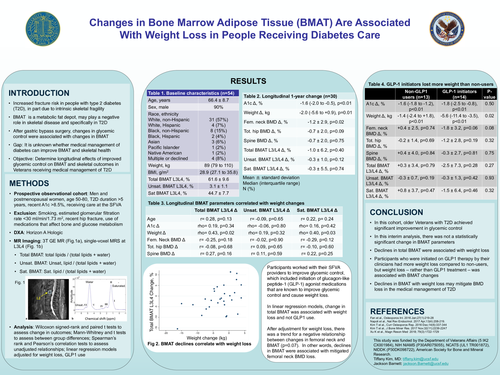
People with type 2 diabetes (T2D) have increased fracture risk due to intrinsic skeletal fragility. Bone Marrow Adipose Tissue (BMAT) is a metabolic fat depot that may have a negative impact in skeletal disease and specifically in T2D. However, the effect of glycemic control on BMAT and skeletal outcomes in people with T2D remains unclear. In this study we aimed to investigate the longitudinal changes in BMAT and bone mineral density (BMD) in older Veterans with T2D who received diabetes care at the San Francisco VA.
Methods
We conducted a prospective observational cohort study of men and postmenopausal women, aged 50-80, with T2D duration >5 years and recent hemoglobin A1c (A1c)
>8.5%. We excluded participants with smoking, renal impairment, recent hip fracture, or use of medications that affect bone and glucose metabolism. Participants worked with their VA providers to improve glycemic control, which included initiation of glucagon-like peptide-1 (GLP-1) agonist medications in some cases. We measured BMAT and BMD by dual-energy X-ray absorptiometry (DXA) and magnetic resonance imaging (MRI) at baseline and 1 year. We used descriptive statistics, correlation analysis, and linear regression models to examine the associations between BMAT, BMD, and clinical variables.
Results
We enrolled 54 participants (90% male, mean age 66.4 years, mean weight 89 kg, mean A1c 9.6%) and completed 1-year follow-up in 30 participants (87% male, mean age 66.4 years, mean weight 86 kg, mean A1c 7.9%). At baseline, mean BMAT at
lumbar spine (L3/L4) was 44.7%, and mean BMD at femoral neck and total hip was 0.8 and 0.9 g/cm2, respectively. At 1 year, participants achieved significant improvement in glycemic control (mean A1c change -1.6%, p<0.01) and modest weight loss (mean weight change -2.0 kg, p=0.01). However, there was not a statistically significant change in BMAT at L3/L4 (mean BMAT change -0.3%, p=0.12) or BMD at femoral neck and total hip (mean BMD change -1.2% and -0.7%, p=0.02 and 0.09, respectively). In correlation analysis, weight change was positively associated with BMAT change at L3/L4 (rho=0.43, p=0.02) and negatively associated with BMD change at femoral neck (rho=-0.25, p=0.18). In linear regression models, BMAT change at L3/L4 was associated with weight change (beta=0.43, p=0.02) and not with GLP-1 use
(beta=-0.19, p=0.32).
Conclusion
In this cohort of older Veterans with T2D, we observed significant improvement in glycemic control and modest weight loss over 1 year, but no significant change in BMAT or BMD. Declines in BMAT with weight loss may mitigate BMD loss in the medical management of T2D. GLP-1 use did not have an independent effect on BMAT or BMD in this interim analysis. Further studies are needed to elucidate the mechanisms and implications of BMAT and skeletal changes in people with T2D.
References
- Fan et al., Osteoporos Int. 2016 Jan;27(1):219-28
- Napoli et al., Nat Rev Endocrinol. 2017 Apr;13(4):208-219.
- Kim T et al., Curr Osteoporos Rep. 2016 Dec;14(6):337-344
- Kim T et al., J Bone Miner Res. 2017 Nov;32(11):2239-2247
- Xu K et al., Magn Reson Med 2018; 79(3):1722-1729