127 posters, 10 topics, 20 sessions, 127 authors
ePostersLive by SciGen Technologies S.A. All rights reserved.
UCSF 2024 Inquiry Symposium
Conference ePosters

P005
Feasibility of a Mobile Application to Track Longitudinal Pain Outcomes after Spinal Joint Injections
Poster Presenter
Authors
Part of Topic
Clinical & Translational Sciences
Introduction:
Tracking outcomes in spine interventions is costly and time-consuming, hindering research progress. One recent randomized controlled trial examining lumbar epidural steroid injections required a budget exceeding two million dollars. Significant portions of research budgets are allocated to hiring personnel for patient recruitment and data collection. As 77% of Americans own smartphones, mobile health (mHealth) applications offer solutions to streamline the research process. These applications allow for remote enrollment and direct engagement with patients, reducing the need to hire research personnel to recruit patients and gather their follow-up outcomes. However, evidence to support the use of mHealth to study pain management interventions is limited and heterogeneous.
Aims:
Our study assessed the feasibility of a custom mHealth application designed to track longitudinal pain outcomes after various spine injections. Specifically, we tested the recruitment and retention capabilities of this custom mobile application paired with several recruitment strategies.
Project Design/Methods:
This prospective observational study approached and enrolled a convenience sample of eligible patients scheduled for spine injections at an academic outpatient surgical center. After screening for inclusion and exclusion criteria, participants were recruited in the pre-injection environment through one of three modalities: in-person research assistant (RA), remote RA, and in-person clinician recruitment. Upon enrollment, a custom-built web-based mHealth application prompted patients to respond to post-injection surveys at pre-defined intervals based on injection type (e.g., epidural steroid injection (ESI), facet joint steroid injection, medial branch block (MBB), and radiofrequency ablation (RFA)). The rates of successful study enrollment (i.e., percentage of patients enrolled from total number approached) and retention (i.e., percentage of requested pain surveys completed by patients) were compared between the different types of patient recruitment (i.e., clinician versus research assistant; remote versus in-person).
Results:
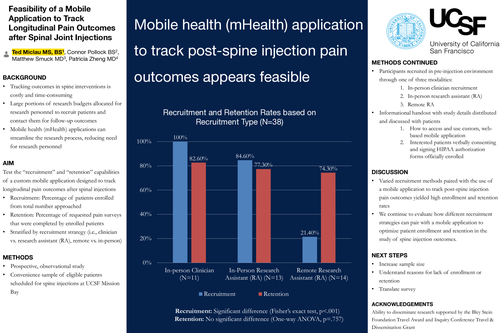
Thirty-eight patients were approached for study enrollment. Enrollment success was 100%, 84.6%, and 21.4% amongst the in-person clinician (N=11), in-person RA (N=13), and remote RA (N=14) recruitment groups, respectively. The percentage of completed surveys was 82.6%, 77.3%, and 74.3% amongst the in-person clinician, in-person RA, and remote RA recruitment groups, respectively. Enrollment differed significantly between the three groups (Fisher’s exact test, p<.001), with remote recruitment exhibiting less success than in-person recruitment. One-way ANOVA demonstrated no significant differences in the percentage of surveys completed by patients between groups (p=.757).
Discussion:
The use of a mHealth application to track post-spine injection pain outcomes appears feasible. Varied recruitment methods paired with the use of a mobile application to track post-spine injection pain outcomes yielded high enrollment and retention rates. In-person recruitment was more effective than remote recruitment, and clinician recruitment may be more effective than non-clinician recruitment. Recruitment approach was not associated with significant differences in post-enrollment survey completion rates. We continue to evaluate how different recruitment strategies can pair with a mobile application to alleviate research burdens and optimize patient enrollment and retention in the study of spine injection outcomes.