127 posters, 10 topics, 20 sessions, 127 authors
ePostersLive by SciGen Technologies S.A. All rights reserved.
UCSF 2024 Inquiry Symposium
Conference ePosters

P010
Patient Perspectives on Social Risk Screening and Documentation in a Dermatology Clinic
Poster Presenter
Authors
Part of Topic
Clinical & Translational Sciences
Project Title: Patient Perspectives on Social Risk Screening and Documentation in a Dermatology Clinic
Introduction: Social risk factors, such as transportation challenges and housing instability, are associated with dermatologic health outcomes and may affect clinical management. Studies exploring social risk screening have been performed in primary care and emergency department (ED) settings but have yet to be studied in dermatology. Consideration of social risk factors is a component of providing person-centered dermatologic care.
Aims: To understand patients’ perspectives on social risk screening and documentation in a dermatology clinic.
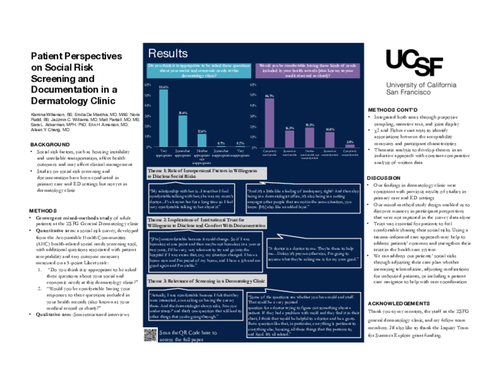
Project Design: We performed a convergent mixed-methods study of patients at the general dermatology clinic at Zuckerberg San Francisco General Hospital (ZSFG). Participants were eligible if they did not require immediate medical attention, were aged ≥18 years, able to speak and read English, Spanish, or Cantonese, able to provide informed consent, and were comfortable using a tablet device. The social risk survey included the 10-item Accountable Health Communities health-related social needs screening tool plus additional questions associated with patient acceptability. There were two primary outcome measures: 1) “Do you think it is appropriate to be asked these questions about your social and economic needs at this dermatology clinic?”, 2) “Would you be comfortable having these kinds of needs included in your health records [also known as your medical record or chart]?).” Responses to both questions were measured on a 5-point Likert scale ranging from very appropriate/very comfortable to very inappropriate/very uncomfortable with a midpoint of neither appropriate nor inappropriate/neither comfortable nor uncomfortable.
Participants who preferred English were invited to participate in semi-structured interviews. We initially used convenience sampling, but transitioned to purposive sampling when it became apparent that most participants were accepting of social risk screening. For the quantitative data analysis, we dichotomized the survey responses by the acceptability outcome measures. We used χ2 and Fisher exact tests performed with Stata 17 SE (StataCorp LLC) to identify associations between the two acceptability measures and participant characteristics. For the qualitative data, we used thematic analysis to develop themes, which involved an inductive approach and constant comparative analysis of the written data.
The quantitative component and the qualitative component were collected and analyzed in parallel and then merged. We integrated data through purposive sampling, narrative text, and joint display.
Results: A total of 135 participants (including 73 males (54.1%)) answered both measures of acceptability in the survey. Of these participants, 116 (85.9%) reported that social risk screening in their dermatology clinic was very or somewhat appropriate and 85 (63.0%) reported being completely or somewhat comfortable with having their social risks documented in the EHR. The following themes were developed: 1) role of interpersonal factors in willingness to disclose social risks, 2) implications of institutional trust for willingness to disclose and comfort with documentation, and 3) relevance of screening in a dermatology clinic.
Discussion: Results of this study showed that most participants found social risk screening to be appropriate in a dermatology clinic, although a smaller proportion of participants were comfortable with EHR documentation of their social risks. Findings of this study were similar to findings in primary care and ED settings and suggest that optimizing patients’ trust in their physicians and the medical system, while addressing privacy and discrimination concerns, may help facilitate disclosure of social risks.