127 posters, 10 topics, 20 sessions, 127 authors
ePostersLive by SciGen Technologies S.A. All rights reserved.
UCSF 2024 Inquiry Symposium
Conference ePosters

P002
Evaluating Loan Burden in Minorities in Anesthesiology and its Impact: A Nationwide Survey
Poster Presenter
Authors
Part of Topic
Clinical & Translational Sciences
Evaluating Loan Burden in Minorities in Anesthesiology and its Impact: A Nationwide Survey
Niti Pawar, BA1, Christy K. Boscardin, PhD1,2, and Odmara Barreto Chang, MD, PhD1
1Department of Anesthesia and Perioperative Care, University of California San Francisco, San Francisco, USA
2Department of Medicine, University of California San Francisco, San Francisco, USA
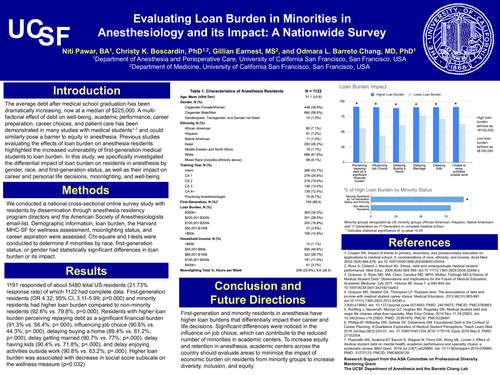
Introduction: The average debt after medical school graduation has been dramatically increasing, now at a median of $225,000. A multi-factorial effect of debt on well-being, academic performance, career preparation, career choices, and patient care has been demonstrated in many studies with medical students1-9 and could similarly pose a barrier to equity in anesthesia. Previous studies evaluating the effects of loan burden in anesthesia residents highlighted the increased vulnerability of first-generation and underrepresented in medicine (URM) medical students to loan burden.
Aim: In this study, we investigated the differential impact of loan burden on residents in anesthesia by gender, race and first-generation status as well as their impact on career and personal life decisions, moonlighting, and well-being.
Project Design/Methods: We conducted a national cross-sectional online survey study with residents utilizing the American Society of Anesthesiologists database. Demographic information, loan burden, the Harvard MHC-SF for wellness assessment, moonlighting status, and career aspiration were assessed. Chi-square and t-tests were conducted to determine if minorities by race, first-generation status, or gender had statistically significant differences in loan burden or its impact.
Results: 380 responded (27.6% response rate) and 330 with complete data. First-generation residents (OR 3.94; 95% CI, 2.34-6.63; p=0.031) and minority residents had higher loan burden compared to non-minority residents (89% vs. 73%; p=0.025). Residents with higher loan burden perceiving repaying debt as a significant financial burden (89.4% vs. 50.1%; p<.001), influencing job choice (93.3% vs. 55%; p<.001), delaying buying a home (82.3% vs. 53.7%; p<.001), delay getting married (55% vs. 47.4%; p=.011), delay having kids (68.2% vs. 52.04%; p<.001), and delay enjoying activities outside work (78.5% vs. 53.2%; p<.001). Higher loan burden was not statistically significant factor in wellbeing (x1=45.3; sd=12.62; x2=44.7; sd=11.1; p=0.684)
Discussion: First generation and minority residents in anesthesia have significant higher loan burden and differently impacting their career and life decisions. To increase equity and retention in anesthesia, the impact of economic burden on minoritized residents needs to be considered.
References:
1. Cooper RA. Impact of trends in primary, secondary, and postsecondary education on applications to medical school. II: considerations of race, ethnicity, and income. Acad Med. 2003;78(9):864-876. doi:10.1097/00001888-200309000-00004
2. Ross S, Cleland J, Macleod MJ. Stress, debt and undergraduate medical student performance. Med Educ. 2006;40(6):584-589. doi:10.1111/j.1365-2929.2006.02448.x
3. Greysen, S. Ryan MD, MA; Chen, Candice MD, MPH; Mullan, Fitzhugh MD A History of Medical Student Debt: Observations and Implications for the Future of Medical Education, Academic Medicine: July 2011 -Volume 86 -Issue 7 -p 840-845 doi: 10.1097/ACM.0b013e31821daf03
4. Grayson MS, Newton DA, Thompson LF. Payback time: The associations of debt and income with medical student career choice. Medical Education. 2012;46(10):983-991. doi:10.1111/j.1365-2923.2012.04340.x
5. Richardson T, Elliott P, Roberts R. The relationship between personal unsecured debt and mental and physical health: a systematic review and meta-analysis. Clin Psychol Rev. 2013;33(8):1148-1162. doi:10.1016/j.cpr.2013.08.009
6.DuggerRA, El-Sayed AM, Dogra A, Messina C, Bronson R, Galea S. The color of debt: racial disparities in anticipated medical student debt in the United States. PLoS One. 2013 Sep 3;8(9):e74693. doi: 10.1371/journal.pone.0074693. PMID: 24019975; PMCID: PMC3760863.
7.Rohlfing J, NavarroR, Maniya OZ, Hughes BD, Rogalsky DK. Medical student debt and major life choices other than specialty. Med Educ Online. 2014 Nov 11;19:25603. doi: 10.3402/meo.v19.25603. PMID: 25391976; PMCID: PMC4229497.
8.PhillipsJP, Wilbanks DM, Salinas DF, Doberneck DM. Educational Debt in the Context of Career Planning: A Qualitative Exploration of Medical Student Perceptions. Teach Learn Med. 2016 Jul-Sep;28(3):243-51. doi:10.1080/10401334.2016.1178116. Epub 2016 May 6. PMID: 27152504.
9.Pisaniello MS, Asahina AT, Bacchi S, Wagner M, Perry SW, Wong ML, Licinio J. Effect of medical student debt on mental health, academic performance and specialty choice: a systematic review. BMJ Open. 2019 Jul 2;9(7):e029980. doi: 10.1136/bmjopen-2019-029980. PMID: 31270123; PMCID: PMC6609129.