127 posters, 10 topics, 20 sessions, 127 authors
ePostersLive by SciGen Technologies S.A. All rights reserved.
UCSF 2024 Inquiry Symposium
Conference ePosters

P004
Utilizing Healthcare Navigators to Support Advanced Care Planning (ACP) Documentation in Oncologic Surgery Patients
Poster Presenter
Authors
Part of Topic
Clinical & Translational Sciences
Title: Utilizing Healthcare Navigators to Support Advanced Care Planning (ACP) Documentation in Oncologic Surgery Patients
Author: Adrian Valderrama, UCSF School of Medicine
Introduction:
Advance care planning (ACP) is critical for ensuring that patient preferences and values are considered in future medical care, and has been widely accepted as a quality metric for older surgical patients. Despite this, the prevalence of ACP is low among surgical patient populations. The PREPARE for You Care tool has been shown to be effective in increasing rates of ACP documentation, yet there is significant room for improvement. This project seeks to determine if Healthcare Navigators (HCN) can be used in conjunction with the PREPARE tool to increase the frequency of ACP documentation compared to the PREPARE tool alone. In addition, we aim to identify any additional barriers to creating ACP by analyzing the content of HCN conversations via their notes.
Hypothesis:
Among surgical oncology patients, the use of Healthcare Navigators in addition to the PREPARE tool will increase the likelihood of patients uploading an
Advanced Directive (AD) compared to the use of the PREPARE tool alone.
Aims:
1) Identify if HCNs augment the effectiveness of the PREPARE tool in increasing the number of patients submitting ACP documentation.
2) Analyze the content of HCN notes to identify barriers to uploading ACP.
Methods:
This is a retrospective cohort study conducted at UCSF using EHR data. The sample population includes patients greater than age 65 from surgical oncology clinics including colorectal, hepatobiliary, endocrine and thoracic clinics. For this study, all patients were sent a message with a link to the PREPARE tool. Two multilingual, ACP-trained HCNs selected a subset of patients to call, prioritizing patients with higher morbidity. HCNs called these patients to discuss ACP including the purpose of an AD and how to upload it. These visits were documented to include the content of the conversations between HCN and patients. The primary outcome was a new Advanced Directive (AD) uploaded to the EHR within 90 days of patient contact. Quantitative analysis was performed to identify differences in rates of uploading an AD between patients that had been contacted by a HCN compared to those who were not. In addition, content analysis was performed on a subset of 100 HCN notes to identify barriers to ACP.
Results:
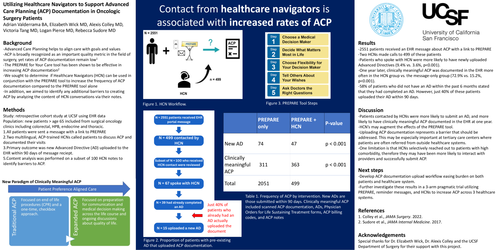
The study sample included 2,551 patients who received an EHR message about ACP with a link to PREPARE, and 499 of these patients also received calls from a HCN. Patients who spoke with a HCN were more likely to have a newly uploaded Advanced Directive (9.4% vs. 3.6%, p<0.001). One year later, clinically meaningful ACP was documented in the EHR more often in the HCN group vs. the PREPARE-only group (72.9% vs. 15.2%, p<0.001). By analyzing the content of HCN notes, we found that 58% of patients who did not have an AD within the past 6 months stated that they had completed an AD. However, just 40% of these patients uploaded their AD within 90 days.
Discussion
In this study, patients contacted by HCNs were more likely to submit an AD, and more likely to have clinically meaningful ACP documented in the EHR at one year. These results suggest that HCNs may augment the effects of the PREPARE tool, leading to increased rates of ACP documentation. The step of uploading ACP appears to be a barrier for many patients given that the majority of patients who stated they had completed an AD did not upload it. It is important to
address this barrier, which may be especially prevalent at tertiary care centers where patients are often referred from outside healthcare systems. One limitation of the study is that HCNs selectively reached out to patients with high morbidity, therefore they may have been more likely to interact with providers and successfully submit ACP. Next steps should include developing an ACP documentation upload workflow that can ease the burden on both patients and the healthcare system. In addition, these results will be further investigated in a 3-arm pragmatic trial utilizing PREPARE, reminder messages, and HCNs to increase ACP across 3 healthcare systems including UCSF, UC Irvine and University of Minnesota.