127 posters, 10 topics, 20 sessions, 127 authors
ePostersLive by SciGen Technologies S.A. All rights reserved.
UCSF 2024 Inquiry Symposium
Conference ePosters

P097
Systematic review of the neural correlates of mindfulness training in adolescents
Poster Presenter
Authors
Part of Topic
Biomedical Sciences
Title: Systematic review of the neural correlates of mindfulness training in adolescents
Introduction: Mental health disorders are a significant public health concern for adolescents in the U.S. According to a mental health surveillance report about children in the U.S. from
2013-2019, 36.7% of high school students aged 14-18 years had experienced persistent feelings of sadness or hopelessness during the past year, and approximately one fourth of adolescents aged 12-17 years reported receiving mental health services in the past year (Bitsko et al., 2022). One promising treatment in this population is mindfulness training. Mindfulness is the practice of non-elaborative observation, acknowledgement, and acceptance of one’s bodily sensations, thoughts, feelings, and environment from moment to moment (Hoffman, 2017). This cognitive skill has been leveraged to create mindfulness-based interventions (MBI), standardized forms of mindfulness training shown to be effective in the treatment of anxious and depressive symptoms in adolescents (Dunning et al., 2019; Chi et al., 2018). Although there is evidence elucidating the measurable effects of mindfulness training on brain structure and function in adults, there has been no summary that examines the neural correlates of MBIs within a solely adolescent population. Developing an adolescent-specific neural model of the effects of mindfulness can help us better understand the mechanisms of symptom improvement in the setting of mindfulness training and subsequently design more targeted treatments for specific symptom profiles.
Aims: In this paper, we systematically review the adolescent literature to investigate how MBIs alter neural structure and function in adolescence. We synthesize and compare our findings with existing adult models and propose our own adolescent model of how mindfulness and mindfulness training induce neural changes in the brain.
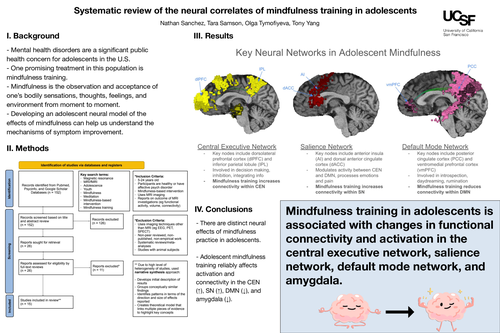
Project design/methods: A search was conducted to identify studies investigating the neuroimaging correlates of mindfulness-based interventions in adolescents. Several electronic databases were searched, including Pubmed, Google Scholar, and Psycinfo. The key search terms were: “magnetic resonance,” “fMRI,” “adolescence,” “youth,” “mindfulness,” “meditation,” “mindfulness-based intervention,” and “mindfulness training.” Following PRISMA guidelines, the articles were independently screened by two reviewers against defined inclusion and exclusion criteria, initially based on title and abstract reviews, followed by full-text reviews. Data from reports was collected by both reviewers and tabulated in an excel sheet. To narratively synthesize the studies, we developed an initial description of the results of included studies, grouped conceptually similar findings, identified patterns across them in terms of both the direction and size of the effects reported, and created a theoretical model that links multiple pieces of evidence to highlight key concepts or issues relevant to the review question.
Results/Product: A total of 15 studies were included for synthesis in this review (Figure 1) with 482 total participants to assess the neural effects of mindfulness interventions in adolescents. All studies use MRI data to demonstrate relative changes in brain regions and networks either
compared to a separate control group or a control condition within the same participants. We observed significant effects of mindfulness interventions within and between brain regions of the triple network model, including the central executive network (CEN), the cingulo-opercular salience network (SN), and the default mode network (DMN). Most evidently, our results demonstrate that mindfulness practice in adolescents is associated with increased activation and connectivity of the CEN. Mindfulness practice also reliably affects activation and connectivity in the SN and DMN, usually activating the SN and deactivating the DMN; however, the findings in these networks are somewhat mixed. We also found several significant associations between mindfulness practice and decreases in amygdala activation in adolescents. In addition, we found evidence of inter-network connectivity changes, including increased connectivity between the CEN and SN, the SN and DMN, the CEN and DMN, and the DMN and amygdala.
Conclusion: There are distinct neural effects of mindfulness practice in adolescents. Adolescent mindfulness reliably affects activation and connectivity in the CEN (↑), SN (↑), DMN (↓), and amygdala (↓).
Works Cited:
Bitsko RH, Claussen AH, Lichstein J, et al. Mental Health Surveillance Among Children — United States, 2013–2019. MMWR Suppl 2022;71(Suppl-2):1–42. DOI: http://dx.doi.org/10.15585/mmwr.su7102a1
Chi, Xinli et al. “Effects of Mindfulness-Based Stress Reduction on Depression in Adolescents and Young Adults: A Systematic Review and Meta-Analysis.” Frontiers in psychology vol. 9 1034. 21 Jun. 2018, doi:10.3389/fpsyg.2018.01034
Dunning, Darren L et al. “Research Review: The effects of mindfulness-based interventions on cognition and mental health in children and adolescents - a meta-analysis of randomized controlled trials.” Journal of child psychology and psychiatry, and allied disciplines vol. 60,3 (2019): 244-258. doi:10.1111/jcpp.12980
Hofmann, Stefan G, and Angelina F Gómez. “Mindfulness-Based Interventions for Anxiety and Depression.” The Psychiatric clinics of North America vol. 40,4 (2017): 739-749. doi:10.1016/j.psc.2017.08.008