127 posters, 10 topics, 20 sessions, 127 authors
ePostersLive by SciGen Technologies S.A. All rights reserved.
UCSF 2024 Inquiry Symposium
Conference ePosters

P068
Autoantibody-Peptide and Amino-Acid Motif Signatures of HLA Genotypes in Human Health
Poster Presenter
Authors
Part of Topic
Biomedical Sciences
Title: Autoantibody-Peptide and Amino-Acid Motif Signatures of HLA Genotypes in Human Health
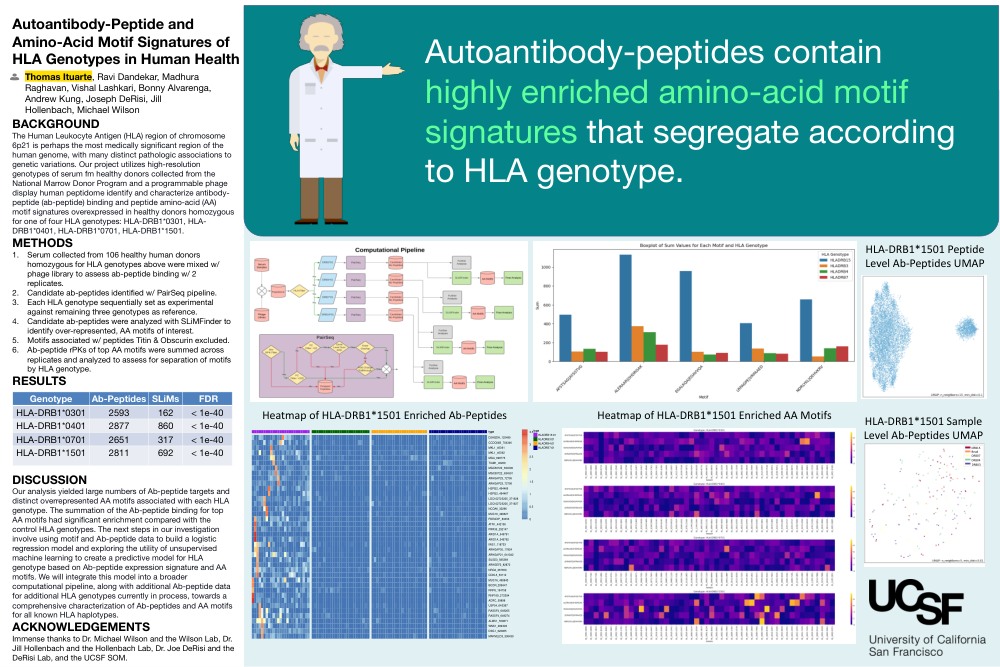
Introduction: The Human Leukocyte Antigen (HLA) region of chromosome 6p21 is perhaps the most medically significant region of the human genome, with over 100 distinct infectious, autoimmune, neoplastic, and pharmacologic associations to genetic variations in the HLA gene region. Despite nearly 50 years of study, many questions remain regarding the extent of HLA- mediated impact on human health and disease progression. Although some degree of uncertainty is related to the inherent complexity of the HLA region, a known limitation of prior studies is the over-reliance on statistically imputed SNP data rather than direct sequencing of the loci. In contrast to prior studies, our project utilizes serum samples from healthy donors collected by the National Marrow Donor Program, all of whom have high-resolution genotypes. In addition, a programmable phage-display library of 731,724 peptides created from publicly available data spanning the entire human proteome was used to identify and characterize autoantibody-peptide (Ab-peptide) binding and peptide amino-acid (AA) motif signatures overexpressed in the Ab- peptides of healthy donors homozygous for one of four HLA genotypes: HLA-DRB1*0301, HLA-DRB1*0401, HLA-DRB1*0701, HLA-DRB1*1501. Further, a programmable phage- display library of 481,966 peptides spanning the known virome was used to explore if a similar bioinformatics pipeline would yield Ab-peptide binding and AA motif signatures for viral reactivity. Our project expands upon computational techniques including the PairSeq algorithm, which identifies mutually enriched peptide signatures, as well as SLiMFinder, a AA motif analysis tool used subsequently to explore and characterize AA motif signatures for four HLA genotypes among enriched Ab-peptides.
Hypotheses: We propose the following as our research hypotheses H1: Ab-peptides and AA motifs segregate based on HLA genotype at a FDR of 0.05. H0: Ab-peptides and AA motifs do not segregate based on HLA phenotype at an FDR of 0.05.
Aims:
Aim 1: Analyze human peptidome data for 4 HLA genotypes—HLA-DRB1*0301, HLA- DRB1*0401, HLA-DRB1*0701, and HLA–DRB1*1501—to characterize autoreactivity signatures of proteome segregation specific to HLA genotype.
- Aim 1a: Characterization and identification of enriched Ab-peptide profiles distinct for each HLA genotype.
- Aim 1b: perform a broad motif analysis looking for enriched motifs of 8-12 AAs shared across Ab-peptides of interest (k-mer, SLIMfinder, etc.)
Aim 2: Analyze virome data for 4 HLA genotypes—HLA-DRB1*0301, HLA-DRB1*0401, HLA-DRB1*0701, and HLA–DRB1*1501—to characterize viral reactivity signatures of proteome segregation specific to HLA genotype.
- Aim 2a: Characterization and identification of virome-associated enriched Ab-peptide profiles distinct for each HLA genotype.
- Aim 2b: Perform a broad motif analysis looking for enriched motifs of 8-12 AAs shared across Ab-peptides of interest (kmer, SLIMfinder, etc.)
Project Design: We used serum samples collected from 106 healthy donors homozygous for one of the four HLA genotypes previously stated in conjunction with our programmable phage display peptidome and virome libraries to assess Ab-peptide binding. There were two replicates for each patient sample. We analyzed the resulting data using a custom bioinformatics pipeline involving an expanded PairSeq algorithm to identify candidate Ab-peptides of interest. We sequentially designated each HLA genotype as the experimental group against the other HLA genotypes as the control. The PairSeq parameters utilized were a minimum fold change threshold of 20, a ‘singlet’ fold change threshold of 200, and a minimum gene-level reads assigned per hundred kilobase (rPK) target value of 200. We then analyzed the candidate Ab-peptide subset with the SLiMFinder algorithm to identify over-represented, convergently evolved, short linear motifs in the candidate peptides. We excluded motifs associated solely with the peptides Titin and Obscurin, as these are very large structural peptides commonly over-represented in experimental data. The Ab-peptide rPKs of top AA motifs were summed across all replicates to assess for separation of motifs by HLA genotype.
Results: For human proteome, our analysis identified 2593 candidate Ab-peptide targets and 162 AA motifs for HLA- DRB1*0301, 2877 candidate Ab-peptide targets and 860 AA motifs for HLA-DRB1*0401, 2651 candidate Ab-peptide targets and 317 AA motifs for HLA-DRB1*0701, and 2811 candidate Ab-peptide targets and 692 AA motifs for HLA-DRB1*1501. P-values were
< 1 x 10^-40 for all AA motifs, and the top 20 had p-values < 1 x 10^-54. PairSeq analysis of virome data did not yield significant results.
Discussion: Our analysis yielded large numbers of Ab-peptide targets and distinct overrepresented AA motifs associated with each HLA genotype. The summation of the Ab- peptide binding for top AA motifs had significant enrichment compared with the control HLA genotypes. The next steps in our investigation involve using motif and Ab-peptide data to build a logistic regression model and exploring the utility of unsupervised machine learning to create a predictive model for HLA genotype based on Ab-peptide expression signature and AA motifs.
We will integrate this model into a broader computational pipeline, along with additional Ab- peptide data for additional HLA genotypes currently in process, towards a comprehensive characterization of Ab-peptides and AA motifs for all known HLA haplotypes. Our PairSeq analysis of virome data yielded fixed and constant results when we performed k-mer analysis at any threshold. Although we expected some exciting findings in the virome data set, the PairSeq reliance on a gene-level k-mer analyses inhibited meaningful results in this data set and each analysis run where we performed k-mer analyses yielded a fixed set of target Ab-peptides. When we removed the gene-level k-mer analysis, the resulting target Ab-peptides varied with changes in analysis parameters, as expected. The PairSeq group analysis, as currently implemented, did not appear to be a useful analytical tool for this data set. As a computational study, one limitation of this project is that we don’t have validation data to verify the accuracy of the Ab-peptide and AA motif signatures identified Therefore, our findings need to be confirmed with appropriately correlated wet-lab assays and this is, understandably, a major next step in our overall investigation.