127 posters, 10 topics, 20 sessions, 127 authors
ePostersLive by SciGen Technologies S.A. All rights reserved.
UCSF 2024 Inquiry Symposium
Conference ePosters

P083
Dynamics of predicted tumor neoepitope presentation in osteosarcoma
Poster Presenter
Authors
Part of Topic
Biomedical Sciences
Charles Macaulay Deep Explore Abstract
Title:
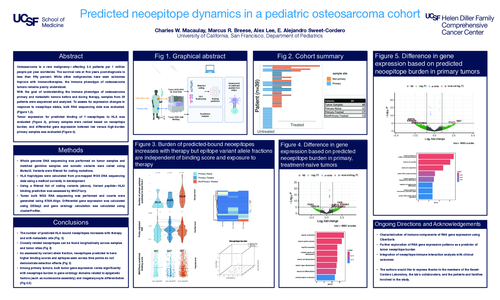
Predicted neoepitope dynamics in a pediatric osteosarcoma cohort
Introduction:
Osteosarcoma is a rare malignancy—affecting 3.4 patients per 1 million people per year worldwide. The survival rate at five years post-diagnosis is less than fifty percent. While other malignancies have seen outcomes improve with immunotherapies, the immune phenotype of osteosarcoma tumors remains poorly understood.
Hypothesis:
Characterization of osteosarcoma tumor immune phenotypes from RNA sequencing data will enable more efficient and widespread understanding of these immune phenotypes.
Aims:
- Characterize the dynamics of osteosarcoma neoantigens that are predicted to bind in sequential samples during treament
- Determine the relationship between these neoantigens and paired tumor immune cell content from RNA sequencing data
- Establish the predictive value of tumor immune cell content as a proxy for neoantigen burden
Project design/Methods:
With the goal of understanding the immune phenotype of osteosarcoma primary and metastatic tumors before and during therapy, samples from 36 patients were sequenced and analyzed. To assess for expression changes in response to neoepitope status, bulk RNA sequencing data was evaluated. Tumor expression for predicted binding of neoepitopes to HLA was evaluated, primary samples were ranked based on neoepitope burden, and differential gene expression between low versus high-burden primary samples was evaluated.
Results:
Analyses demonstrate that: the number of predicted HLA-bound neoepitopes increases with therapy and with metastatic site, clonally related neoepitopes can be found longitudinally across samples and tumor sites, and neoepitopes predicted to have higher binding scores and epitopes seen across time points do not demonstrate selection effects. However, analysis of ongoing tumor RNA sequencing may demonstrate differences in immune cell content within tumors related to neoepitope content.
Conclusion:
As time increases and as tumors metastasize from primary osteosarcoma lesions, they acquire more neoantigenic mutations. It remains to be seen how this effects the tumor immune cell content. Future work will elucidate this with the ultimate goal of better enabling precise treatments for these tumors which have eluded one-size-fits-all treatment approaches.