127 posters, 10 topics, 20 sessions, 127 authors
ePostersLive by SciGen Technologies S.A. All rights reserved.
UCSF 2024 Inquiry Symposium
Conference ePosters

P019
Single-nuclei sequencing of the normal pituitary gland and pituitary neuroendocrine tumors
Part of Topic
Biomedical Sciences
Title: Single-nuclei RNA sequencing of the normal pituitary gland and pituitary neuroendocrine tumors
Introduction: Pituitary neuroendocrine tumors (PitNETs) are common intracranial tumors originating from the anterior pituitary gland. They can either overproduce hormones, resulting in specific symptoms, or remain hormonally silent and primarily cause mass effects or be incidentally diagnosed. The 2017 World Health Organization (WHO) classification introduced a new approach based on cell lineage using key transcription factors (TFs) for categorizing pituitary tumors. However, there is still limited understanding of PitNET tumorigenesis and the dynamics of TF expression. This study utilizes single- nuclei RNA-sequencing to analyze a large dataset of cells from PitNETs patients, aiming to reconstruct a comprehensive atlas of the human pituitary gland and investigate the origin and trajectory leading to different subtypes of PitNETs.
Hypothesis or question (if applicable): Hypothesis 1: The development of the five types of neuroendocrine cells in the normal pituitary gland is dependent on complex cascades of transcription factors. Hypothesis 2: Analysis of the transcriptomics of pituitary neuroendocrine tumors will uncover both shared and distinct patterns of transcription factor expression when compared to those observed during normal gland development.
Aims: To uncover transcriptomic changes of both normal pituitary gland and pituitary neuroendocrine tumors
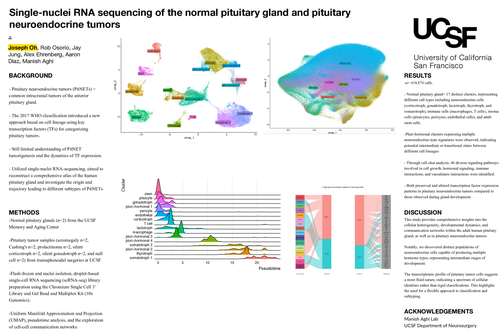
Project Design/Methods: The study utilized samples from normal pituitary glands (n=2) obtained from the UCSF Memory and Aging Center with a minimal post-mortem interval (PMI < 5 hrs) during the period of 2022-2023. Pituitary tumor samples (acromegaly n=2, Cushing's n=2, prolactinoma n=2, silent corticotroph n=2, silent gonadotroph n=2, and null cell n=2) were sourced from transsphenoidal surgeries performed at the UCSF Department of Neurosurgery in 2023. All samples were promptly flash-frozen, and the nuclei were isolated. Single nuclei were subjected to droplet-based single-cell RNA sequencing (scRNA-seq) library preparation using the Chromium Single Cell 3’ Library and Gel Bead and Multiplex Kit (10x Genomics). The sequencing data was then mapped using CellRanger. Data analysis involved techniques such as Uniform Manifold Approximation and Projection (UMAP), pseudotime analysis, and the exploration of cell-cell communication networks.
Result: In total, the dataset comprised 419,874 cells. Within the normal pituitary gland, 17 distinct clusters were identified using PCA and UMAP, representing different cell types including neuroendocrine cells (corticotroph, gonadotroph, lactotroph, thyrotroph, and somatotroph), immune cells (macrophages, T cells), stroma cells (pituicytes, pericytes, endothelial cells), and adult stem cells. Pluri-hormonal clusters expressing multiple neuroendocrine-type signatures were observed, indicating potential intermediate or transitional states between different cell lineages. Pseudotime trajectory analysis revealed the developmental progression of these plurihormonal cells originating from stem cells. Through cell-chat analysis, 46 diverse signaling pathways involved in cell growth, hormonal signaling, immune interactions, and vasculature interactions were identified. Additionally, we identified both preserved and altered transcription factor expression patterns in pituitary neuroendocrine tumors compared to those observed during gland development.
Discussion/Conclusion: Discussion/Conclusion: This study provides comprehensive insights into the cellular heterogeneity, developmental dynamics, and communication networks within the adult human pituitary gland, as well as in pituitary neuroendocrine tumors. Notably, we discovered distinct populations
of neuroendocrine cells capable of producing multiple hormone types, representing intermediate stages of development. The transcriptomic profile of pituitary tumor cells suggests a more fluid nature, indicating a spectrum of cellular identities rather than rigid classifications. This highlights the need for a flexible approach to classification and subtyping. Future investigations should focus on understanding the bidirectional relationship between pituitary tumors and the surrounding non-tumor cells, as our findings suggest a significant presence of the tumor microenvironment.