127 posters, 10 topics, 20 sessions, 127 authors
ePostersLive by SciGen Technologies S.A. All rights reserved.
UCSF 2024 Inquiry Symposium
Conference ePosters

P041
Deep-Learning Algorithms for PSMA-PET Image Segmentation: The Effect of Grouping Data
Poster Presenter
Authors
Part of Topic
Biomedical Sciences
Deep-Learning Algorithms for PSMA-PET Image Segmentation: The Effect of Grouping Data
Introduction: Prostate cancer is the most common cancer in men, as well as the 3rd most common cancer death for men.1 In recent years, the FDA has approved 68Ga-PSMA-11, a PET radiotracer that binds to prostate specific membrane antigen, a protein on the surface of prostate cancer cells that is overexpressed, especially in aggressive prostate cancer.2 Furthermore, studies have shown that PSMA-PET total tumor volume can predict the outcomes of targeted theranostics like [ 177Lu]Lu-PSMA-617 radioligand therapy.3 Calculating the total volume and activity of PSMAPET signals is extremely time-intensive for nuclear medicine radiologists, and deep learning models offer a means to automate this process.
Hypothesis & Aims: We aim to develop a deep learning algorithm to accurately identify & quantify cancer vs. normal uptake in PSMA-PET reconstruction. 1. Optimize a deep learning model for segmentation of PSMA-PET images by grouping subvolumes such that it can quantify lesion volume and activity most effectively 2. Correlate PSMA-PET lesion volume & activity with cancer progression & treatment response
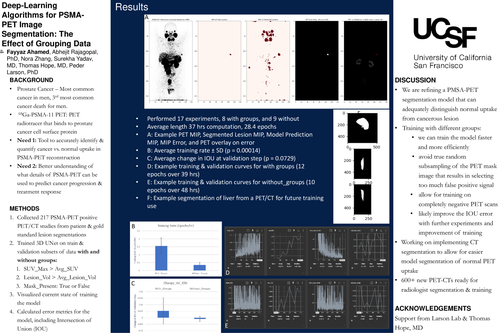
Methods: We collected 217 PSMA-PET positive PET-CTs and had our nuclear medicine radiologist provide gold-standard segmentations that identified cancerous lesions and their volumes. We calculated all possible subvolumes of 64x64x64 pixels within our PSMA-PET images and divided these subvolumes into 8 groups based on whether or not the subvolume’s maximum SUV is greater than the average SUV_max across scans, whether the lesion_volume was greater than the average lesion volume across scans, and whether a lesion was present in the subvolume or not. We then trained a 3D UNet model using these subvolumes, both with these groups, and without the groups, and recorded various error metrics comparing the predicted lesions to the gold-standard segmentations. We also used inference to generate whole-body predictions by stitching together the various subvolumes.
Results: 17 experiments were performed, 8 of which were done with groups, and 9 of which were performed without groups. The average length of an experiment was 37 hrs and 28.4 epochs were performed during this time. The average training rate was 1.55 ± 0.50 epochs/hr for training with groups, and 0.35 ± 0.15 epochs/hr for training without groups (p=0.00014). The average change in the intersection over union (IOU) metric was 0.005 ± 0.010 in training with groups and 8.8*10-4 ± 0.002 in training with groups (p=0.073). Other error metrics did not have conclusive results at this time. The CT segmentation model also demonstrated promising results for future stages of the project.
Discussion: Our experiments determined that training with groups using the 3D UNet is faster than without groups, and potentially more efficient. The error metrics were overall similar. Notably, the IOU metric had greater positive change when training with groups, but the difference was not statistically significant. CT segmentation also shows promise to increase the effectiveness of model training such that we can design a fully usable PSMA-PET segmentation model.
References:
1. Litwin MS, Tan H-J. The Diagnosis and Treatment of Prostate Cancer: A Review. JAMA. 2017;317(24):2532. doi:10.1001/jama.2017.7248
2. Commissioner O of the. FDA Approves First PSMA-Targeted PET Imaging Drug for Men with Prostate Cancer. FDA. Published December 2, 2020. Accessed March 10, 2021. https://www.fda.gov/news-events/press-announcements/fda-approves-first-psmatargeted-pet-imaging-drug-men-prostate-cancer
3. Seifert R, Kessel K, Schlack K, Weber M, Herrmann K, Spanke M, Fendler WP, Hadaschik B, Kleesiek J, Schäfers M, Weckesser M, Boegemann M, Rahbar K. PSMA PET total tumor volume predicts outcome of patients with advanced prostate cancer receiving [177Lu]Lu-PSMA-617 radioligand therapy in a bicentric analysis. Eur J Nucl Med Mol Imaging. 2021 Apr;48(4):1200-1210. doi: 10.1007/s00259-020-05040-1. Epub 2020 Sep 24. PMID: 32970216; PMCID: PMC8041668.