127 posters, 10 topics, 20 sessions, 127 authors
ePostersLive by SciGen Technologies S.A. All rights reserved.
UCSF 2024 Inquiry Symposium
Conference ePosters

P047
Effects of toxicants and psychoactive compounds on cellular health
Poster Presenter
Authors
Part of Topic
Biomedical Sciences
Project Title: Effects of toxicants and psychoactive compounds on cellular health
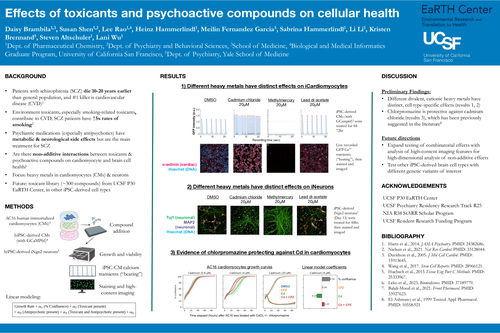
Introduction: Patients with schizophrenia die on average 15-20 years earlier than the general population, most commonly from cardiovascular disease. Patients with schizophrenia have increased exposure to environmental toxicants, with >10-fold higher rates of homelessness (and hence more exposure to air pollutants) and >3-fold rates of cigarette smoking. In addition, first- and second-generation antipsychotics, which are the mainstay treatments for schizophrenia, have well-known adverse effects on cardiovascular, metabolic and neurologic health. The combinatorial effects of toxicants and drugs on cellular health have not been explored. Furthermore, toxicity studies traditionally have depended on animal models, have been derived from human epidemiology data, or require human clinical trials. Here, we leverage the use of high-content cell profiling assays to allow for unbiased hazard identification, high-throughput combinatorial studies, and concentration-response modeling.
Hypothesis or question: Are there non-additive interactions between toxicants and psychoactive compounds in cardiomyocyte and brain cell health?
Aims: Aim 1. Design a pilot library to establish a toxicant-antipsychotic profiling platform. We will select environmental toxicants from the EaRTH Center toxicant library that have established cardiotoxicity based on literature search and have relevance to schizophrenia (e.g., heavy metals, cigarette combustion byproducts). We will also select antipsychotics based on clinical use (e.g., commonly prescribed), known adverse cardiotoxic side effects, and range of molecular targets (e.g., ion channels, protein translation). We will then utilize these compounds in our AC16 cardiomyocyte/neuron cellular assay (Aim 2). Aim 2. Test individual toxicants/compounds for effect on cell growth to establish assay parameters. We will incubate the toxicants and antipsychotic drugs identified in Aim 1 in AC16 cardiomyocytes/neurons seeded in 96-well plate assays at various concentrations. We will image the perturbed cells via Incucyte microscopy over 48 hours. We will measure cell confluence over time (as a proxy for cell viability and growth) and plot dose-response curves per toxicant and antipsychotic utilizing Incucyte data analysis software. We will identify toxicants and antipsychotics with the highest toxicity to subsequently test in combinatorial studies in Aim 3. Aim 3. Perform combinatorial studies for antipsychotics and toxicants. We will test combinatorial effects (toxicant-antipsychotic pairs) of the 5 toxicants and 5 antipsychotics identified in Aim 2 at 4 relevant concentrations per compound (5x5x4).
Project Design/Methods: To elucidate the interactions between environmental toxicants and antipsychotics, we will conduct high-throughput microscopy-based phenotypic profiling, a technique pioneered by the Altschuler and Wu labs. We will utilize an immortalized human cardiomyocyte cell line, AC16, and hiPSC derived iNgn2 neurons. The cells will be seeded in 96-well plates with cell culture media for 24 hours at 37C and then perturbed with toxicants 24 hours later at varying concentrations (20uM-100pM). Cells will then be imaged at 10x every 4 hours for a total duration of 48 hours utilizing Incucyte microscopy. AC16 cardiomyocytes/iNgn2 neurons seeded in 96-well plates for 48 hours will then be treated, fixed and stained using Cell Painting (an assay with 6 well-described fluorescent markers imaged in 5 channels with 8 organelle readouts) and/or neuronal markers (Tuj1/MAP2) and imaged on the Operett, a high-throughput microscope. Bright field images obtained from the Incucyte microscopy will be captured periodically after compound treatment and subsequently subjected to cell segmentation, and the coverage area will be used to calculate confluence. Dose response curves will be generated from this analysis using built-in Incucyte software. For quantitative analysis, we will use linear modeling with confluence as a proxy for cell growth. We will use linear model coefficients to identify additive effects in combinatorial studies.
Results: Out of >20 compounds tested from the EaRTH Center toxicant library, we found that the heavy metals, cadmium, methyl mercury and lead, were the most toxic. In AC16 cardiomyocytes, they resulted in decreased growth rate, morphological changes (decreased DNA expression, decreased myocardial protein expression), and aberrant/decreased cardiac beating activity. In neurons, we also identified distinct changes in neuronal proteins and DNA levels in response to different heavy metals. Interestingly, in combinatorial studies performed in AC16 cardiomyocytes, we found that chlorpromazine had a protective effect on cadmium, but not with other antipsychotics nor other antipsychotic-toxicant combinations.
Discussion/Conclusion: These findings show the utility of utilizing high-content cell profiling assays for the use of single and combinatorial toxicants/psychoactive compounds in iPSC-derived cardiomyocytes and neurons. Future directions include performing further analysis of high content imaging features for high dimensional analysis to create phenotypic “profiles”. Additional future directions include testing other iPSC derived neuronal and cardiomyocyte cell types.