127 posters, 10 topics, 20 sessions, 127 authors
ePostersLive by SciGen Technologies S.A. All rights reserved.
UCSF 2024 Inquiry Symposium
Conference ePosters

P096
Endocrinology Practice Adherence to American Thoracic Society Guidelines: Unveiling Gaps in Obesity Hypoventilation Syndrome Screening
Part of Topic
Clinical & Translational Sciences
Title:
Endocrinology Practice Adherence to American Thoracic Society Guidelines: Unveiling Gaps in Obesity Hypoventilation Syndrome Screening
Introduction:
The prevalence of obesity continues to rise, further increasing the risk of sleep-disordered breathing which includes hypoventilation and obstructive sleep apnea (OSA). Obesity hypoventilation syndrome (OHS) is defined by sleep-disordered breathing with a BMI >30 kg/m2 and daytime hypercapnia >45 mmHg while OSA is sleep-disordered breathing that can be diagnosed by polysomnography alone. These conditions are important to diagnose as they can increase the risk of cardiovascular disease, worsening obesity, and mood disorders.
To better diagnose and manage OHS, the American Thoracic Society (ATS) released a clinical practice guideline in 2019. Although this guideline was published in 2019, it is unclear how often physicians follow or are aware of these recommendations. Further studies can assess the proportion of patients receiving sleep studies in accordance with this guideline, while also increasing awareness among physicians.
Aims:
The objective of this study was to determine if individuals with severe obesity (BMI >40), who were referred to outpatient endocrinology and had a serum bicarbonate level ≥27 mmol/L, were correctly identified and directed to either pulmonary medicine or sleep medicine in accordance with ATS guidelines. Additionally, a secondary aim was to examine the percentage of obstructive sleep apnea (OSA) among patients undergoing sleep evaluation.
Methods:
We enrolled adult patients referred to outpatient endocrinology between July 2018 and July 2023, with a BMI exceeding 40 kg/m². Patients who were hospitalized or lacked complete records, including BMI data, were excluded. Data collection encompassed demographic information, lab values, presence of
concurrent diabetes or hypertension, referrals to sleep or pulmonary services, and details of sleep studies. Statistical analyses included chi-square, t-test, and regression.
Results:
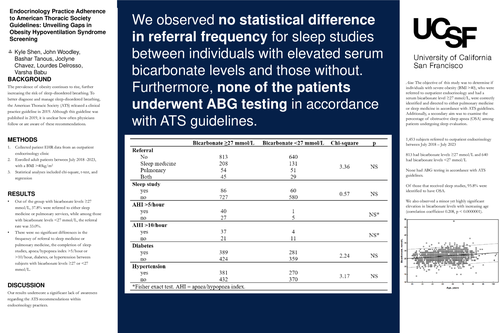
Out of 1,453 subjects, 813 (comprising 223 males and 590 females, with a mean age of 54.5 ± 14.39 years) exhibited bicarbonate levels ≥27 mmol/L, while 640 (consisting of 143 males and 496 females, with one gender unspecified, with a mean age of 49.8 ± 15.13 years) displayed bicarbonate levels <27 mmol/L. None of the patients were referred for arterial blood gas (ABG) testing. Out of the group with bicarbonate levels ≥27 mmol/L, 37.8% were referred to either sleep medicine or pulmonary services, while among those with bicarbonate levels <27 mmol/L, the referral rate was 33.0%. Of those that
received sleep studies, 95.8% were identified to have OSA. There were no significant differences in the frequency of referral to sleep medicine or pulmonary medicine, the completion of sleep studies, apnea/hypopnea index >5/hour or >10/hour, diabetes, or hypertension between subjects with
bicarbonate levels ≥27 or <27 mmol/L. We observed a minor yet highly significant elevation in
bicarbonate levels with increasing age (correlation coefficient 0.208, p < 0.0000001). However, per Cohen's criteria, the magnitude of the correlation noted in this instance is considered small to medium.
Discussion:
Our results underscore a significant lack of awareness regarding the ATS recommendations within endocrinology practices. Specifically, we noted no noticeable difference in referral rates between individuals with elevated serum bicarbonate levels and those without. Additionally, none of the patients underwent arterial blood gas (ABG) testing in line with ATS guidelines.
Serum bicarbonate levels are routinely assessed as part of standard chemistry panels. They serve as a valuable screening tool for Obesity Hypoventilation Syndrome (OHS), with demonstrated high sensitivity (76-92%) but lower specificity (50-74%). Notably, Borel et al. found a low prevalence of OHS (1.1%)
among obese patients with elevated bicarbonate levels, suggesting that the elevation in bicarbonate
likely reflects factors beyond compensation for primary respiratory acidosis. This observation was made in a population with multiple underlying health conditions and concurrent medication use. Another notable finding from our study was a slight yet highly significant increase in bicarbonate levels with age. This aligns with previous research indicating a relationship between age and bicarbonate levels.
Although our study offers valuable insights, it is important to recognize several limitations. Firstly, it was conducted solely at a single medical facility, which may restrict the applicability of our findings to a broader population. Additionally, our reliance on data from a single database raises the possibility that some patients may have undergone sleep studies at different facilities, potentially resulting in
incomplete or erroneous information in our analysis. Furthermore, temporal bias is a concern, as some patients may have previously undergone evaluations or treatments for sleep-related conditions, which could influence the outcomes and interpretation of our results.
In conclusion, our study highlights the necessity for heightened awareness and compliance with ATS guidelines in endocrinology practices. The absence of differentiation in referral patterns based on
bicarbonate levels, along with the recognized limitations, underscores the significance of additional research and multicenter studies to validate and expand upon our results. These insights aid in
enhancing our comprehension of the difficulties in identifying and treating OHS, especially concerning age-related variances and potential confounding factors affecting serum bicarbonate levels.