127 posters, 10 topics, 20 sessions, 127 authors
ePostersLive by SciGen Technologies S.A. All rights reserved.
UCSF 2024 Inquiry Symposium
Conference ePosters

P095
Machine Learning for Predicting Hemorrhage In Pediatric Patients with Brain Arteriovenous Malformation
Poster Presenter
Authors
Part of Topic
Clinical & Translational Sciences
Machine Learning for Predicting Hemorrhage In Pediatric Patients with Brain Arteriovenous Malformation
Satvir Saggi, Ethan Winkler MD PhD, Nalin Gupta MD PhD
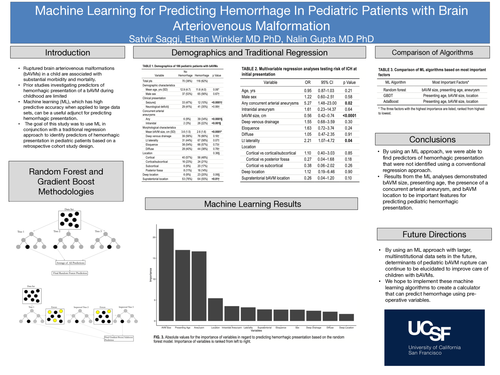
Introduction: Ruptured brain arteriovenous malformations (bAVMs) in a child are associated with substantial morbidity and mortality. Prior studies investigating predictors of hemorrhagic presentation of a bAVM during childhood are limited. Machine learning (ML), which has high predictive accuracy when applied to large data sets, can be a useful adjunct for predicting hemorrhagic presentation.
Aims: The goal of this study was to use ML in conjunction with a traditional regression approach to identify predictors of hemorrhagic presentation in pediatric patients based on a retrospective cohort study design.
Methods: Using data obtained from 186 pediatric patients over a 19-year study period, the authors implemented three ML algorithms (random forest models, gradient boosted decision trees, and AdaBoost) to identify features that were most important for predicting hemorrhagic presentation. Additionally, logistic regression analysis was used to ascertain significant predictors of hemorrhagic presentation as a comparison.
Results: All three ML models were consistent in identifying bAVM size and patient age at presentation as the two most important factors for predicting hemorrhagic presentation. Age at presentation was not identified as a significant predictor of hemorrhagic presentation in multivariable logistic regression. Gradient boosted decision trees/AdaBoost and random forest models identified bAVM location and a concurrent arterial aneurysm as the third most important factors, respectively. Finally, logistic regression identified a left-sided bAVM, small bAVM size, and the presence of a concurrent arterial aneurysm as significant risk factors for hemorrhagic presentation.
Discussion: By using an ML approach, the authors found predictors of hemorrhagic presentation that were not identified using a conventional regression approach. Results from the ML analyses demonstrated bAVM size, presenting age, the presence of a concurrent arterial aneurysm, and bAVM location to be important features for predicting pediatric hemorrhagic presentation. By using an ML approach with larger, multi- institutional data sets in the future, determinants of pediatric bAVM rupture can con- tinue to be elucidated to improve care of children with bAVMs.