127 posters, 10 topics, 20 sessions, 127 authors
ePostersLive by SciGen Technologies S.A. All rights reserved.
UCSF 2024 Inquiry Symposium
Conference ePosters

P094
ASO Treatment of CLN7 Batten Disease: Neuropathology of Unique N=1 Trial
Poster Presenter
Authors
Part of Topic
Clinical & Translational Sciences
ASO Treatment of CLN7 Batten Disease: Neuropathology of Unique N=1 Trial
Authors: Ramon Villaverde, Qiyu Zhang, Aikaterini Chatzipili, Alice Li, Sanda Alexandrescu, Anna Stagner, Timothy W. Yu, Michael B. Miller
Background:
The neuronal ceroid lipofuscinoses (NCLs) are collectively a group of thirteen genetically defined lysosomal storage disorders that are collectively known as Batten disease. While rare, NCL is the most common cause of neurodegeneration in children and can manifest clinically with rapid psychomotor regression, seizures, and vision loss. Histologically, NCL is characterized by accumulation in neurons and other cell types of autofluorescent storage material resembling lipofuscin, a pigment associated with aging, leading to severe cerebral atrophy.
Abnormal storage material may also be found in other tissues such as the skin, muscle, rectum, and eye. Findings from this project will further our understanding of the neuropathology of the rare CLN7 subtype of the disease, which occurs in young children. Specifically, this project focuses on a patient case for which a novel “n of 1” CLN7 genetic therapy, an antisense oligonucleotide (ASO) called milasen uniquely targeting the patient’s disease-driving MFSD8 mutation, was developed and administered. Overall, this project will aid our understanding of the pathology and pathogenesis in Batten disease more broadly, and contribute to improved diagnostic and therapeutic approaches to these fatal neurodegenerative diseases.
Research Question
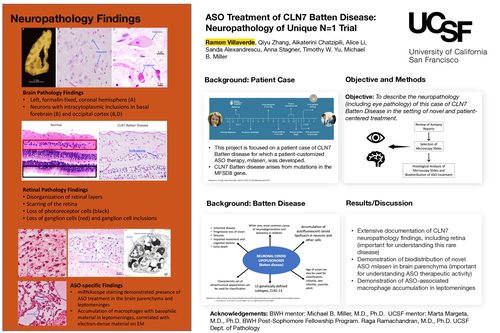
The goal of this project is to both further characterize and describe the neuropathology, including ocular pathology, of the CLN7 form of Batten disease in the setting of this unique case of treatment with a novel ASO therapy and to study the distribution of this therapy in tissues through microscopic analysis.
Methods
For this study, we examined hematoxylin and eosin (H&E) stains of cerebral, ocular, and other tissues pertaining to this patient case of CLN7 Batten disease were utilized. To visualize the intracellular inclusions typical of the disease, we also utilized PAS-carbohydrate staining. We performed nucleic-acid-hybridization-based RNAscope localization to analyze the biodistribution of the investigational drug across a variety of different tissues. This project included microscopic analysis by neuropathologists both at Brigham and Women’s Hospital and Massachusetts Eye and Ear. Findings were compiled and documented.
Results and Conclusions
Upon our macroscopic examination of the brain, we observed diffuse cerebral atrophy. We also saw widespread intracytoplasmic inclusions throughout the brain in H&E stains. Microscopic exam of the eye showed extensive atrophy and scarring of the outer retina. We noticed essentially complete absence of the retina’s cone and rod outer segments which are necessary for vision. When we analyzed RNA-based localization of the therapeutic agent milasen, we observed strong localization in the cytoplasm and nuclei of neurons throughout the prefrontal cortex of the brain. The meninges also showed strong localization of the drug within macrophages. Organs outside of the nervous system, such as the liver, kidney, and colon, also demonstrated presence of milasen. Taken together, these results allow us to begin to characterize the microscopic changes associated with this rare subtype of the most common cause of neurodegeneration in the pediatric setting.