127 posters, 10 topics, 20 sessions, 127 authors
ePostersLive by SciGen Technologies S.A. All rights reserved.
UCSF 2024 Inquiry Symposium
Conference ePosters

P093
BP Activate: A Blood Pressure Technology Pilot Using a Computerized Algorithm to Better Address Blood Pressure Management
Poster Presenter
Authors
Part of Topic
Epidemiology & Population Sciences
Deep Explore Abstract
Title:
BP Activate: A Blood Pressure Technology Pilot Using a Computerized Algorithm to Better Address Blood Pressure Management
Introduction:
Hypertension (HTN) currently impacts over half of the US adult population. Despite many effective options for blood pressure management, control of blood pressure remains a challenge, as only 44% of US hypertensive adults are currently controlled to < 140/90 mmHg. There are two main issues with current HTN management: 1) healthcare providers do not have the time or tools to gather all the relevant information to make individualized treatment recommendations for their patients and 2) patients dismiss their high BP readings and/or resist treatment. We aim to show that providing patients with a summary of their blood pressure readings along with specific medication adjustment recommendations from a computerized algorithm, in the form of a “BP Activate Letter”, may help activate patients to talk with their provider about their BP and make BP medication changes. This work will also inform larger comparative effectiveness trials that can help shape current hypertension management practice with the digital tools/capabilities we have today.
Hypothesis:
Patients with hypertension who receive a BP Activate letter with personalized medication recommendations versus No Letter, or versus a “Control Letter” with a simple generic recommendation to discuss their blood pressure with their primary care provider, will be more likely to achieve a BP goal of <140/90 or have a medication change during the study period.
Aims:
This study aims to assess the effectiveness of the BP Activate letter and a Control letter, compared with no intervention, on the primary outcome of achieving BP goal or having a medication change. In addition, the study aims to assess secondary outcomes such as scheduling an appointment, completing a visit, making a medication change, and achieving BP goal. Furthermore, it aims to assess interaction effects of patient characteristics on the primary outcome.
Project Design/Methods:
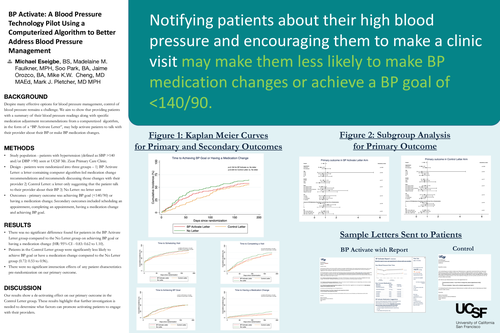
We designed a randomized quality improvement study in which UCSF Mt. Zion Primary Care Clinic patients with hypertension and currently uncontrolled BP (defined as SBP >140 or DBP >90 at their last visit) were randomized to one of three groups: 1) BP Activate Letter: patients were mailed a letter containing computer algorithm- determined medication change recommendations based on the patient’s medical records, and recommendations to discuss those changes with their provider; or 2) Control Letter: patients were mailed a letter suggesting that the patient talk to their provider about their BP without providing any specific medication recommendations; or 3) No Letter: no intervention was delivered. Patients were followed for 6 months after randomization. Outcomes were analyzed using time-to-event methods, including Kaplan-Meier plots, and Cox proportional hazard regression to assess for interaction effects. Randomization was stratified by having a scheduled appointment prior to study enrollment or not.
Results:
Of 591 patients identified via EHR data, 484 patients were found to be eligible and approved by their primary care provider and were randomized into the three study groups (BP Activate Letter n = 160, Control Letter n = 160, No Letter n = 164). There was no statistically significant difference found for patients having a medication change or achieve BP goal in the BP Activate group compared to the No Letter group (HR: 95% CI - 0.83: 0.62 to 1.10).
Patients in the Control group however were significantly less likely to have a medication change or achieve BP goal compared to the No Letter group (0.72: 0.53 to 0.96). There were no significant interaction effects of any patient characteristics pre-randomization on our primary outcome.
Discussion:
Our results did not support our hypothesis that patients receiving the BP Activate Letter would be more likely to achieve our primary outcomes. More specifically, we saw a de-activating effect on some of our primary outcomes for our Control Letter group, as these patients were less likely to have a medication change or achieve BP goal compared to the No Letter group. Major limitations of our study include inability to confirm if patients read/received the BP Activate or Control letters and relying on clinic measurements of BP to determine achieving BP goal. These results highlight that further investigation is needed to determine what factors can promote activating patients to engage with their providers.