127 posters, 10 topics, 20 sessions, 127 authors
ePostersLive by SciGen Technologies S.A. All rights reserved.
UCSF 2024 Inquiry Symposium
Conference ePosters

P025
Long-term cognitive decline after total joint arthroplasty: a population-based approach
Poster Presenter
Authors
Part of Topic
Epidemiology & Population Sciences
Long-term cognitive decline after total joint arthroplasty: a population-based approach Angelina Tang, L. Grisell Diaz-Ramirez, John Boscardin, Alex Smith, Maria Glymour, Elizabeth Whitlock
Introduction: Thirty-one percent of older adults undergoing elective total joint arthroplasty (TJA) meet criteria for postoperative neurocognitive disorder at twelve months after surgery. (1) As older adults continue to be among the highest utilizers of TJA (2), it is important that we improve our understanding of the association between TJA and cognition. However, there is little data demonstrating whether TJA cause a change in cognitive trajectory pre- and post-procedure.
Aims: Because TJA results in pain relief and improved mobility and sleep, which may be cognitively beneficial, the average long-term cognitive outcome from TJA is important to measure. This information may be helpful when counseling patients on the long-term risks and benefits of the procedure.
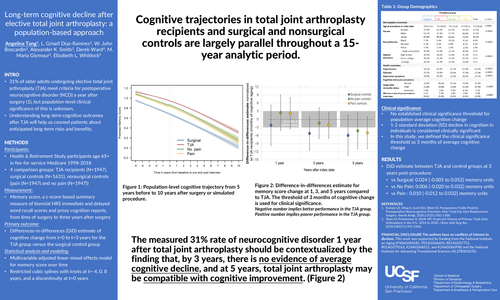
Methods: We linked Health and Retirement Study (HRS) data to Medicare claims and identified adults who underwent elective TJA between 1998 and 2018 at age 65 or older. Surgical controls were adults 65 or older who underwent elective surgery not expected to result in functional benefits (e.g., cholecystectomy; hysterectomy). TJA recipients were also compared to age- and sex-matched older adults who either did, or did not, report pain at the pre-procedure HRS interview (“pain” and “no pain” controls). Exclusion criteria for the TJA group and surgical controls included TJA that was prompted by a fracture and surgeries that were indicated for cancer, respectively. The primary outcome was differences-in-differences (DiD) estimate of cognitive change measured by the memory score, a z-score summary measure of biennial HRS cognitive test scores and proxy cognition reports, from the time of surgery to three years after surgery in the TJA versus the surgical control group, using a linear mixed effects model adjusted for health and demographic factors flexibly modeled with restricted cubic splines (knots at -4, 0, 8 years; discontinuity at surgery) and including survey weights.
Results: There were 1,947 TJA recipients (average age 74; 63% female, 11% of a race/ethnicity other than white) and 1,631 surgical controls (average age 76, 38% female, 15% nonwhite). TJA recipients’ average memory score declined by 0.16 [0.14-0.18] units from the time of surgery to 3 years postoperatively. The surgical control group declined by 0.024 [-0.005 to 0.052] memory units more than the TJA recipients. Controls with and without pain were statistically indistinguishable. (DiD in controls with pain: 0.010 [-0.012 to 0.032] memory units & DiD in controls without pain: 0.006 [-0.012 to 0.032] memory units). (Figure)
Conclusion: There is no evidence of average cognitive decline in the three years after TJA in older adults. Average long-term outcomes after TJA do not differ significantly from surgical and nonsurgical matched controls.

References:
1) Evered, Lisbeth BSc, MBiostat*; Scott, David A. MB, BS, PhD, FANZCA*; Silbert, Brendan MB, BS, FANZCA*; Maruff, Paul PhD†. Postoperative Cognitive Dysfunction Is Independent of Type of Surgery and Anesthetic. Anesthesia & Analgesia: May 2011 - Volume 112 - Issue 5 - p 1179-1185. doi: 10.1213/ANE.0b013e318215217e
2) Sloan, Matthew MD, MS1,a; Premkumar, Ajay MD, MPH2; Sheth, Neil P. MD3. Projected Volume of Primary Total Joint Arthroplasty in the U.S., 2014 to 2030. The Journal of Bone and Joint Surgery: September 5, 2018 - Volume 100 - Issue 17 - p 1455-1460. doi: 10.2106/JBJS.17.01617