127 posters, 10 topics, 20 sessions, 127 authors
ePostersLive by SciGen Technologies S.A. All rights reserved.
UCSF 2024 Inquiry Symposium
Conference ePosters

P022
Sex differences in electrolyte abnormalities indicating refeeding syndrome risk among hospitalized adolescents and young adults with eating disorders
Poster Presenter
Authors
Part of Topic
Epidemiology & Population Sciences
Title:
Sex differences in electrolyte abnormalities indicating refeeding syndrome risk among hospitalized adolescents and young adults with eating disorders.
Introduction:
Refeeding syndrome is the gravest possible medical complication in malnourished patients undergoing refeeding in the hospital. We previously reported that males with malnutrition secondary to eating
disorders required more calories and had longer hospital stays than females; however, sex differences in electrolyte abnormalities indicating refeeding syndrome risk remain unknown.
Hypothesis or Question:
Our research question revolves around elucidating the differences in electrolyte abnormalities indicating refeeding syndrome risk among male and female adolescents and young adults with eating disorders hospitalized for medical instability.
Aims:
The objective of this study was to determine the prevalence of refeeding hypophosphatemia, hypokalemia, and hypomagnesemia among a sample of male and female adolescents and young adults hospitalized for eating disorders and to compare sex differences in electrolyte abnormalities indicating refeeding syndrome risk.
Project Design/Methods:
We retrospectively reviewed the electronic medical records of 558 patients aged 9-25 years admitted to the University of California, San Francisco Eating Disorders Program for medical instability between May 2012 and August 2020. Serum was drawn per standard of care between 5-7 am each morning and
electrolyte abnormalities indicating refeeding syndrome risk were defined as: hypophosphatemia (<3.0 mg/dL), hypokalemia (<3.5 mEq/L), and hypomagnesemia (<1.8 mg/dL). Logistic regression was used to assess factors associated with electrolyte abnormalities indicating refeeding syndrome risk.
Results/Product:
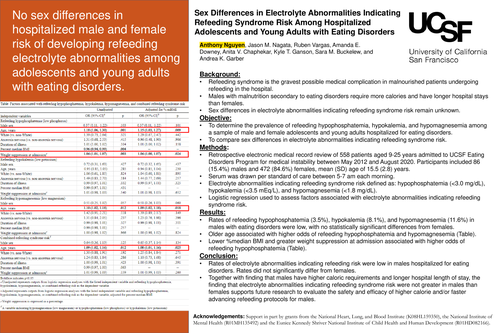
Participants included 86 (15.4%) males and 472 (84.6%) females, mean (SD) age 15.5 (2.8) years. Rates of refeeding hypophosphatemia (3.5%), hypokalemia (8.1%), and hypomagnesemia (11.6%) in males hospitalized with eating disorders were low, with no statistically significant differences from females.
Older age was associated with higher odds of refeeding hypophosphatemia and hypomagnesemia. Lower percent median body mass index and greater weight suppression at admission were associated with higher odds of refeeding hypophosphatemia.
Discussion/Conclusion:
Rates of electrolyte abnormalities indicating refeeding syndrome risk were low in males hospitalized for eating disorders and rates did not significantly differ from females. Together with our finding that males have higher caloric requirements and longer hospital length of stay, the finding that electrolyte
abnormalities indicating refeeding syndrome risk were not greater in males than females supports future research to evaluate the safety and efficacy of higher calorie and/or faster advancing refeeding protocols for males.