127 posters, 10 topics, 20 sessions, 127 authors
ePostersLive by SciGen Technologies S.A. All rights reserved.
UCSF 2024 Inquiry Symposium
Conference ePosters

P001
Cyberbullying and Eating Disorder Symptoms in U.S. Early Adolescents
Poster Presenter
Authors
Part of Topic
Epidemiology & Population Sciences
Deep Explore Abstract - Spring 2024
Title: Cyberbullying and Eating Disorder Symptoms in U.S. Early Adolescents
Introduction:
Cyberbullying is a serious public health issue due to its increasing prevalence among adolescents and its impact on adolescent mental health, including disordered eating behaviors. In early adolescence, screen time usage increases at the greatest rate and cyberbullying is most prevalent. Eating disorders also often onset in adolescence.
However, a majority of the current literature on cyberbullying and eating behaviors focuses on older adolescents and young adults, rather than early adolescents. Few studies have used large, diverse samples examining the association between cyberbullying and eating disorders in early adolescents using the Diagnostic and Statistical Manual, 5th Edition (DSM-5) criteria, and no studies have investigated the link between cyberbullying perpetration and eating disorder symptoms.
Hypothesis: We hypothesized that cyberbullying (victimization and perpetration) would be associated with eating disorder symptoms in early adolescents.
Aims: The objective of this study was to examine the associations between cyberbullying (victimization and perpetration) and eating disorder symptoms in a large, national cohort of 10-14-year-old early adolescents in the United States (US).
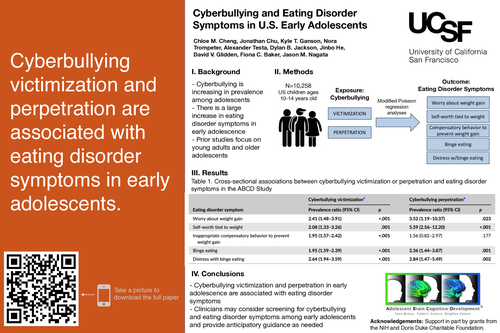
Project Design: We analyzed cross-sectional data from the 2-year follow-up of the Adolescent Brain Cognitive Development (ABCD) Study, a longitudinal study of brain development and health in children recruited from 21 sites around the US. Adolescents completed a self-reported questionnaire to capture lifetime cyberbullying (victimization and perpetration) using a modified version of the validated Cyberbullying Scale. The Kiddie Schedule for Affective Disorders and Schizophrenia (KSADS-5), a computerized tool for categorizing child and adolescent mental health concerns based on the DSM-5, was used for assessment of eating disorder symptoms. Modified Poisson regression analyses were used to determine the association between cyberbullying (victimization and perpetration) and self-reported eating disorder symptoms (worry about weight gain, self- worth tied to weight, inappropriate compensatory behavior to prevent weight gain, binge eating, and distress with binge eating), adjusting for sex, race/ethnicity, household income, years of parent education, and ABCD study site.
Results: In the sample (N=10,258, 49% female, 46% racial/ethnic minority), 9.5% of adolescents reported lifetime cyberbullying victimization and 1.1% reported lifetime cyberbullying perpetration. Cyberbullying victimization was associated with worry about weight gain (prevalence ratio [PR] 2.41, 95% confidence interval [CI] 1.48–3.91), self-worth tied to weight (PR 2.08, 95% CI 1.33–3.26), inappropriate compensatory behavior to prevent weight gain (PR 1.95, 95% CI 1.57–2.42), binge eating (PR 1.95, 95% CI 1.59–2.39), and distress with binge eating (PR 2.64, 95% CI 1.94–3.59). Cyberbullying perpetration was associated with worry about weight gain (PR 3.52, 95% CI 1.19–10.37), self-worth tied to weight (PR 5.59, 95% CI 2.56–12.20), binge eating (PR 2.36, 95% CI 1.44–3.87), and distress with binge eating (PR 2.84, 95% CI 1.47–5.49).
Discussion: Cyberbullying victimization and perpetration in early adolescence are associated with eating disorder symptoms.
The findings of this study have significant implications for public policy, public health, and clinical practice. In particular, our study supports the use of strategies to teach early adolescents methods to navigate negative appearance-related online comments. In addition, digital literacy curricula could provide anticipatory guidance about cyberbullying and disordered eating among early adolescents. Pediatricians can also consider inquiring about cyberbullying and eating disorder symptoms among early adolescents and provide anticipatory guidance as needed.
These results should be interpreted in light of this study’s limitations. Due to the cross-sectional nature of the data analysis, we cannot establish causality. In addition, participants who identified as more than one race/ethnicity were categorized as only one race/ethnicity during analysis (e.g., Hispanic/Latino only), which may not capture the nuances of their multiracial identities. The measures utilized in this study were based on self-report and may be subject to reporting, social desirability, and recall bias. Furthermore, although the ABCD assessment of cyberbullying is based on and similar to the validated Cyberbullying Scale, it has not yet been validated for itself.
Future studies should continue to examine the relationship between cyberbullying and eating disorder symptoms as the ABCD cohort ages to mid and late adolescence, when the diagnosis of eating disorders increases in prevalence. Studies evaluating the prospective association between cyberbullying and eating disorder symptoms, as well as the association between cyberbullying and specific eating disorders (e.g., anorexia nervosa, bulimia nervosa, and binge eating disorder) represent other possible areas for future research. Further research is also needed to understand the mechanisms that underpin the findings from this study.