127 posters, 10 topics, 20 sessions, 127 authors
ePostersLive by SciGen Technologies S.A. All rights reserved.
UCSF 2024 Inquiry Symposium
Conference ePosters

P030
Changes in PrEP Awareness and PrEP Use Among Trans Women in San Francisco: Comparing the PrEP Cascade Between 2019-2020 and 2023-2024
Poster Presenter
Authors
Part of Topic
Epidemiology & Population Sciences
Changes in PrEP Awareness and PrEP Use Among Trans Women in San Francisco: Comparing the PrEP Cascade Between 2019-2020 and 2023-2024
Norman Archer¹, Erikka Palafox², Chelsea O’Neal², Raul Ruiz², Bow Suprasert², Moranda Tate², Glenda Baguso², Willi McFarland², and Erin Wilson²
¹ UCSF School of Medicine
² San Francisco Department of Public Health
Introduction: Improving the access and utilization of pre-exposure prophylaxis (PrEP) is a critical strategy for reducing HIV infection in transgender women (trans women) and ending the HIV epidemic. Although there has been an increase in awareness of PrEP among trans women in San Francisco in the past decade, PrEP use remains low. Our objective was to compare the PrEP cascade in San Francisco in 2019-2020 and 2023- 2024.
Methods: We analyzed data from the 2019-2020 and 2023-2024 cohorts of the
National HIV Behavioral Surveillance Study in San Francisco. Trans women were recruited via respondent-driven sampling. Key indicators of the PrEP cascade were
evaluated, including awareness, provider discussions, and recent use. Sample characteristics were also collected and analyzed.
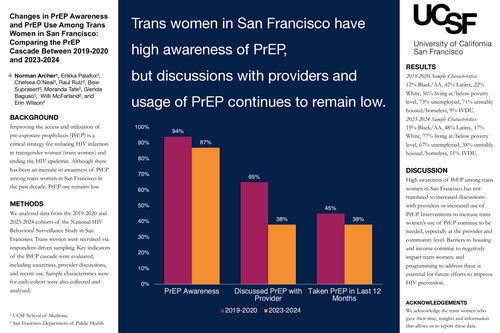
Results: Awareness of PrEP among trans women in San Francisco decreased from 2019-2020 (94.0%) to 2023-2024 (87%). Discussion of PrEP with a healthcare provider decreased significantly from 65% (2019-2020) to 38% (2023-2024). Use of PrEP in the past 12 months decreased from 45% (2019-2020) to 38% (2023-2024). 2019-2020 Sample Characteristics: 12% Black/AA, 42% Latinx, 22% White, 56% living at/below poverty level, 73% unemployed, 71% unstably housed/homeless, 9% IVDU. 2023-2024 Sample Characteristics: 19% Black/AA, 48% Latinx, 17% White, 77% living at/below poverty level, 67% unemployed, 38% unstably housed/homeless, 11% IVDU.
Conclusions: High awareness of PrEP among trans women in San Francisco has not translated to increased discussions with providers or increased use of PrEP. Interventions to increase trans women’s use of PrEP continue to be needed, especially at the provider and community level. Barriers to housing and income continue to negatively impact trans women, and programming to address these is essential for future efforts to improve HIV prevention.