127 posters, 10 topics, 20 sessions, 127 authors
ePostersLive by SciGen Technologies S.A. All rights reserved.
UCSF 2024 Inquiry Symposium
Conference ePosters

P091
Retrospective Analysis of Adult-Onset Vascular Malformations at a Multidisciplinary Vascular Anomalies Center
Poster Presenter
Authors
Part of Topic
Clinical & Translational Sciences
Purpose
Vascular anomalies (VascAnom) most often present during childhood but adult presentation without any previous signs or symptoms is not rare. Most vascular malformations are due to somatic mutations in oncogenes. Whether adult-onset vascular malformations are actually congenital with tardive onset is not known. We aimed to better characterize features of adults presenting to our VascAnom center and consider pathogenetic implications.
Methods
Retrospective chart review of all adult patients presenting to our multidisciplinary VascAnom center between 2018 and 2023. Diagnosis (with clinical radiologic or histopathologic correlation), relevant past medical history including family history and recalled history of trauma were recorded.
Results
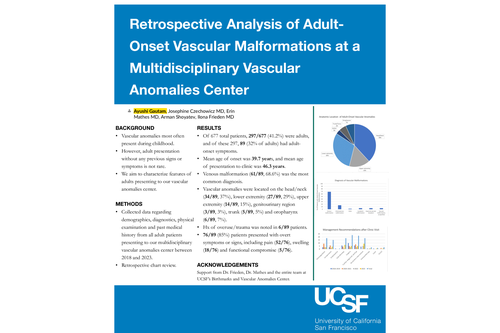
Of 677 total patients seen, 279/677 were adults and of these 279, 89 had adult-onset vascular signs or symptoms. Patients were excluded if diagnosis was uncertain or not a VascAnom or if onset was prior to age 18 years.
Venous malformation (61/89; 68.6%) was the most common diagnosis including 2 patients with late-onset multifocal venous malformations. Also observed were arteriovenous malformations (14/89; 15.7%), fibro-adipose vascular anomalies (FAVA) (2/89, 2.2%) and acquired vascular neoplasms (4/89, 4.5%). 4 patients had lymphatic malformations, one possibly iatrogenic due to cardiac surgery.
The mean age of onset was 39.7 years with a mean age of presentation of 46.3 years. VascAnom were located on the head and neck (34/89, 37%) upper extremity (14/89, 15%), lower extremity (27/89, 29%), genitourinary region (3/89, 3%), oropharynx (6/89, 7%) and torso (5/89, 5%).
History of overuse or trauma was notable in 6 patients. 76/89 (85%) patients presented with signs or symptoms, including pain (52/76, 68.4%), swelling (18/76, 20%) and functional compromise (5/76, 6.6%). 62/89 (70%) patients presented with visible changes on the skin.
Management recommendations following patients’ visit to the multidisciplinary clinic ranged from anticoagulation (18/89, 20%), compression (15/89, 17%), sclerotherapy (18/89, 20%), surgery (23/89, 26%), further diagnostic workup (22/89, 25%), immunotherapy (3/89, 3.4%), laser (2/89, 2.2%), embolization (1/89, 1%) and PT/OT (3/89, 3.4). 18/89 (20%) patients were recommended to pursue no further diagnostic workup or intervention.
Conclusion Adult-onset VascAnom patients can provide additional clues to pathogenesis and natural history. Genomic studies are needed to further help in understanding whether most are congenital with tardive onset or represent de novo conditions, possibly triggered during adulthood.