127 posters, 10 topics, 20 sessions, 127 authors
ePostersLive by SciGen Technologies S.A. All rights reserved.
UCSF 2024 Inquiry Symposium
Conference ePosters

P090
Exploring measures of age-associated skin barrier decline
Poster Presenter
Authors
Part of Topic
Clinical & Translational Sciences
Title: Exploring measures of age-associated skin barrier decline
Authors: Richard W. Kim BS1; Emma Doan BA2, Theodora Mauro, MD2, Katrina Abuabara MD2,3
- University of California San Francisco School of Medicine, San Francisco, CA, USA.
- Department of Dermatology, University of California San Francisco, San Francisco, CA, USA.
- Division of Epidemiology and Biostatistics, University of California, Berkeley School of Public Health, Berkeley, CA, USA.
Introduction: Though there are many measures of skin barrier function, existing literature demonstrates high variability of these measures when evaluating age associated skin barrier decline.1 For example, transepidermal water loss (TEWL), the quantity of water lost from inside the body by diffusion across the stratum corneum, is used as a key standard of skin barrier function.2 However, multiple studies have demonstrated a paradoxical improvement (decrease) or no change in TEWL in older skin.3 Other measures of the skin barrier, such as stratum corneum hydration (SCH) and pH, similarly have unreliable results in predicting age associated skin barrier decline. Given that age-associated skin barrier decline could be an important contributor to systemic inflammation and associated disease processes, we sought to conduct a small, pilot study to validate reliable skin barrier measures in aging skin.4
Hypothesis: We hypothesize that current measures of skin barrier function are not reliable in capturing age associated skin barrier decline.
Aims: Determine appropriate skin barrier measures that can distinguish between younger and older skin.
Project Design: In this cross-sectional observational study, we recruited 2 groups (older patients aged ≥ 65 years and younger patients aged 20-40 years) of healthy participants with no prior history of inflammatory skin disease or recent history (within 4 weeks) of immunomodulating therapies. Skin barrier measures including skin pH, SCH, and TEWL were measured on two bodily sites – the distal anterior wrist and superior buttocks. Skin pH, SCH, baseline TEWL, and area under the curve (AUC) when plotting TEWL measures after medical grade tape strippings were averaged for each age group. Two-sample t-tests were utilized to compare means of different skin barrier measures between the 2 groups.
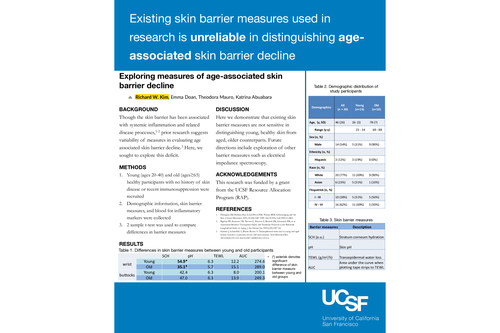
Results: A total of 26 patients were recruited – 16 younger (mean age 26±3) and 10 older (mean age 78±7). 12 (46%) of patients were female, and 20 (77%) identified as white. Skin pH, TEWL, and AUC did not demonstrate significant differences between younger and older participants. Though SCH did not differ for the 2 groups on the superior buttocks, there was significant difference noted for SCH on the distal anterior wrist between younger and older groups (54.9 vs 35.1, p=0.02)
Discussion: Our results demonstrate that existing skin barrier measures are not sensitive in distinguishing young, healthy skin from aged, older counterparts. Future directions of the study
include comparison of novel skin barrier measures such as electrical impedance spectroscopy to traditional ones. Furthermore, we plan to analyze which inflammatory markers are upregulated in the setting of age-associated skin barrier decline.
References
- Luebberding S, Krueger N, Kerscher M. Age-related changes in skin barrier function - quantitative evaluation of 150 female subjects. Int J Cosmet Sci. 2013;35(2):183-190. doi:10.1111/ics.12024
- Roskos KV, Guy RH. Assessment of skin barrier function using transepidermal water loss: effect of age. Pharm Res. 1989;6(11):949-953. doi:10.1023/a:1015941412620
- Hahnel E, Blume-Peytavi U, Trojahn C, Kottner J. Associations between skin barrier characteristics, skin conditions and health of aged nursing home residents: a multi-center prevalence and correlational study. BMC Geriatr. 2017;17:263. doi:10.1186/s12877-017- 0655-5
- Pilkington SM, Bulfone-Paus S, Griffiths CEM, Watson REB. Inflammaging and the Skin. J Invest Dermatol. 2021;141(4S):1087-1095. doi:10.1016/j.jid.2020.11.006