127 posters, 10 topics, 20 sessions, 127 authors
ePostersLive by SciGen Technologies S.A. All rights reserved.
UCSF 2024 Inquiry Symposium
Conference ePosters

P008
Collaborations in Global Radiology: How to Build Equitable Partnerships with Low-and Middle-income Countries
Poster Presenter
Authors
Part of Topic
Social & Behavioral Sciences
TITLE:
Global Radiology: Building Equitable and Sustainable Partnerships with Low- and Middle-Income Countries by Addressing Colonial Legacies
6INTRODUCTION:
While radiologic imaging is ubiquitous throughout medical care in high-income countries (HICs), there are critical shortages of radiological equipment and trained workforce in low and middle-income countries (LMICs). Global Radiology partnerships can be leveraged to help address these shortages. Over the past decade, there have been major global health eMorts to implement and scale-up radiology workforce and technology in LMICs. Radiology’s growing presence in global health is happening concurrently with calls to decolonize global health--a movement that seeks to address the legacy of colonization in global health initiatives in order to reduce health inequities and build sustainable global health partnerships. This conversation is largely absent in the radiologic literature, so the goal of this project is to explain the Decolonize Global Health (DGH) movement and identify what radiology can learn from it to foster equitable and sustainable global radiology partnerships.
QUESTION:
As radiology expands its global health presence, what can the specialty learn from the DGH discourse to build sustainable global health partnerships?
AIMS:
• Discuss the global shortage of radiology and the importance of global radiology engagement
• Outline the Decolonizing Global Health (DGH) movement
● Origins of global health, decolonization, and the DGH movement
● Goals of the DGH movement
● Challenges of the DGH movement
● Explain how colonial legacies persist in current global health practice and how to address them
● Identify examples of successful equitable HIC-LMIC partnerships in radiology
PROJECT DESIGN/METHODS:
PubMed and Google scholar were queried for articles or books about decolonization in global health.163 articles on PubMed were then screened for relatedness to the subject, length (abstracts and short letters were excluded) and free full text availability which yielded 40 articles. In addition to journal articles, three seminal books on decolonization were identified and included. The texts were then read and the findings were synthesized into a review article.
RESULTS/PRODUCT:
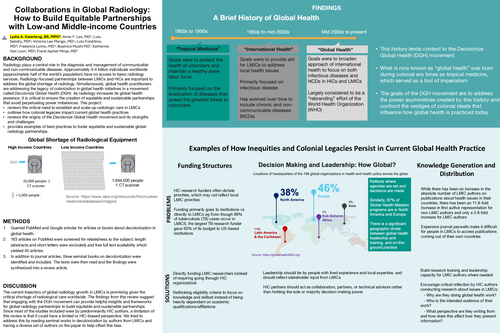
Overall, it was discovered that the colonial origins of global health still impact its current day practice. The DGH movement highlights 3 major domains where these colonial origins impact current global health practice: decision making and leadership, knowledge generation and circulation, and funding practices. In decision making and leadership, for example, literature shows that 87% of Global Health Masters programs are in North America and Europe. Similarly, the headquarters of most global health organizations are located in HICs and are mostly run by people from HICs. This reflects a significant geographic divide between global health leadership and on-the-ground practice.
Some examples of ways to address these colonial legacies include increasing geographic proximity between organization headquarters and where they work, restructuring funding practices to reflect local priorities, and ensuring that LMIC researchers lead and determine priorities of research that is performed within their own countries. Local experts within LMICs hold a wealth of knowledge and can provide vital information on how to best implement accessible imaging modalities and advance the field of radiology.
This project also highlighted examples of global radiology partnerships that embody the values of decolonization were highlighted. The findings from this review were summarized into a PowerPoint and was accepted as an educational exhibit at the Radiological Society of North America (RSNA) 2023 annual conference. In addition, the findings were written up into a manuscript that is currently undergoing final revisions by co-authors. The review paper will be submitted to various journals for possible publication.
DISCUSSION/CONCLUSION:
The current trajectory of global radiology growth in LMICs is promising given the critical shortage of radiological care worldwide. The findings from this review suggest that engaging with the DGH movement can provide helpful insights and frameworks for global radiology partnerships to build equitable and sustainable partnerships. Since most of the studies included were by predominantly HIC authors, a limitation of this review is that it could have a limited or HIC-biased perspective. We tried to address this by reading seminal works in decolonization by authors from LMICs and having a diverse set of authors on the paper to help oMset this bias.