127 posters, 10 topics, 20 sessions, 127 authors
ePostersLive by SciGen Technologies S.A. All rights reserved.
UCSF 2024 Inquiry Symposium
Conference ePosters

P011
Food Insecurity Among Patients with Cancer: Overview and Implications
Poster Presenter
Authors
Part of Topic
Social & Behavioral Sciences
Introduction: Food insecurity is defined as a household-level economic and social condition of limited or uncertain access to adequate food (1). Food insecurity is prevalent among cancer patients; it is estimated that 17% to 23% of cancer patients experience food insecurity (2,3), with even higher rates (56%) among underserved populations (4). Food insecurity among cancer patients has been linked to negative clinical outcomes, such as reduced treatment adherence and worse quality of life (5,6). The topic of food insecurity among cancer patients is gaining more attention in recent years (6,7), although food insecurity remains an underrecognized issue, requiring solutions to address it.
Hypothesis: N/A
Aims: We aimed to characterize the impact of food insecurity on cancer-related outcomes, identify barriers to food security among cancer patients, and summarize interventions that have specifically been designed to alleviate food insecurity among cancer patients.
Project Design/Methods: We performed a review of the literature with a focus on the following topics: the prevalence of food insecurity among cancer patients; the impact of food insecurity on cancer-related outcomes; the barriers to food security experienced by patients with cancer; and the interventions that have been implemented to address food insecurity in healthcare settings.
We subsequently created unique conceptual frameworks to summarize the barriers to food security among cancer patients and to summarize suggested solutions to these barriers. Finally, we summarized these findings in a commentary, which provides a call to action to alleviate food insecurity for cancer patients through further research studies on the topic and innovations in health policy and health care. Knowledge gained from this review of literature will be used in the design and implementation of our ongoing pilot study to address food insecurity among cancer survivors living with persistent poverty.
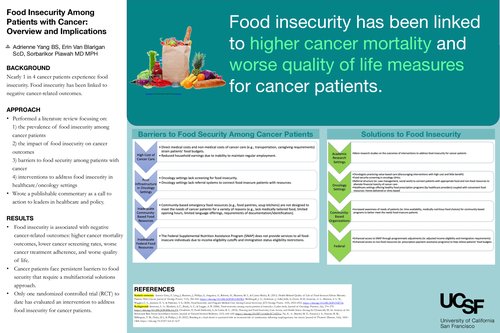
Results: Food insecurity is associated with negative cancer-related outcomes. Several studies throughout the past two decades support the relationship between food insecurity and higher cancer mortality outcomes, lower cancer screening rates, worse cancer treatment adherence, and worse quality of life. In addition, patients with cancer face numerous barriers to food security.
First, cancer care is expensive, limiting patients’ funds for food. A second barrier is the lack of screening and effective referrals to food resources in oncologic settings. A third barrier is that most community-based emergency food resources, such as food banks or soup kitchens, cannot meet the unique needs of cancer patients for the following reasons: lacking medically tailored or palatable food, limited opening hours that conflict with patients’ clinic appointments, inadequate language offerings, and eligibility criteria requiring documentation/identification, which may discourage undocumented immigrants. A final barrier is that federal food assistance programs, such as the Supplemental Nutrition Assistance Program (SNAP), cannot always meet the needs of food-insecure individuals with cancer due to barriers such income eligibility cutoffs, lack of knowledge of income eligibility cutoffs, immigration status requirements, and administrative delays. Interventions to address food insecurity have been implemented in a variety of healthcare settings, although few have specifically been designed to address food insecurity among cancer patients. Only one randomized controlled trial has evaluated an intervention to address food insecurity for cancer patients.
Discussion: Food security remains an underrecognized, yet essential component of cancer care that influences cancer-related outcomes. Only one study to date has formally evaluated the impact of a food insecurity intervention for cancer patients on cancer-related outcomes. Patients with cancer continue to face barriers to food security that must be addressed. A multifactorial approach to solutions is needed, including changes at the level of academic research settings, oncology settings, community-based emergency food resources, and federal resources. Solutions such as these can decrease rates of food insecurity among individuals diagnosed with cancer, helping to reduce socioeconomic disparities in cancer outcomes.
References:
- Definitions of Food Security. (2023, October). USDA Economic Research Service. https://www.ers.usda.gov/topics/food-nutrition-assistance/food-security-in-the-u- s/definitions-of-food-security/#ranges
- Simmons, L. A., Modesitt, S. C., Brody, A. C., & Leggin, A. B. (2006). Food insecurity among cancer patients in kentucky: A pilot study. Journal of Oncology Practice, 2(6), 274–279. https://doi.org/10.1200/JOP.2006.2.6.274
- Charkhchi, P., Fazeli Dehkordy, S., & Carlos, R. C. (2018). Housing and Food Insecurity, Care Access, and Health Status Among the Chronically Ill: An Analysis of the Behavioral Risk Factor Surveillance System. Journal of General Internal Medicine, 33(5), 644–650. https://doi.org/10.1007/s11606-017-4255-z
- Gany, F., Lee, T., Ramirez, J., Massie, D., Moran, A., Crist, M., McNish, T., Winkel, G., & Leng, J. C. (2014). Do our patients have enough to eat?: Food insecurity among urban low-income cancer patients. Journal of Health Care for the Poor and Underserved, 25(3), 1153–1168. https://doi.org/10.1353/hpu.2014.0145
- McDougall, J. A., Anderson, J., Adler Jaffe, S., Guest, D. D., Sussman, A. L., Meisner,
A. L. W., Wiggins, C. L., Jimenez, E. Y., & Pankratz, V. S. (2020). Food Insecurity and Forgone Medical Care Among Cancer Survivors. JCO Oncology Practice, 16(9), e922– e932. https://doi.org/10.1200/JOP.19.00736
- Raber, M., Jackson, A., Basen-Engquist, K., Bradley, C., Chambers, S., Gany, F. M., Halbert, C. H., Lindau, S. T., Pérez-Escamilla, R., & Seligman, H. (2022). Food Insecurity Among People With Cancer: Nutritional Needs as an Essential Component of Care. JNCI Journal of the National Cancer Institute, 114(12), 1577–1583. https://doi.org/10.1093/jnci/djac135
- Patel, K.G., Borno, H.T. and Seligman, H.K. (2019). Food insecurity screening: A missing piece in cancer management. https://doi.org/10.1002/cncr.32291