127 posters, 10 topics, 20 sessions, 127 authors
ePostersLive by SciGen Technologies S.A. All rights reserved.
UCSF 2024 Inquiry Symposium
Conference ePosters

P007
Understanding the relationship between experiences with healthcare discrimination and emergency healthcare delay among intersex adults
Poster Presenter
Authors
Part of Topic
Social & Behavioral Sciences
Understanding the relationship between experiences with healthcare discrimination and emergency healthcare delay among intersex adults
Jeremy C. Wang, Hemal Kanzaria, Katharine B. Dalke, Rahul Nachnani, Jason D. Flatt
Objectives
Intersex people, also referred to as people with Differences in Sexual Development, are individuals who were born with gonadal, chromosomal, and/or anatomic traits that fall outside of traditional conceptions of the sex binary. Qualitative studies among intersex individuals have revealed that some intersex
individuals delay seeking healthcare when needed due to past experiences with discrimination in healthcare settings. The relationships between healthcare discrimination and emergency healthcare utilization patterns have not been studied quantitatively among intersex populations. The goal of this study was to examine the association between experiences with healthcare discrimination and emergency healthcare delay among intersex adults.
Methods
We recruited a non-probability sample of intersex adults (n=178) living in the United States through in-person outreach at the Androgen Insensitivity Syndrome-Differences of Sex Development Support Group conference in Chicago, Illinois, social media advertising, and targeted outreach to members of online intersex support groups. Inclusion criteria included being 18 years of age and older, diagnosis of an intersex variation, and currently residing in the United States. From July-September 2018, participants completed an online survey asking about demographic information (age, race, gender identity, income), ever having been denied or given lower quality medical care, ever having been denied or given lower quality mental healthcare, and ever having delayed emergency healthcare. We utilized multivariable logistic regressions, adjusting for race, gender, age, and income to examine the associations between experiences with healthcare discrimination and delaying emergency healthcare.
Results/Findings
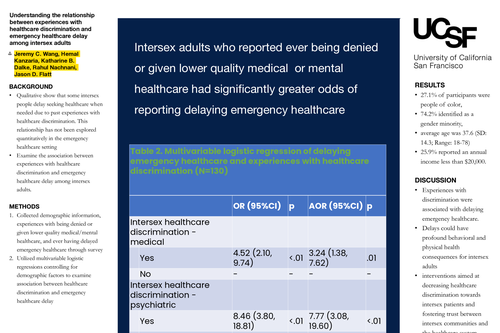
Of all participants, 27.1% were people of color, 74.2% identified as a gender minority, average age was 37.6 (SD: 14.3; Range: 18-78), and 25.9% reported an annual income less than $20,000. Intersex adults who reported ever being denied or given lower quality medical care had nearly 10 times greater odds (OR: 9.67; 95%CI: 4.58-20.41; p<.01) of reporting delaying emergency healthcare than those who were never denied or given lower quality medical care. Those who reported ever being denied or given lower quality mental healthcare had over 7 times greater odds (OR: 7.77; 95% CI: 3.08, 19.60; p<.01) of reporting delaying emergency healthcare than those who were never denied or given lower quality mental healthcare.
Conclusion
In this national sample of intersex adults living in the United States, experiences with healthcare discrimination were associated with reporting delaying emergency healthcare. Resulting delays could have profound behavioral and physical health consequences for intersex adults and should be evaluated in future studies. Emergency healthcare providers should adopt patient care practices that are inclusive of intersex individuals. Additionally, interventions aimed at decreasing healthcare discrimination towards intersex patients and fostering trust between intersex communities and the healthcare system should studied.