127 posters, 10 topics, 20 sessions, 127 authors
ePostersLive by SciGen Technologies S.A. All rights reserved.
UCSF 2024 Inquiry Symposium
Conference ePosters

P031
Policies to Support Lactation at Highly Ranked US Medical Schools
Part of Topic
Social & Behavioral Sciences
Title: Policies to Support Lactation at Highly Ranked US Medical Schools
Introduction: Despite the American Academy of Pediatrics' recommendation of breastfeeding for at least 2 years, lactating physicians face numerous barriers in achieving this goal. While there's been a recent call to action by physician leaders to support lactating physicians, there's been little examination of existing lactation-support policies. This study aims to assess the status of lactation-support policies at top US schools of medicine (SOMs).
Aims: Investigate the availability and comprehensiveness of lactation-support policies directed towards faculty physicians across different US medical schools. Evaluate the extent to which leading US schools of medicine provide dedicated lactation spaces and equipment, financial incentives, and resources to support lactating physicians in balancing clinical responsibilities with breastfeeding.
Project Design/Methods: Following the STROBE reporting guideline, this cross-sectional study obtained institutional lactation-support policies from the top 50 US SOMs based on the 2022 US News and World Report Rankings. Policies were systematically evaluated for dedicated lactation spaces or equipment, accommodations, and resources. Data were verified directly with the institutions, and descriptive statistics were conducted for analysis.
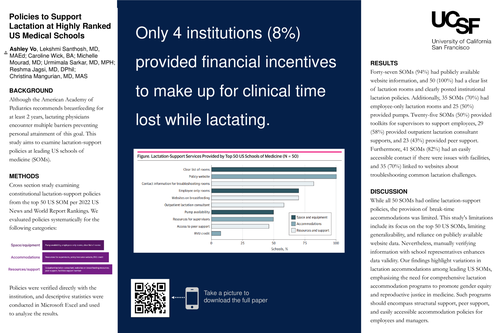
Results: In this cross-sectional study of 50 US SOMs, 47 SOMs (94%) had publicly available website information, and 50 (100%) had a clear list of lactation rooms and clearly posted institutional lactation policies. Additionally, 35 SOMs (70%) had employee-only lactation rooms and 25 (50%) provided pumps. Only 4 institutions (8%) provided financial incentives to make up for clinical time lost while lactating. Twenty-five SOMs (50%) provided toolkits for supervisors to support lactating employees returning from leave, 29 (58%) provided outpatient lactation consultant supports, and 23 (43%) provided peer support. Furthermore, 41 SOMs (82%) had an easily accessible contact if there were issues with lactation facilities, and 35 (70%) linked to websites about troubleshooting common lactation challenges. The Figure outlines the available services. Anonymized institution-specific details are noted in the Table.
Discussion: While all 50 SOMs had online lactation-support policies, the provision of break-time accommodations was limited. This study's limitations include its focus on the top 50 US SOMs, limiting generalizability, and reliance on publicly available website data. Nevertheless, manually verifying information with school representatives enhances data validity. Our findings highlight variations in lactation accommodations among leading US SOMs, emphasizing the need for comprehensive lactation accommodation programs to promote gender equity and reproductive justice in medicine. Such programs should encompass structural support, peer support, and easily accessible accommodation policies for employees and their managers.