127 posters, 10 topics, 20 sessions, 127 authors
ePostersLive by SciGen Technologies S.A. All rights reserved.
UCSF 2024 Inquiry Symposium
Conference ePosters

P032
Youth Education on Contraception Access via Telemedicine
Poster Presenter
Authors
Part of Topic
Social & Behavioral Sciences
Youth Education on Contraception Access via Telemedicine
S. Sei Dojiri, Jennifer Yarger, Danielle Van Liefde, Astrid Quirarte, Andrea Jackson, Cynthia Harper
Introduction: The COVID-19 pandemic has led to widespread expansion of telehealth services for adolescent and young adult patients, including contraceptive care. However, prior research demonstrates that many young people lack awareness of telehealth services or how to use them.
Aims: Our aim was to develop and conduct formative testing of an educational tool to increase young people’s knowledge of telehealth for contraception and to qualitatively assess their attitudes towards this means of accessing contraception.
Hypothesis: The tool will increase young people’s knowledge of using telehealth for contraception.
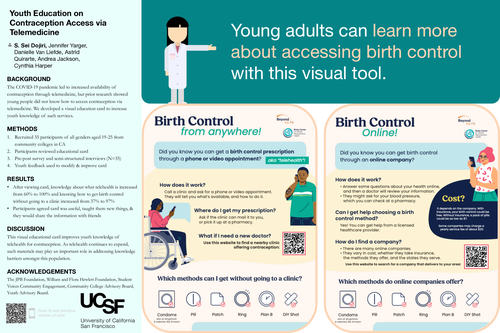
Project Design: We developed a youth-friendly visual tool on how to access contraception through video and phone visits and online birth control platforms. We recruited 35 young people aged 18-25 of all gender identities in California through social media and outreach at community colleges. Participants completed pre- and post-surveys after reviewing the tool, and we measured changes in telehealth knowledge with the McNemar test. We also conducted semi-structured interviews to understand the survey responses, their perceptions of the educational tool, and their experiences and challenges using telehealth for contraception. We used a modified form of grounded theory to analyze responses to the interview data.
Results: Participants included diverse sexual orientations, with 51% straight, 26% bisexual and 18% gay/lesbian or queer. 80% were sexually active and 63% wanted birth control. Most of the participants (86%) identified as a woman, 11% man, and 3% genderqueer/gender non-binary. Participants largely identified as Latinx (57%), with 14% Asian, 14% White, 11% Mideastern, and 9% Black. Telehealth knowledge increased universally after viewing the educational tool. The percentage who knew what telehealth is increased from 60% to 100% (p< 0.001), and knowledge of how to get contraception without going to a clinic in person increased from 37% to 97% (p< 0.001). After viewing the telehealth information, most participants correctly identified which contraceptive methods are available through telemedicine visits, including the pill (100%), patch (100%), vaginal ring (86%), and emergency contraception (86%). Acceptability was high, with all participants agreeing that the tool was useful, taught them new things, and that they would share the information with friends. One participant commented, “I liked seeing what methods you can get through telehealth. It was really informative.” The interview data revealed areas where participants need additional education about telehealth for contraception. Many participants shared concerns about the cost and insurance coverage of telehealth services, confidentiality, and the safety and legitimacy of online birth control prescription companies. Many were unsure how to find a health center that offers telemedicine visits. Most participants wanted to know more about birth control methods available through telehealth, such as their effectiveness and how to use them.
Discussion: This youth-friendly tool helped to improve young people’s knowledge of telehealth for contraception. The next stage involves reviewing feedback from a youth community advisory board to ensure acceptability and effectiveness among diverse groups of young people. As the use of telehealth continues to grow, educational materials are necessary to help address the low levels of telehealth knowledge and barriers to health care among young people.