127 posters, 10 topics, 20 sessions, 127 authors
ePostersLive by SciGen Technologies S.A. All rights reserved.
UCSF 2024 Inquiry Symposium
Conference ePosters

P088
Evaluating the Impact of Neoadjuvant Immune-Checkpoint Inhibitors on DIEP Flap Breast Reconstruction
Poster Presenter
Authors
Part of Topic
Clinical & Translational Sciences
Evaluating the Impact of Neoadjuvant Immune-Checkpoint Inhibitors on DIEP Flap Breast Reconstruction
Jasmin Wilson BS1, Nisha Parmeshwar MD1, Aileen Gozali MM1, Merisa Piper MD1
1Division of Plastic Surgery, Department of Surgery, University of California, San Francisco, San Francisco, CA
Background
The advent of various immunotherapies has positively impacted oncologic outcomes for patients undergoing treatment for breast cancer. As a clinical trial center, our institution has experienced higher use of immune-checkpoint inhibitors, including Programmed cell Death – 1 (PD-1) inhibitors for neoadjuvant therapy, with minimal understanding of their impact on reconstructive outcomes. We present our experience with neoadjuvant PD-1 inhibitors and evaluate their impact on outcomes after deep inferior epigastric perforator (DIEP) flap breast reconstruction.
Methods
A retrospective review of patients who underwent DIEP flaps for breast reconstruction from November 2004 through December 2022 was completed. Demographic, chemotherapeutic, intraoperative, and post-operative variables were recorded. Patients with a history of neoadjuvant therapy were identified and their regimens were recorded. Each flap was categorized based on immediate or delayed DIEP for analysis.
Results
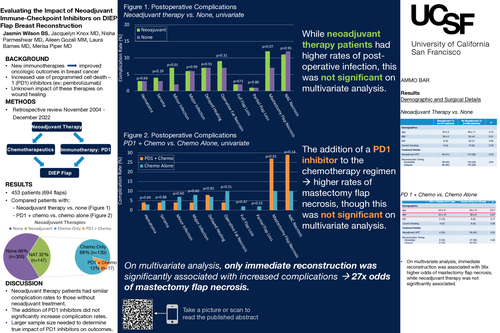
We identified 694 DIEP flaps from 454 patients, of which 225 (32%) were exposed to neoadjuvant therapy. 93 (41.3%) of these were immediate DIEPs at the time of mastectomy. Immediate DIEPs were associated with significantly higher rates of overall complications (41.9% vs 24.2%, p =0.005), delayed wound healing (14% vs 2.3% p= 0.001), infection (12.9%
vs 5.3%, p = 0.043), and mastectomy skin flap necrosis (28% vs 1.5%, p <0.001). Interestingly, delayed DIEPs had significantly more fat necrosis (12.1% vs 4.3%, p = 0.042) and revisions (56.1% vs 35.5%, p = 0.002). Amongst all flaps with neoadjuvant therapy exposure, 11 (4.9%) received a PD-1 inhibitor. Flaps exposed to neoadjuvant PD-1 inhibitors had significantly higher mastectomy skin necrosis (45.5% vs 10.7%, p = 0.001) compared to all other neoadjuvant therapies. However, on multivariate regression analysis accounting for age, diabetes, exposure to PD-1 inhibitors, and immediate reconstruction, immediate reconstruction significantly increased odds of mastectomy skin necrosis 27x (OR 27.2, p < 0.001) while exposure to PD-1 inhibitor lacked statistical significance (OR 5.3, p = 0.054).
Conclusion
Neoadjuvant PD-1 inhibitor therapy was not significantly associated with mastectomy skin flap necrosis when controlling for other variables. However, immediate reconstruction in the setting of neoadjuvant chemotherapy increased the odds of mastectomy flap necrosis 27 – fold. This suggests an even greater risk of necrosis among neoadjuvant therapy patients with immediate
flaps compared to those with delayed. Thus, neoadjuvant PD-1 inhibitors should not prevent patients from receiving any particular form of reconstruction, but understanding the potential clinical impact of exposure to PD-1 inhibitors in conjunction with immediate flap reconstruction warrants further consideration and patient counseling.