127 posters, 10 topics, 20 sessions, 127 authors
ePostersLive by SciGen Technologies S.A. All rights reserved.
UCSF 2024 Inquiry Symposium
Conference ePosters

P087
Cosmetic Treatments in Head Variant Linear Morphea: A Retrospective Cohort Study
Poster Presenter
Authors
Part of Topic
Clinical & Translational Sciences
Title: Cosmetic Treatments in Head Variant Linear Morphea: A Retrospective Cohort Study Authors: Winnie Fan, BS,1 Bianca Obiakor, BS,1 Jason Pomerantz, MD,2 William Hoffman, MD,2 Matthew French, BS,3 and Anna Haemel, MD3
- University of California, San Francisco School of Medicine, San Francisco, CA
- Department of Plastics Surgery, University of California, San Francisco, San Francisco, CA
- Department of Dermatology, University of California, San Francisco, San Francisco, CA
Introduction:
Head variant linear morphea, encompassing Parry Romberg Syndrome (PRS) and en coup de sabre (ECDS), is a sclerosing autoimmune disorder that can affect patients’ quality of life due to facial scarring and volume loss. Despite the potential of dermal injectables and fat transfers for cosmetic enhancement, data on their long-term efficacy, optimal timing, and safety remain limited in this patient population1,2.
Aims:
This study aimed to assess the efficacy, optimal treatment parameters, and outcomes of autologous fat transfers and injectable treatments in patients with head variant linear morphea.
Project Design/Methods:
This is an IRB-approved retrospective chart review of adult patients with head variant linear morphea seen at the UCSF Department of Dermatology and/or Plastic Surgery from 01/01/2015 to 06/13/2023. Patients who underwent cosmetic treatment (injectables/filler treatment of any type) to correct disease defects were included. Data on demographics, disease characteristics, treatment parameters, and patient/surgeon satisfaction were collected. Descriptive statistics were used to summarize the demographics and disease characteristics. To determine the association between disease stability at the time of treatment, use of systemic treatments at the time of cosmetic procedures, and the occurrence of post-treatment reactivation, chi-square tests of independence were performed, using a significance level of 0.05.
Results:
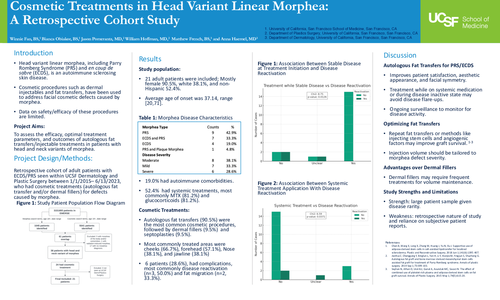
Twenty-one patients underwent cosmetic treatments for head variant linear morphea. The mean age was 37.1 years old, with a female predominance (90.5%). Most patients (71.4%) opted for cosmetic treatments after the disease was considered inactive by their clinicians. Autologous fat transfer was the preferred treatment (90.5%). Most patients (65.0%) reported aesthetic improvement, and 68.4% noted better symmetry. Surgeon assessments aligned closely with patient satisfaction, with 73.3% observing improved facial symmetry. Follow-up ranged from 4.3 to 185.15 months (mean 66.6 months). Three patients (14.3%) experienced disease reactivation post-treatment. There was a significant association between disease stability at the time of treatment and the absence of post-treatment reactivation (χ²(2) = 8.75, p
= 0.013). Similarly, a significant association was found between the use of systemic treatments during cosmetic procedures and the absence of disease reactivation (χ²(2) = 6.59, p = 0.037).
Discussion:
This study highlights the effectiveness of cosmetic interventions, particularly autologous fat transfers, for improving facial aesthetics and symmetry in patients with head variant linear morphea. Notably, we found that the timing of the cosmetic intervention and systemic treatment use influence the risk of disease reactivation post-treatment. Our findings suggest that patients may benefit from carefully timed treatments during disease inactive state or while on systemic treatments and underscore the importance of ongoing disease monitoring. While the retrospective nature of the study and reliance on subjective outcome reports limits its scope, the analysis of 21 patients offers valuable insights into a relatively rare condition.
Prospective studies with larger cohorts and objective measures are needed to corroborate our findings and further elucidate the role of cosmetic treatments in the management of head variant linear morphea.
References:
- Creadore A, Watchmaker J, Maymone MB, Pappas L, Lam C, Vashi NA. Cosmetic treatment in patients with autoimmune connective tissue diseases: best practices for patients with morphea/systemic sclerosis. Journal of the American Academy of Dermatology. 2020 Aug 1;83(2):315-41.
- Choksi AN, Orringer JS. Linear morphea-induced atrophy treated with hyaluronic acid filler injections. Dermatologic surgery. 2011 Jun 1;37(6):880-3.