127 posters, 10 topics, 20 sessions, 127 authors
ePostersLive by SciGen Technologies S.A. All rights reserved.
UCSF 2024 Inquiry Symposium
Conference ePosters

P086
Natural progression of anterior segment parameters and longitudinal effects of laser peripheral iridotomy in patients with primary angle closure suspect
Poster Presenter
Authors
Part of Topic
Clinical & Translational Sciences
Abstract
Introduction:
Primary angle-closure glaucoma (PACG) is a leading cause of irreversible blindness worldwide. The prophylactic use of laser peripheral iridotomy (LPI) in patients with primary angle closure suspect (PACS) to prevent progression to PACG has been debated, with the Zhongshan Angle-Closure Prevention (ZAP) trial indicating limited efficacy. Anterior segment optical coherence tomography (AS-OCT) data can be helpful in monitoring and predicting the progression of PACS to PACG, but long-term AS-OCT data have not been well documented. This study provides a comprehensive evaluation of longitudinal changes in angle, iris, and anterior chamber dimensions as measured by AS-OCT for PACS patients over 72 months, both with and without prophylactic LPI.
Hypothesis:
We hypothesize that LPI induces significant, long-lasting anatomical changes in the anterior segment of PACS patients.
Aims:
1) To evaluate the long-term changes in AS-OCT parameters in PACS patients post-LPI.
2) Compare the changes in AS-OCT parameters in eyes that received LPI to control eyes.
Methods:
A secondary analysis of the ZAP trial, a prospective, randomized controlled trial, was conducted. The study involved 889 PACS patients from Guangzhou, China, randomized to undergo LPI in one eye, with the fellow eye serving as a control. Key biometric parameters, including angle opening distance (AOD), trabecular-iris space area (TISA), iris curvature, and anterior chamber depth (ACD), were measured using AS-OCT over 72 months. Statistical analyses utilized generalized estimating equations to compare changes between treated and untreated eyes.
Results:
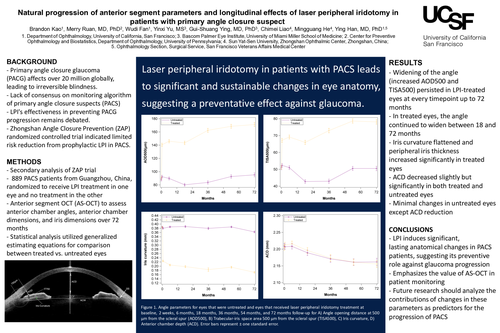
692 patients of the 889 ZAP participants who reached the 72 month time point were included in this analysis. LPI-treated eyes exhibited sustained angle widening, with increases in AOD500 (baseline: 90.0 µm, 2 weeks: 140.5 µm, 72 months: 168.6 µm),
TISA500 (baseline: 51.1 µm, 2 weeks: 67.2 µm, 72 months: 78.1 µm), and ARA
(baseline: 98.7 1000µm², 2 weeks: 137.5 1000µm², 72 months: 161.1 1000µm²). At every time point, each angle parameter is significantly larger in treated than in untreated eyes. LPI resulted in a significant flattening of iris curvature and thickening of the peripheral iris thickening, which were both maintained over the study period. Finally,
ACD in untreated eyes decreased from 2.21 mm to 2.16 mm at 72 months (p<0.001), while ACD in treated eyes decreased from 2.20 mm to 2.16 mm (p<0.001). No significant difference in ACD between treated and untreated eyes was found at any of the time points.
Discussion and Conclusions:
The study demonstrated that LPI leads to significant and sustained anatomical alterations in PACS patients. These changes, including angle widening and iris flattening, are indicative of a reduced risk of PACG progression. While LPI presents a viable preventative measure, the slight reduction in ACD across both groups suggests a nuanced effect, necessitating further investigation into the long-term clinical outcomes. Future studies should continue to explore the predictive value of early and longitudinal AS-OCT measurements in monitoring PACS.