127 posters, 10 topics, 20 sessions, 127 authors
ePostersLive by SciGen Technologies S.A. All rights reserved.
UCSF 2024 Inquiry Symposium
Conference ePosters

P085
Switchable AML cell model system for investigating chemical inhibitors of oncogenic Ras signaling
Poster Presenter
Authors
Part of Topic
Biomedical Sciences
Switchable AML cell model system for investigating chemical inhibitors of oncogenic Ras signaling
Introduction: Oncogenic mutations in Ras, a small GTPase that plays a crucial role in regulating signals essential for cell survival and differentiation, are common in various cancers, including pediatric hematologic malignancies like acute myeloid leukemia (AML). There are three main isoforms of Ras, with N-Ras and K-Ras being the most significant. These isoforms exhibit different mutation patterns, with N-Ras frequently mutated at residue 61 and K-Ras at residue
12. Recently, there has been progress in understanding the structure and function of Ras, leading to the development of direct inhibitors targeting specific mutations, such as G12C in K- Ras. Additionally, multiple efforts to generate chemical inhibitors for other proteins in the Ras/MAPK pathway and isoform-specific regulatory mechanisms represent potential therapeutic avenues for pediatric AML. However, the lack of a robust leukemia cell model capable of assessing treatment efficacy across different Ras isoforms and mutations is a significant obstacle. To address this, we aimed to create a customizable cell model system that can be induced to depend on oncogenic Ras/MAPK signaling, facilitating the evaluation of targeted therapies.
Hypothesis: We hypothesized that the expression of oncogenic mutations of NRAS and KRAS in an AML cell line dependent on Ras signaling would serve as an effective tool for comparing Ras isoform- and variant-specific response differences to targeted therapies.
Aims: The goals of the project are to: (1) generate an inducible cell model system using the FLT3-mutant, AML cell line MOLM-13 by turning off its constitutively active receptor tyrosine kinase with the highly potent FLT3 inhibitor quizartinib (AC220) and redirecting its survival dependency onto oncogenic Ras and (2) use the validated system to compare isoform-specific biochemical function and response to novel small molecule inhibitors.
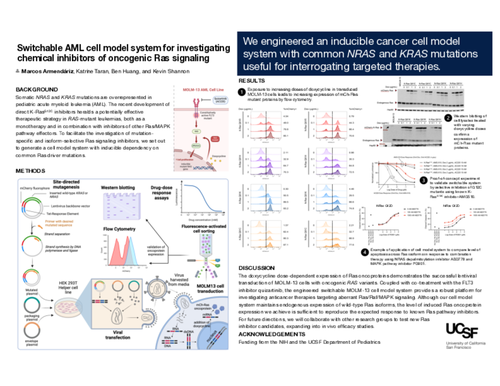
Methods: We performed site-directed mutagenesis to generate clinically relevant KRAS and NRAS mutants fused at the N-terminus with the mCherry fluorophore in a lentiviral vector, which was subsequently used for lentiviral transduction of MOLM-13 cells. Transduced cells underwent fluorescence-activated cell sorting and Ras oncoprotein expression was verified via flow cytometry and Western blotting. The RAS-mutant cell model system was validated by treating it with the inducer doxycycline before performing drug-dose response experiments to verify the expected level of anti-proliferation and apoptosis using known Ras/MAPK pathway inhibitors.
Results: After cell sorting, exposure to 2 µg/mL of doxycycline consistently induced mCherry- Ras expression in greater than 70% of events analyzed in transduced mutant cell lines via flow cytometry. Similarly, Western blotting of cell lysates pre-treated with doxycycline demonstrated high levels of expression of the mCherry-Ras oncoproteins. The dependency of the engineered cell lines on oncogenic Ras was confirmed with the observed attenuation of the anti-proliferation effect of AC220 after Ras oncoprotein induction with doxycycline.
Furthermore, in a proof-of-concept experiment the K-Ras G12C inhibitor AMG510 was shown to
inhibit only the NRAS G12C and KRAS G12C mutant cell lines and not the G12D mutants as expected. To further explore the capability of the cell model system to demonstrate isoform- specific antitumor response, an apoptosis experiment using the NRAS mutant-specific depalmitoylation inhibitor ABD778 showed cooperation with a Ras/MAPK pathway inhibitor only in the NRAS-mutant cell line as expected.
Discussion and Conclusion: The doxycycline dose-dependent expression of Ras oncoproteins demonstrates the successful lentiviral transduction of MOLM-13 cells with oncogenic RAS variants. Coupled with co-treatment with the FLT3 inhibitor quizartinib, the engineered switchable MOLM-13 cell model system provides a robust platform for investigating anticancer therapies targeting aberrant Ras/Raf/MAPK signaling across the major Ras isoforms and mutations. Although our cell model system maintains endogenous expression of wild-type Ras isoforms, the level of induced Ras oncoprotein expression we achieve is sufficient to reproduce the expected response to known Ras pathway inhibitors. Soon, we will collaborate with research partners to test novel Ras/MAPK pathway inhibitors in vitro, with the ability to expand into in vivo studies given our engineered human AML cell lines have successfully engrafted in immunodeficient mice.