127 posters, 10 topics, 20 sessions, 127 authors
ePostersLive by SciGen Technologies S.A. All rights reserved.
UCSF 2024 Inquiry Symposium
Conference ePosters

P080
Young Adult and Family Advisory Board Contributions to the Study of Psilocybin for Anorexia in Young Adults
Poster Presenter
Authors
Part of Topic
Clinical & Translational Sciences
Project Title: Young Adult and Family Advisory Board Contributions to the Study of Psilocybin for Anorexia in Young Adults
Introduction: This Deep Explore project is building on the Study of Psilocybin for Anorexia Nervosa in Young Adults (SPANYA) clinical research trial. SPANYA will involve an 8-week psilocybin-assisted therapy intervention for transitional-aged youth 18-25 years old with refractory Anorexia Nervosa (AN). This project focused on community engagement by collaborating with two advisory boards consisting of young adults (YA) with lived experiences of AN and parents of children with AN to gather their perspective prior to enrolling participants in SPANYA. Although the larger study, including the creation of advisory boards was IRB approved, advisors are not trial participants and did not formally consent. The objective of these advisory boards is to use the information collected to inform the design of a participant-centered trial. Specifically, the aims of these advisory boards were to:
Aim 1: Investigate perspectives of parents with adult children with AN on SPANYA’s trial design including family therapy, educational resources for families, family roles in psychedelic therapy, possible barriers to enrollment or participation, and our planned recruitment and screening processes.
Aim 2: Investigate perspectives of young adults with lived experiences of AN including approach to communicating about required nutrition intake, family involvement, information needed at time of consent, communication with family and outside providers, possible barriers to enrollment or participation, and our planned recruitment and screening processes.
Project Design & Methods:
The study team reached out to known providers who refer patients for eating disorder treatment at UCSF. Psychotherapists were given information about the purpose of the advisory board and contact information for the research team to distribute to young adult clients or parents who might be interested in participating in the advisory boards. Interested young adults and parents contacted the study team PI. Young adults were eligible if they were in remission from anorexia nervosa or if they were too old (over age 26) to participate in the trial. Parents were eligible to participate if they had a child who had lived experience with AN who was either in remission or too old to participate in the trial. Two advisory boards were established. These groups met separately and committed to meeting quarterly through SPANYA’s first year and then semi- annually thereafter. Meetings were conducted on zoom and transcribed by study staff. Study staff then reviewed the information collected for common themes and significant findings including possible modifications to SPANYA’s trial design.
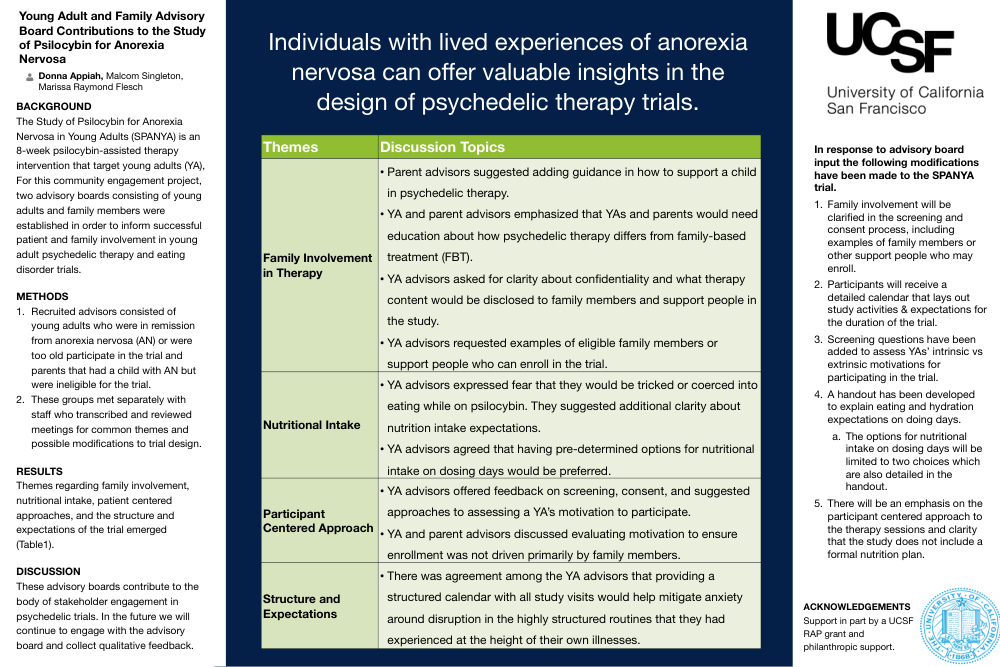
Results: The YA advisors expressed a need for a highly structured and transparent approach in the clinical trial because of the rigid routines that they had relied on during the peak of their own lived experiences with AN. YA advisors reflected that at the height of their illness they had specific routines that would be interrupted by participating in a trial like SPANYA. Disruptions could cause anxiety and there was agreement among the YA advisors that providing a detailed calendar and clarifying language would help mitigate this anxiety.
YA advisors expressed fear that they would be tricked or coerced into eating during their psilocybin dosing sessions when they were in an altered state YA advisors agreed that having limited options for nutritional intake would be preferred as having more options could be anxiety provoking for YA participants.
Both YAs and parent advisors expressed wariness and an emphasis on not repeating family- based treatment (FBT), the current first line therapy for AN in which parents take over all aspects of feeding the patient. The YA advisors said that YA participants would need clarity on the role of parents in the trial, specifically how the psychotherapy differed from FBT. One YA advisor expressed concern over disclosure, fearing they would say something that would upset their family member. The YA advisors suggested that the research team make clear that the YA participants in the trial can confidentiality speak with their study psychotherapists and choose what to disclose to their participating family member.
Regarding family participation, the YA advisors discussed offering examples of what support might look like. The YA advisors reported that YA participants would need to know that a support person should be someone who has been actively engaged in helping the participant access care for their eating disorder for at least the past year. YA advisors suggested examples of different family members or support people could be helpful during the consent process (e.g. parents, adult siblings, spouses, long-term close friends if family is not available).
Parent advisors expressed uncertainty about how to support a YA participant during a psychedelic therapy trial. Like YA advisors, parent advisors wanted clarification over their role in psychedelic therapy and clarity about how it differed from FBT approaches. Although both YAs and parents are to be enrolled in the trial and considered participants, it was important to YA advisors to clarify with both YA participants and parent participants that YAs are the target participants. The YA advisors offered feedback on elements of the screening and consent process. They talked about building in assessments about a YA participant’s motivation to participate in the trial and having multiple team members along the consent process evaluate motivation to ensure enrollment was not driven primarily by family members. YA advisors provided possible questions for use during the screening process.
Discussion Given the information gathered above, the following modifications were made to the SPANYA trial. The role of family involvement will be clarified beginning in the screening and consent process, including examples of possible family members and support people who could enroll with the young adult. During the screening and enrollment process participants will receive a detailed calendar that lays out key dates and expectations for the length of the trial.
Additional screening questions have been added to assess intrinsic vs extrinsic motivations for participating in the trial. The study team has developed a handout to explain expectations related to eating and hydration on doing days, including instances in which participants may be asked to take in additional nutrition such as episodes of dizziness or hypoglycemia. The options for nutritional intake on dosing days will be limited to two choices which are also detailed in this participant handout. There will be an emphasis on the participant centered approach to the therapy sessions and clarity that the study does not include an overarching nutrition plan.