127 posters, 10 topics, 20 sessions, 127 authors
ePostersLive by SciGen Technologies S.A. All rights reserved.
UCSF 2024 Inquiry Symposium
Conference ePosters

P079
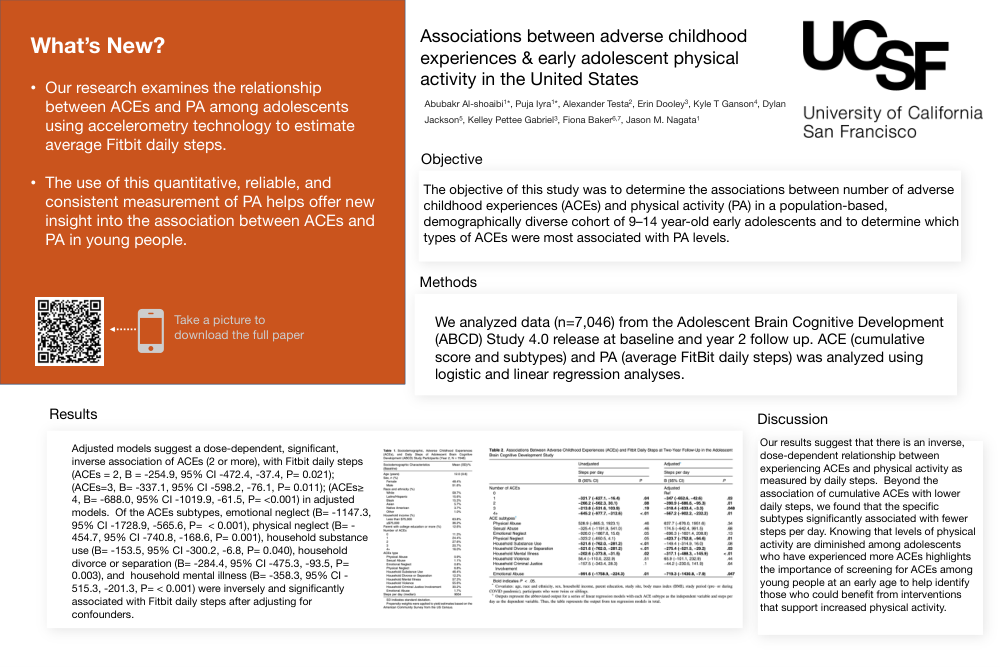
Associations between adverse childhood experiences & early adolescent physical activity in the United States
Part of Topic
Epidemiology & Population Sciences
Abstract:
Objective: The objective of this study was to determine the associations between number of
adverse childhood experiences (ACEs) and physical activity (PA) in a population-based, demographically diverse cohort of 9–14 year-old early adolescents and to determine which types of ACEs were most associated with PA levels.
Methods: We analyzed data (n=7,046) from the Adolescent Brain Cognitive Development
(ABCD) Study 4.0 release at baseline and year 2 follow up. ACE (cumulative score and subtypes) and PA (average FitBit daily steps) was analyzed using logistic and linear regression analyses.
Results: Adjusted models suggest a dose-dependent, significant, inverse association of ACEs (2
or more), with Fitbit daily steps (ACEs = 2, B = -254.9, 95% CI -472.4, -37.4, P= 0.021);
(ACEs=3, B= -337.1, 95% CI -598.2, -76.1, P= 0.011); (ACEs≥ 4, B= -688.0, 95% CI -1019.9, -
61.5, P= <0.001) in adjusted models. Of the ACEs subtypes, emotional neglect (B= -1147.3, 95% CI -1728.9, -565.6, P= < 0.001), physical neglect (B= -454.7, 95% CI -740.8, -168.6, P=
0.001), household substance use (B= -153.5, 95% CI -300.2, -6.8, P= 0.040), household divorce
or separation (B= -284.4, 95% CI -475.3, -93.5, P= 0.003), and household mental illness (B= -
358.3, 95% CI -515.3, -201.3, P= < 0.001) were inversely and significantly associated with Fitbit daily steps after adjusting for confounders.
Conclusions: Our results suggest that there is an inverse, dose-dependent relationship between
experiencing ACEs and physical activity as measured by daily steps. Beyond the association of cumulative ACEs with lower daily steps, we found that the specific subtypes significantly associated with fewer steps per day. Knowing that levels of physical activity are diminished among adolescents who have experienced more ACEs highlights the importance of screening for
ACEs among young people at an early age to help identify those who could benefit from interventions that support increased physical activity.
What’s New:
Our research examines the relationship between ACEs and PA among adolescents using accelerometry technology to estimate average FitBit daily steps. The use of this quantitative, reliable, and consistent measurement of PA helps offer new insight into the association between ACEs and PA in young people.