127 posters, 10 topics, 20 sessions, 127 authors
ePostersLive by SciGen Technologies S.A. All rights reserved.
UCSF 2024 Inquiry Symposium
Conference ePosters

P076
Racial Disparities in Physical Restraint Use: A Cross-Sectional Study at Two San Francisco Emergency Departments
Poster Presenter
Authors
Part of Topic
Epidemiology & Population Sciences
Title:
Racial Disparities in Physical Restraint Use: A Cross-Sectional Study at Two San Francisco Emergency Departments
Introduction:
Studies have shown that Black patients at highest risk of physical restraint in the emergency department (ED). Systemic racism at the hospital level may play a role in these disparities, but its mechanism of impact is not currently known. To address this, we compare rates of physical restraint in EDs at two hospitals, to assess for differences in factors associated with restraint in both settings.
Hypothesis:
Patient identified as Black experience a disproportionate odds or restraint use regardless of hospital type.
Aims:
- Identify patient and system level factors influencing restraint use at San Francisco General Hospital (SFGH) Emergency Department.
- Compare odds of physical restraints between SFGH and UCSF Parnassus Emergency Departments.
Methods
This is a retrospective cross-sectional study of adults seeking emergency mental health care between January 2019 and December 2020 at two EDs in San Francisco - one located at an urban, tertiary, academic medical center, and the other at a county hospital and trauma center. Descriptive analysis consisted of frequency distributions of sample characteristics in combination with chi-square tests of homogeneity. We performed multivariable logistic regression to estimate associations between race and restraint, adjusted for ethnicity, sex, age, insurance status, comorbidities, housing status, ED arrival method and time of ED presentation, with the lowest risk group in each category as the referent. Finally, we stratified models by hospital to assess for differences between the two sites.
Results
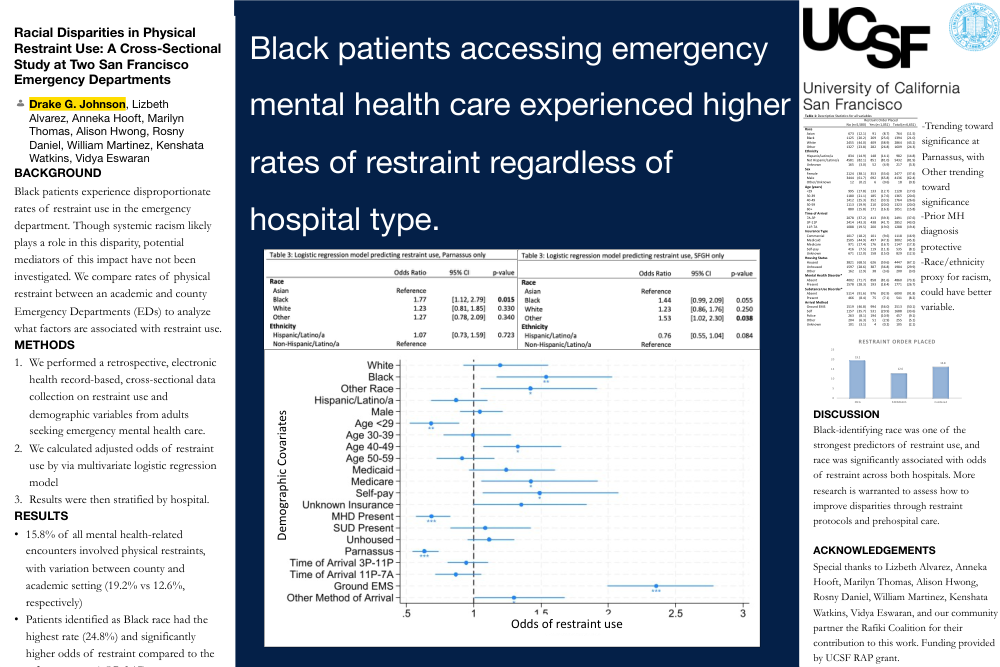
Among 6,631 total ED encounters, 1,051 (15.8%) involved physical restraints. Overall, restraint use was higher at the county ED (19.2% vs 12.6%, p < 0.01), which also saw a higher number of patients identified as Black race (24.8% vs 17.4%, p < 0.01). In multivariable analyses, Black patients had significantly higher odds of restraint than Asian patients at the academic ED (aOR 2.17, 95%CI 1.17-4.03) and approached significance at the county ED (aOR 1.44, 95%CI 0.99-2.09). In combined analyses, Black race (aOR 1.61, 95%CI 1.17-2.20) age 40-49 (aOR 1.3, 95%CI 1.02-1.66),
homelessness (aOR 1.20, 95%CI 1.01-1.43), and arrival by ambulance (aOR 1.83, 95%CI 1.53-2.21) were also associated with higher odds of restraint.
Conclusion
Our results suggest that Black race is associated with higher odds of restraint use, regardless of hospital type. This implies that anti-Black racism may be systemic and be related to factors beyond the local healthcare system. Attention to factors such as the availability of psychiatric resources among middle-aged populations and the role of the prehospital environment during mental health crises may be prudent in efforts to achieve health equity.