127 posters, 10 topics, 20 sessions, 127 authors
ePostersLive by SciGen Technologies S.A. All rights reserved.
UCSF 2024 Inquiry Symposium
Conference ePosters

P075
Health Disparities in Autoimmune Hepatitis
Poster Presenter
Authors
Part of Topic
Clinical & Translational Sciences
Introduction:
Deep Explore Spring 2024 Abstract: Health Disparities in Autoimmune Hepatitis
Irina Adao, MS4
Autoimmune hepatitis (AIH) is an uncommon chronic inflammatory condition of the liver. Research to date has uncovered racial and ethnic disparities within patients with AIH, including higher prevalence and worse outcomes in Black and Latinx patients (1–3). Social determinants of health (SDOH) describe external factors, such as economic, social, environmental, educational, and healthcare-related, that have been shown to affect people’s health and increase risk for certain chronic conditions (4). However, this has not yet been studied in patients with AIH. Thus, this study seeks to analyze the associations between SDOH and AIH to further health equity in patients with AIH by identifying the crucial social factors that exacerbate AIH disease severity and mortality and informing the design and focus of future interventions.
Question:
What is the association between social determinants of health and autoimmune hepatitis?
Aims:
- To describe the social determinants of health in participants with AIH compared to participants without AIH. Covariates include age, sex, ethnicity and race, and cohort.
- We hypothesize that participants with AIH will have less favorable SDOH compared to those without AIH.
- Among AIH participants, examine associations between SDOH and disease severity, which is measured as cirrhosis at time of survey. Covariates include sex, age, ethnicity and race, and time to diagnosis.
- We hypothesize that discrimination will be associated with increased disease severity.
Methods:
Study Design: This is a cross-sectional study to examine associations between SDOH and AIH. Participants were recruited from 1) the Prospective Observational Study to Understand Liver Diseases (POSULD) cohort, 2) via the Autoimmune Hepatitis Association (AIHA), 3) during hepatology clinic visits, and 4) online via the POSULD website. Participants were given a description of the study and the option to participate. The questionnaire was comprised of validated instruments from the PhenX toolkit and other studies. The SDOH domains included education, financial security, built environment, healthcare access, social/community support. We also assessed liver health care, including self-reported laboratory results, treatment, and complications (i.e. cirrhosis and transplant). The questionnaire was administered in-person, via telephone, or online to allow for greater accessibility. Questionnaires were available in English and Spanish. Interpreters were used for English second-language participants.
Analysis Approach: For aim 1, we calculated a composite SDOH score, which dichotomized and summed each SDOH domain. Higher scores indicated less favorable SDOH. We compared the composite score between those with and without AIH with a five-number summary and Wilcox rank sums test. Then, we did a logistic regression for AIH diagnosis as predicted by SDOH with two models. The first model used the composite SDOH score as the independent variable. The second model used each SDOH category as independent variables. Both models were adjusted for age, sex, and ethnicity and race. With an alpha of 0.05, power of 80%, and a standardized effect size of 0.2, our minimum sample size was 80 AIH participants and 54 non-AIH participants.
For aim 2, we performed a logistic regression for cirrhosis as predicted by SDOH, adjusting for covariates. We used a simplified model that included 1 variable from each SDOH category: highest education level from education access and quality, unmet health needs from health care and quality, household exposures from neighborhood and built environment, discrimination from social and community context, and job security from economic stability.
Results:
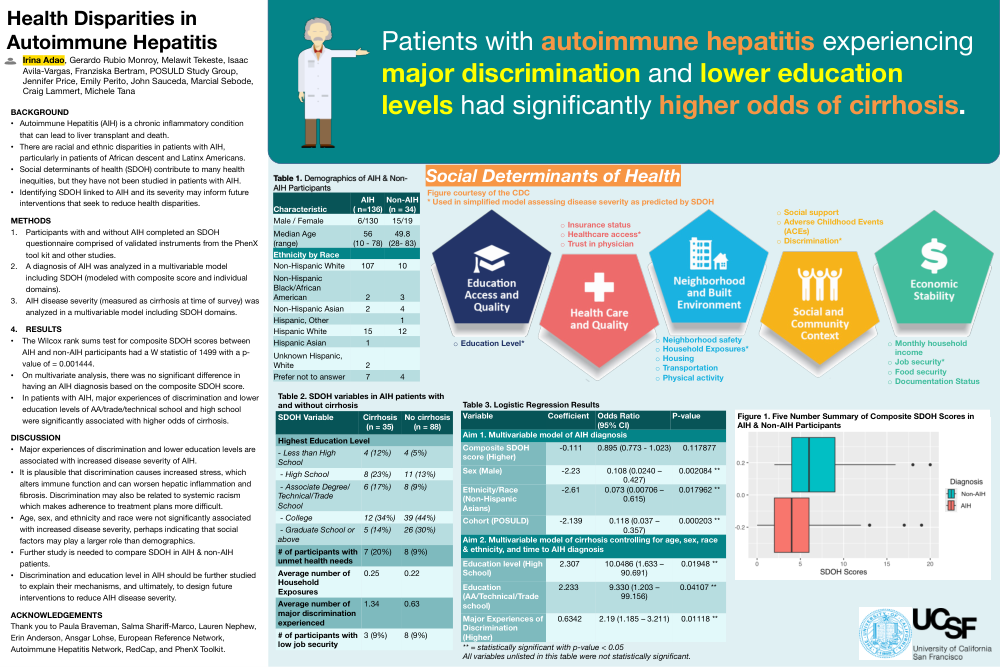
For aim 1, our final sample size (n = 136 AIH, n = 34 non-AIH) did not meet our minimum sample size. Our participants’ diagnoses were 112 AIH alone, 24 AIH with concurrent liver diseases, 3 primary biliary cholangitis (PBC), 9 Metabolic Dysfunction-Associated Steatotic Liver Disease (MASLD), 3 Alcohol-Associated Liver Disease (ALD), 16 healthy participants, and 2 other. 40 participants were recruited from POSULD, and 130 were recruited from the AIHA, online website, and non-POSULD clinic visits. There were 21 male, 149 female, 117 non-Hispanic white, 5 non-Hispanic Black/African American, 4 non-Hispanic Asian, 1 non-Hispanic other, 27 Hispanic white, 1 Hispanic Asian, 2 unknown- Hispanic white, and 11 unknown race and ethnicity. Age ranged from 10 – 83, with median age of 55. The five-number
summary was 0, 2, 4, 6, and 19 for AIH participants and 2, 4, 6, 9, 20 for non-AIH participants. The rank sums test for composite SDOH scores between AIH and non-AIH participants had a W statistic = 1499 with a p-value = 0.001444.
Aim 1’s first model showed no statistically significant difference in AIH diagnosis based on the composite SDOH score.
It did show statistically significant differences in AIH diagnosis based on sex (males had 0.11 times the odds of an AIH diagnosis compared to females), cohort (POSULD cohort had 0.11 times the odds of an AIH diagnosis compared to non- POSULD), and race and ethnicity (non-Hispanic Asian participants had 0.07 times the odds of having an AIH diagnosis compared to non-Hispanic white participants). Aim 1’s second model showed statistically significant differences in an AIH diagnosis based on cohorts (POSULD cohort had 0.03 times the odds of an AIH diagnosis compared to non-POSULD cohort), day-to-day discrimination (those with high day-to-day discrimination had 0.99 times the odds of an AIH diagnosis compared to those who had none), and food security (those with very low food security had 0.005 times the odds of an AIH diagnosis compared to those with high food security). All other variables were not statistically significant.
For aim 2, our final sample size (n = 35 with cirrhosis, n = 88 without cirrhosis) did not meet our minimum sample size. There were 5 male and 118 female, 98 non-Hispanic white, 1 non-Hispanic Black/African American, 2 non-Hispanic Asian, 13 Hispanic white, 1 Hispanic Asian, 1 unknown-Hispanic white, and 7 unknown race and ethnicity. Age ranged from 10 to 78, with median age of 56. Our logistic regression showed statistically significant differences in having cirrhosis at time of survey in AIH participants based on major experiences of discrimination (those with more major experiences of discrimination had 2.1 times the odds of having cirrhosis compared to those without) and two levels of education (compared to those who completed graduate school, those whose highest education level was high school had 10 times the odds of having cirrhosis and those whose highest education level was an associate degree or technical or trade school had 9.3 times the odds of having cirrhosis). All other variables were insignificant.
Discussion/Conclusion:
Overall, we did not find a significant difference in having an AIH diagnosis based on the composite SDOH score. We suspect this may be due to our limited number of people without AIH. We did not expect very low food security to be significantly associated with lower odds of an AIH diagnosis. We suspect that certain non-AIH liver diseases, especially ALD, may have been large drivers of this association. Additionally, most of our non-AIH participants were from the POSULD cohort, who have less favorable SDOH compared to non-POSULD, which would also skew our results.
Additionally, those in the non-POSULD cohort who were not patients at ZSFG or UCSF required internet access and some degree of technology savvy given they could only complete it online, which could contribute to this skewing as well.
Our Aim 2 results support the hypothesis of discrimination being associated with worse disease severity in AIH participants. Discrimination has been shown to be associated with increased stress levels and poorer outcomes in other chronic conditions (5). We suspect a similar mechanism may be at play here. It could be that increased stress alters immune function, thus increasing the inflammation of AIH and subsequently leading to worsening fibrosis and cirrhosis. Education level of high school and associate degree or trade or technical school was also associated with a cirrhosis diagnosis. This is not surprising, as lower education levels have also been associated with poorer outcomes in other chronic conditions (6). We hypothesize that lower education levels may be related to lower health literacy, which can lead to delayed care, misunderstandings about health conditions, or lower adherence. It may also be related on an economic level as education levels may limit economic growth and opportunity.
Notably, age, sex, and race and ethnicity were not associated with increased disease severity, which may indicate that social factors play a larger role than certain intrinsic factors about a patient. A major limitations of this study was inadequate numbers of participants. Though we administered surveys in a variety of ways, participants were still missed. Notably, telephone calls had a lower yield than internet or in-person recruitment. Advertising the study to patients during their clinic visit did increase yield for subsequent telephone administration. Additionally, self -reported data may accrue recall bias. However, the use of self-reported data is still valuable, as evidenced by a study in 2018 that showed that self- reported data of health care visits were similar to electronic medical records (7). Although we used validated instruments whenever possible, we shortened several instruments for brevity to maximize completion. Overall, given the limited sample size, further investigation is needed in associations between SDOH and a diagnosis of AIH. Now that education level and discrimination have been identified as significant for increased disease severity, these domains should also be further studied to explain their mechanisms for worse disease severity and, ultimately, to design future interventions to reduce disease severity in patients with AIH.
References:
- Lee B, Holt EW, Wong RJ, Sewell JL, Somsouk M, Khalili M, et al. Race/ethnicity is an independent risk factor for autoimmune hepatitis among the San Francisco underserved. Autoimmunity. 2018 Aug;51(5):258–64.
- Wen JW, Kohn MA, Wong R, Somsouk M, Khalili M, Maher J, et al. Hospitalizations for Autoimmune Hepatitis Disproportionately Affect Black and Latino Americans. Am J Gastroenterol. 2018 Feb;113(2):243–53.
- Wong RJ, Gish R, Frederick T, Bzowej N, Frenette C. The impact of race/ethnicity on the clinical epidemiology of autoimmune hepatitis. J Clin Gastroenterol. 2012 Feb;46(2):155–61.
- Social Determinants of Health - Healthy People 2030 | health.gov [Internet]. [cited 2024 Mar 31]. Available from: https://health.gov/healthypeople/priority-areas/social-determinants-health
- Cuevas AG, Ong AD, Carvalho K, Ho T, Chan SW (Celine), Allen JD, et al. Discrimination and systemic inflammation: A critical review and synthesis. Brain Behav Immun. 2020 Oct;89:465–79.
- Montez JK, Cheng KJ. Educational disparities in adult health across U.S. states: Larger disparities reflect economic factors. Front Public Health. 2022 Aug 16;10:966434.
- Wallace E, Moriarty F, McGarrigle C, Smith SM, Kenny RA, Fahey T. Self-report versus electronic medical record recorded healthcare utilisation in older community-dwelling adults: Comparison of two prospective cohort studies. PLOS ONE. 2018 Oct 26;13(10):e0206201.