127 posters, 10 topics, 20 sessions, 127 authors
ePostersLive by SciGen Technologies S.A. All rights reserved.
UCSF 2024 Inquiry Symposium
Conference ePosters

P074
mTranS-C: An Innovative, Mobile Behavioral Sleep Intervention for Improving Sleep Health Deficits and Decreasing Mental Healthcare Stigma Among Latinx Adolescents
Poster Presenter
Authors
Part of Topic
Social & Behavioral Sciences
Jared Peralta
mTranS-C: An Innovative, Mobile Behavioral Sleep Intervention for Improving Sleep Health Deficits and Decreasing Mental Healthcare Stigma Among Latinx Adolescents
Introduction
More than two thirds of U.S. high school students report getting less than 8 hours of sleep on school nights and approximately 11 percent of adolescents report significant insomnia symptoms. Research suggests that there is an association between sleep health deficits and mental health problems such as depression among children and adolescents. Mental healthcare is sought out less among the Latinx community due to issues of stigma and cultural miscommunication. In an effort to address this issue, we conducted a secondary analysis study among Hispanic vs non-Hispanic youth to test a mobile adaptation of the Transdiagnostic Sleep and Circadian Intervention (TranS-C), which is a brief sleep intervention with demonstrated efficacy for improving sleep and mental health outcomes in youth (we refer to this novel intervention as mTranS-C).
Aims
The first aim of this study is to test the efficacy of mTranS-C to improve sleep quality in Latinx versus non Latinx youth. Secondly, we aim to assess whether mTranS-C is associated with changes in attitudes and stigma about seeking mental healthcare in a sample of Latinx versus non-Latinx adolescents with sleep health deficits. Our third aim is to assess whether there are different rates of participation in mTranS-C between Latinx and non-Latinx adolescents.
Methods
This study is a secondary analysis using a mixed methods design of a dataset of quantitative data from a completed trial on mTranS-C. An open trial among adolescents with sleep health deficits (SHDs) from the community and the Gardner Packard Primary Care facility was conducted to assess the effectiveness of mTranS-C. Phone interviews and online questionnaires were used to conduct weekly assessments on participating adolescents including baseline, post- treatment, and 3-month follow-up data measures. Data measures that were collected during the assessments include Mental Help Seeking Attitude Scale (MHSAS) scores, Pittsburgh Sleep Quality Index (PSQI), mTranS-C tracking data, and demographic data (age, biological sex, race/ethnicity, household income, maternal education level). We analyzed quantitative data using mixed effects models and univariate analysis of variance where applicable. We calculated mixed effects models, with sleep quality index as an outcome and ethnicity as the predictor, accounting for maternal education level, household income, and biological sex in the model.
Similar mixed effects models were used to analyze our measures of MHSAS and univariate analysis of variance was performed using treatment participation as outcomes and ethnicity as a predictor.
Results
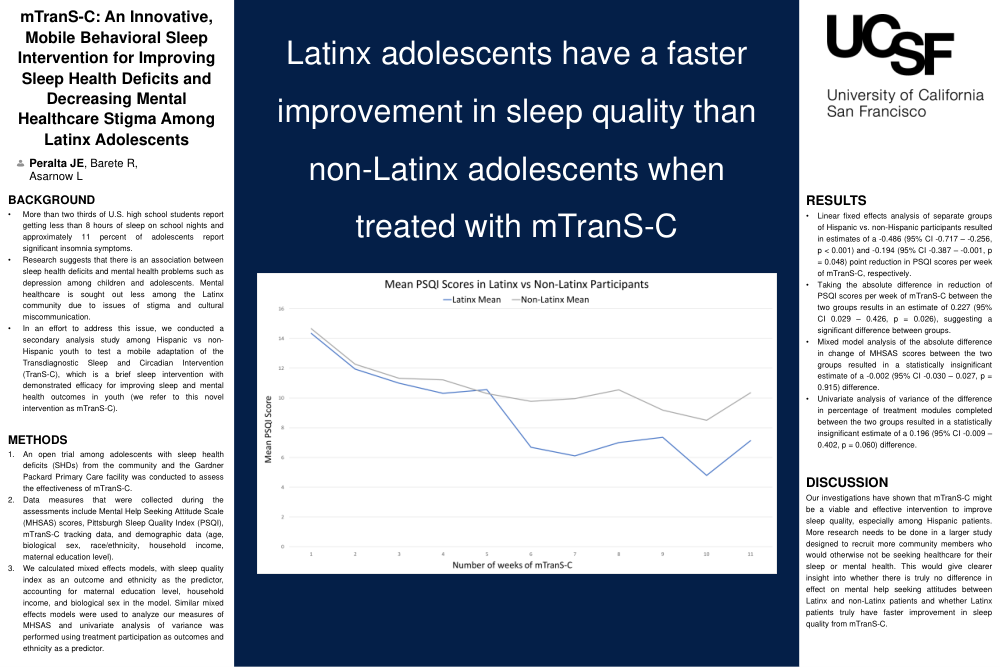
18 Hispanic/Latinx and 30 non-Latinx adolescents participated in the study for a total sample size of 48 participants. Linear fixed effects analysis of separate groups of Hispanic vs. non- Hispanic participants resulted in estimates of a -0.486 (95% CI -0.717 – -0.256, p < 0.001) and -
0.194 (95% CI -0.387 – -0.001, p = 0.048) point reduction in PSQI scores per week of mTranS-C, respectively. Taking the absolute difference in reduction of PSQI scores per week of mTranS-C between the two groups results in an estimate of 0.227 (95% CI 0.029 – 0.426, p = 0.026), suggesting a significant difference between groups. Mixed model analysis of the absolute difference in change of MHSAS scores between the two groups resulted in a statistically insignificant estimate of a -0.002 (95% CI -0.030 – 0.027, p = 0.915) difference. Univariate analysis of variance of the difference in percentage of treatment modules completed between the two groups resulted in a statistically insignificant estimate of a 0.196 (95% CI -0.009 – 0.402, p = 0.060) difference.
Discussion
Here we have shown that mTranS-C can be an effective intervention that results in a significant improvement in sleep quality among both Hispanic and non-Hispanic participants. We have also demonstrated that mTranS-C results in a faster rate of decrease in PSQI scores among Hispanic participants vs non-Hispanic participants, suggesting that people who identify as Hispanic are likely to have a quicker improvement in sleep quality. Moreover, there is no significant difference in change of MHSAS scores or percentage of mTranS-C modules completed between the two groups, suggesting that mTranS-C is an equitable treatment that is accessible regardless of Hispanic identity. One major limitation of this study is that it is a post-hoc analysis of a prior trial that was not originally designed to investigate differences in outcomes between demographic groups, thus our finding that Hispanic participants improved their sleep quality faster could be a false positive. Selection bias is another important factor to consider since participants recruited from the community and clinic are more likely to have good attitudes towards seeking mental health care and are thus more likely to consent to participating in the study. Nevertheless, our investigations have shown that mTranS-C might be a viable and effective intervention to improve sleep quality, especially among Hispanic patients. More research needs to be done in a larger study designed to recruit more community members who would otherwise not be seeking healthcare for their sleep or mental health. This would give clearer insight into whether there is truly no difference in effect on mental help seeking attitudes between Latinx and non-Latinx patients and whether Latinx patients truly have faster improvement in sleep quality from mTranS-C.