127 posters, 10 topics, 20 sessions, 127 authors
ePostersLive by SciGen Technologies S.A. All rights reserved.
UCSF 2024 Inquiry Symposium
Conference ePosters

P073
CArdiac REhabilitation for Building Exertional heArt Rate for Chronotropic Incompetence in Long COVID (CARE BEAR-LC): Update on Early Enrollment Phase of a Pilot, Mechanistic Trial
Poster Presenter
Authors
Part of Topic
Clinical & Translational Sciences
Title:
CArdiac REhabilitation for Building Exertional heArt Rate for Chronotropic Incompetence in Long COVID (CARE BEAR-LC): Update on Early Enrollment Phase of a Pilot, Mechanistic Trial
Authors:
Christopher A. Hill, Danny Li, Marta Levkova, Veronica Schaffer, Shreya Swaminathan, Michael
J. Peluso, Donald J. Grandis, Steven G. Deeks, Priscilla Y. Hsue, Matthew S. Durstenfeld
Introduction:
Following initial infection with SARS-CoV-2, up to 30% of people experience persistent symptoms lasting months after the acute phase of the illness in a poorly understood syndrome known as Long Covid (LC) or Post-Acute Sequalae of COVID-19 (PASC). Cardiopulmonary symptoms including chest pain, palpitations, shortness of breath, and fatigue are common, and the presence of these symptoms has been shown to be associated with significantly reduced exercise capacity when measured with cardiopulmonary exercise testing (CPET). Physiologic mechanisms leading to this reduction in exercise capacity may be multifactorial, with proposed contributing factors including deconditioning, autonomic dysfunction, endothelial dysfunction, and abnormal peripheral oxygen extraction or use. An exercise prescription is emerging as a leading therapeutic option to achieve recovery of normal function in these patients. However, more rigorous studies are required to confirm a causal relationship between the intervention and response. Furthermore, the optimal type and duration of exercise remain unknown.
Hypothesis:
In a non-randomized, controlled trial, participants with LC-associated exercise intolerance who complete a 16-week cardiac rehabilitation (CR) program will demonstrate increases in peak VO2 and peak exercise heart rate, which will result in improved clinical symptoms as well as respiratory capacity, anaerobic threshold, endothelial function and inflammatory markers.
Aims:
Aim 1: To assess whether 16 weeks of cardiac rehabilitation improves exercise capacity as measured by peak VO2 during maximal cardiopulmonary exercise testing among adults with reduced exercise capacity and chronotropic incompetence in the setting of Long COVID.
Methods:
This single-center study uses a pre-post design with a non-randomized control group to establish whether CR improves exertional chronotropy and exercise capacity (peak VO2) in LC.
Inclusion Criteria: Adults age ≥18 with confirmed SARS-CoV-2 infection at least 3 months prior, at least one persistent COVID-attributed symptom without alternative explanation, reduced exercise capacity <85% predicted and adjusted heart rate reserve achieved <80%.
Exclusion Criteria: Pre-existing cardiac disease, chronic lung disease requiring home oxygen, on beta-blockers, non-dihydropyridine calcium channel blockers or ivabradine, implanted pacemaker, and severe post-exertional malaise.
Baseline assessments: Baseline assessments include a symptomatic assessment with validated questionnaires, blood collection for measurement of hemoglobin and inflammatory markers, cardiopulmonary exercise testing, and brachial artery flow mediated dilation (FMD) testing.
Intervention: Participants in the intervention group will complete the standard of care cardiac rehabilitation program at UCSF Parnassus. Using the hybrid model, participants will attend twice weekly CR sessions in-person for the first five weeks, then transition to a primarily virtual model for ten weeks. CR entails an individualized exercise prescription as well as dietary, smoking cessation, and stress management counseling.
Control group: A non-randomized control group will include individuals who would otherwise be eligible for the study but are not able to participate in CR due to scheduling constraints.
Follow up assessments: To be completed within two weeks of the completion of the CR program, follow up assessments will involve a repeat of the baseline tests.
Results:
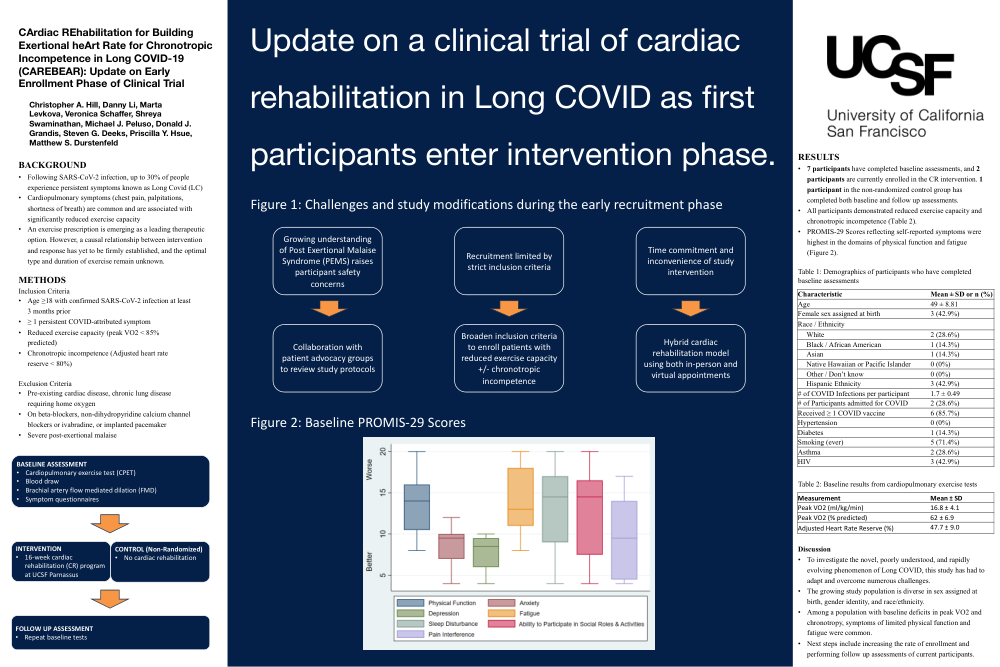
CAREBEAR-LC has currently performed 7 baseline assessments, and 2 participants are currently enrolled in the CR intervention. One participant in the non-randomized control group has completed both baseline and follow up assessments.
Among the participants who have completed baseline assessments, the average age was 49 years old, and 3 /7 (43%) were female sex assigned at birth. The mean number of prior SARS-CoV-2 infections was 1.7.
At baseline, all participants had reduced exercise capacity (peak VO2 < 85% predicted) and chronotropic incompetence (AHRR < 80%). Using the Patient-Reported Outcomes Measurement Information System (PROMIS) to characterize the nature and severity of symptoms experienced by participants at baseline, scores were highest in the domains of physical function and fatigue (Figure 1).
Discussion:
To investigate the novel, poorly understood, and rapidly evolving phenomenon of Long COVID, this study has had to adapt and overcome numerous challenges.
Principally, the development of this study coincided with the emergence of post-exertional malaise syndrome (PEMS) as a common manifestation of Long COVID. This observation raised concerns that rigorous exercise could worsen LC symptoms and harm participants.
Communication with patient advocacy groups has been essential to collaboratively review study protocols and ensure adequate participant education around risks and benefits.
Additionally, the underlying mechanisms driving exercise intolerance in LC are poorly understood. Consequently, inclusion criteria for the study have needed to be adjusted during the early enrollment phase. Specifically, the original criteria of reduced exercise capacity <85% predicted and adjusted heart rate reserve achieved <80% on maximal CPET have been relaxed to allow enrollment of more participants.
Finally, the time commitment of attending in-person CR appointments has presented a barrier for some participants. Our study has sought to mitigate this barrier by offering a hybrid model of CR, which includes both in-person and virtual appointments.
Table 1: Demographics of participants who completed baseline assessments
|
Characteristic |
Mean ± SD or n (%) |
|
Age |
49 ± 8.81 |
|
Female sex assigned at birth |
3 (42.9%) |
|
Race / Ethnicity |
|
|
White |
2 (28.6%) |
|
Black / African American |
1 (14.3%) |
|
Asian |
1 (14.3%) |
|
Native Hawaiian or Pacific Islander |
0 (0%) |
|
Other / Don’t know |
0 (0%) |
|
Hispanic Ethnicity |
3 (42.9%) |
|
Number of COVID Infections per participant |
1.7 ± 0.49 |
|
Number of participants admitted for COVID |
2 (28.6%) |
|
Received ≥ 1 COVID vaccine |
6 (85.7%) |
|
Hypertension |
0 (0%) |
|
Diabetes |
1 (14.3%) |
|
Smoking (ever) |
5 (71.4%) |
|
Asthma |
2 (28.6%) |
|
HIV |
3 (42.9%) |
Table 2: Baseline results from cardiopulmonary exercise tests
|
Measurement |
Mean ± SD |
|
Peak VO2 (ml/kg/min) |
16.8 ± 4.1 |
|
Peak VO2 (% predicted) |
62 ± 6.9 |
|
Adjusted Heart Rate Reserve (%) |
47.7 ± 9.0 |
Figure 1: Baseline PROMIS-29 scores