127 posters, 10 topics, 20 sessions, 127 authors
ePostersLive by SciGen Technologies S.A. All rights reserved.
UCSF 2024 Inquiry Symposium
Conference ePosters

P071
Diagnostic Test Accuracy for Deep Fungal Infections
Poster Presenter
Authors
Part of Topic
Clinical & Translational Sciences
Title: Diagnostic Test Accuracy for Deep Fungal Infections
Introduction: Cutaneous invasive fungal disease refers to a range of severe, infectious processes involving the skin that can stem from either primary infection or by spreading to the skin from an internal infectious source. In both cases, skin exam findings are crucial in establishing the diagnosis of these potentially life-threatening infections. These infections most commonly affect patients with immunodeficiencies, severe comorbidities, and advanced age. Because of the nature of these infections and the populations they typically affect, timely diagnosis is critical in maximizing treatment outcomes. Though dermatologists rely on diagnostic tests such as potassium hydroxide staining, fungal tissue culture, dermatopathology, and universal fungal PCR, the performance of these tests remains understudied.
Aims:
Determine the sensitivity, specificity, positive predictive value (PPV), and negative predictive value (NPV) of the diagnostic tests available for use on skin tissue specimens, using the final clinical diagnosis as the gold standard.
Assess the speed at which diagnostic tests run on skin tissue return.
Describe the clinical characteristics and outcomes of the population typically affected by cutaneous invasive fungal disease.
Describe the range of fungal species typically grown on fungal culture from suspected cutaneous invasive fungal disease.
Methods:
Positive diagnostic tests for fungal infection from microbiology and dermatopathology databases for skin tissue samples were retrospectively reviewed from the University of California, San Francisco from 2012-2022. Available test results from the corresponding patients were extracted, and the sensitivity, specificity, PPV, and NPV of these tests were analyzed, using the final clinical diagnosis as the reference standard. Additionally, clinical and demographic characteristics of the population were collected, as well as data on the outcomes of the episodes of infection.
Results:
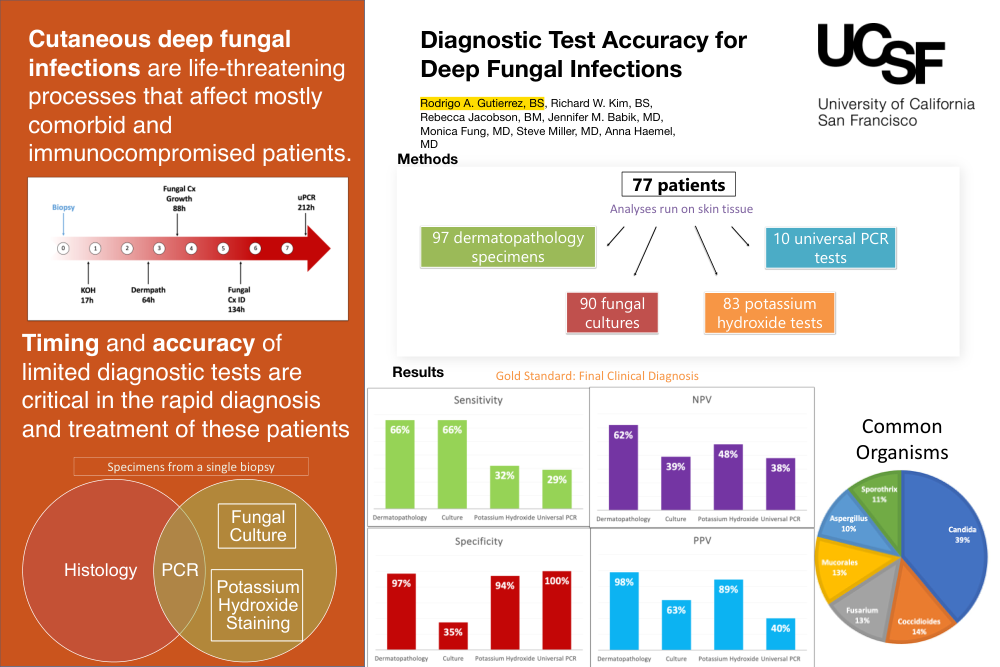
The study population consisted of 97 dermatopathology specimens, 90 fungal cultures, 83 potassium hydroxide tests, and 10 universal fungal PCR results. These tests results were taken from a total of 77 patients. 53% were male with a median age of 53, and relevant comorbidities included liver disease (26%), diabetes mellitus (25%), transplant history (23%), and hematologic malignancy (23%). Dermatopathology had 66% sensitivity, 97% specificity, 98% PPV, and 62% NPV. Potassium hydroxide staining had 32% sensitivity, 94% specificity, 89% PPV, and 48% NPV. Fungal culture had 66% sensitivity, 35% specificity, 63% PPV, and 39% NPV. Universal fungal PCR had 29% sensitivity, 100% specificity, 40% PPV, and 38% NPV. The mean time to a positive result for each test was 17 hours for potassium hydroxide staining, 64 hours for
dermatopathology, 88 hours for fungal culture growth, 134 hours for culture organism identification, and 212 hours for universal fungal PCR. Combining dermatopathology and fungal culture analyses on the same skin tissue sample increased the sensitivity to 91%. Of all fungal organisms identified by isolation from culture, the breakdown is as follows: Candida (33%), Coccidioides (12%), Fusarium (11%), Mucorales (11%), Aspergillus (9%), and Sporothrix (9%).
Discussion/Conclusion:
This study underscores the medically vulnerable patient population typically affected by cutaneous invasive fungal disease, and the limited performance of the diagnostic tests available to dermatologists in the inpatient setting. Given the importance of timely, accurate results in diagnosing these severe infections, running multiple diagnostic tests on the same skin tissue sample is helpful in diagnosing invasive fungal disease. This study was limited by incorporation bias and data collection from a single, urban institution on the west coast of the US, limiting the external validity of these results. This study is aimed to assist physicians in assessing hospitalized patients with suspected life-threatening infection.