127 posters, 10 topics, 20 sessions, 127 authors
ePostersLive by SciGen Technologies S.A. All rights reserved.
UCSF 2024 Inquiry Symposium
Conference ePosters

P070
Patient-Reported Aesthetic Outcomes Following Cervicofacial Reconstruction with Microvascular Free Tissue Transfer
Poster Presenter
Authors
Part of Topic
Clinical & Translational Sciences
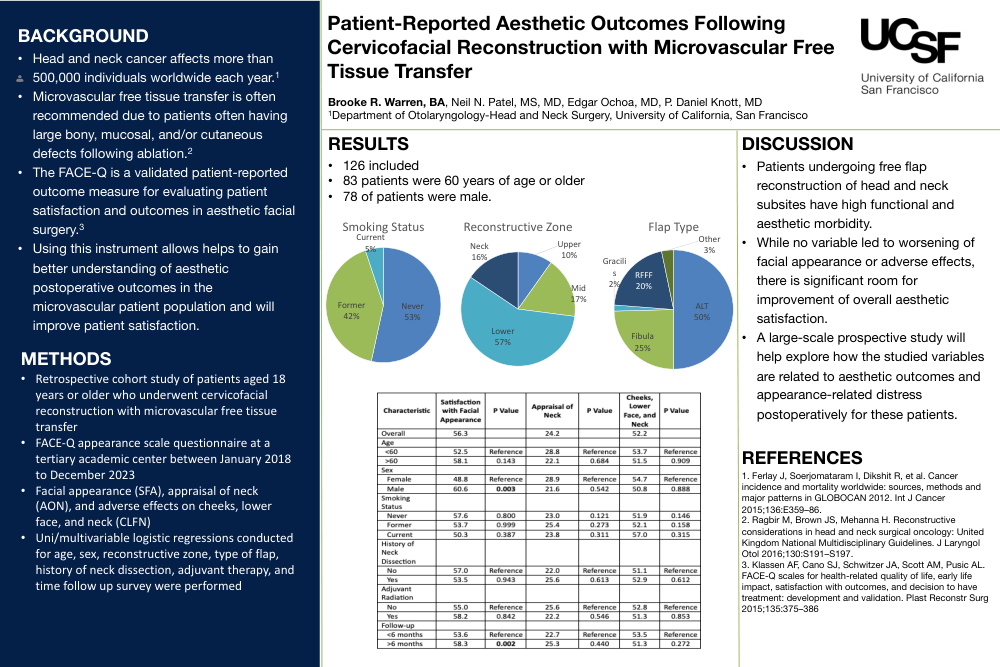
Title: Patient-Reported Aesthetic Outcomes Following Cervicofacial Reconstruction with Microvascular Free Tissue Transfer
Brooke R. Warren, BA, Neil N. Patel, MS, MD, Edgar Ochoa, MD, P. Daniel Knott, MD
Introduction: Head and neck cancer affect more than 500,000 individuals worldwide every year. Microvascular free tissue transfer is often recommended due to patients often having large bony, mucosal, and/or cutaneous defects following ablation.1 Increased understanding of disease phenotype and advances in adjuvant therapy have improved patient longevity and has
improved cancer survivorship.2 Reconstructive surgery therefore extends beyond tissue
replacement—it now aims to improve in aesthetic appearance and overall function. The FACE-Q is a validated patient-reported outcome measure for evaluating patient satisfaction and outcomes in aesthetic facial surgery.3 Using this instrument allows an avenue to gain better understanding of aesthetic postoperative outcomes in the microvascular patient population and will help to improve patient satisfaction.
Aims: The aim of this study was to assess the long-term patient-reported satisfaction with facial appearance following microvascular facial reconstruction and to identify independent predictors for appearance-related distress utilizing the FACE-Q patient-reported outcome measures.
Methods: We conducted a retrospective cohort study of patients aged 18 years or older who underwent cervicofacial reconstruction with microvascular free tissue transfer. Patients completed a FACE-Q appearance scale questionnaire at a tertiary academic center between January 2018 to December 2023. The survey includes facial appearance (SFA), appraisal of neck (AON), and adverse effects on cheeks, lower face, and neck (CLFN). Scores were tallied on a 4- point Likert scale, then converted to a Rasch modeled scale of 0 to 100 where higher scores reflected high overall satisfaction and outcomes. Adverse effects score (CLFN) was tallied on a 3- point Likert scale and converted to a 0 to 100 scale where higher scores reflected poorer outcomes. Univariate logistic regressions were conducted for age, sex, reconstructive zone, type of flap, history of neck dissection, adjuvant therapy, and time follow up survey were completed. Multivariable analysis was also conducted with the same variables.
Results: Of all charts reviewed, 126 patients who underwent free flap reconstruction of a head and neck subsite met study criteria. 83 patients were 60 years of age or older. 78 of patients were male. A majority of patients (51%) have no smoking history, while 40% smoked previously and 5% currently smoke. 68 patients have a history of neck dissection and 49 underwent adjuvant radiation. The lower face was the most common reconstructive zone (70), followed by
mid face (21) and neck (19). There were 61 ALT flaps, 30 fibula flaps, 25 radial forearm free flaps (RFFF), and 2 gracilis flaps.
The average SFA, AON, and CLFN score for the cohort was 56.3, 24.2, and 52.2, respectively. On multivariable regression, male patients had significantly higher satisfaction compared to female patients (p = 0.003). Increased time following procedure was also associated with higher
satisfaction of facial appearance (p = 0.002). There was no statistically significant difference for
SFA, AON, and CLFN scores on both univariate and multivariable analysis based on
reconstructive zone or type of flap utilized. Additionally, smoking status and history of neck dissection did not have significant association on FACE-Q scores in aforementioned categories.
Conclusion: Patients undergoing free flap reconstruction of head and neck subsites have high functional and aesthetic morbidity. While no variable led to worsening of facial appearance or adverse effects, there is significant room for improvement of overall aesthetic satisfaction. A
large-scale prospective study will help explore how the studied variables are related to aesthetic outcomes and appearance-related distress postoperatively for these patients.