127 posters, 10 topics, 20 sessions, 127 authors
ePostersLive by SciGen Technologies S.A. All rights reserved.
UCSF 2024 Inquiry Symposium
Conference ePosters

P066
INSTITUTIONAL EXPERIENCE TREATING CHILDREN WITH RELAPSED/REFRACTORY ACUTE MYELOID LEUKEMIAS WITH CPX-351, A LIPOSOMAL FORMULATION OF CYTARABINE AND DAUNORUBICIN
Poster Presenter
Authors
Part of Topic
Clinical & Translational Sciences
Title: Institutional Experience Using CPX-351 in Children with Relapsed/Refractory Myeloid Malignancies
Introduction: Survival rates in pediatric acute myeloid leukemia (AML) are poor, with 40% of patients dying from leukemia or treatment-related toxicity1. At relapse, AML is rarely curable, with a five-year overall survival (OS) of 30%2 despite hematopoietic stem cell transplantation (HSCT). The presence of minimal residual disease (MRD) prior to HSCT is a negative prognostic factor3,4. Thus, the ability of AML salvage regimens to induce MRD-negative remissions is vital. However, there is no clear consensus regarding the optimal treatment of relapsed/refractory AML. In 2019, the Children’s Oncology Group (COG) released the results of a pediatric phase I/II study (AAML1421) of CPX-351, a liposomal preparation of cytarabine and daunorubicin. This trial of AML in first relapse reported an overall response rate (ORR) of 75.6% after one cycle, similar to other published regimens for relapsed AML with the potential for reduced cardiotoxicity. Based on these results, CPX-351 is often utilized as an AML salvage regimen.
Aim: We present our institutional experience administering CPX-351 to children with relapsed myeloid malignancies to provide a “real-world” experience that more closely recapitulates the heterogeneity of relapsed disease.
Method: We performed a retrospective chart review at UCSF Benioff Children’s Hospitals from January 2016 through August 2023 after institutional review board approval. We identified all patients who received CPX-351 as a salvage regimen for relapsed myeloid malignancies, including those who received CPX-351 with other targeted agents.
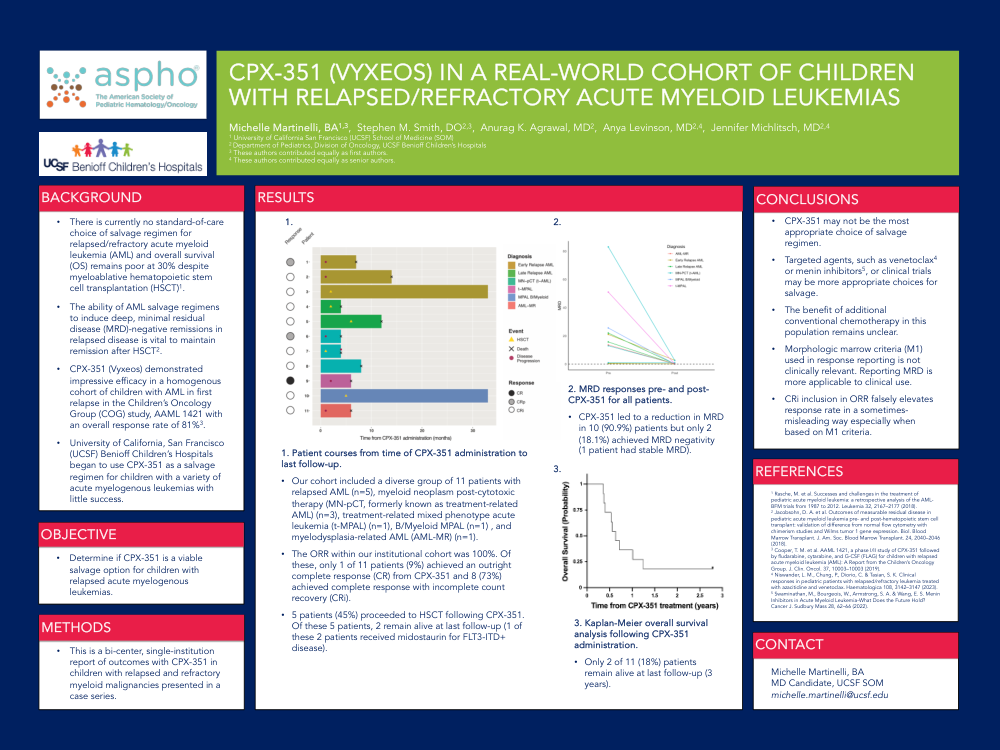
Results: We identified a diverse group of 11 patients with relapsed AML (n=5), myeloid neoplasm post-cytotoxic therapy (MN-pCT, formerly known as treatment-related AML) (n=3), treatment-related mixed phenotype acute leukemia (t-MPAL) (n=1), B/Myeloid MPAL (n=1) , and myelodysplasia-related AML (AML-MR) (n=1). This cohort of patients was similar in age, CNS status, and prior HSCT status to the AAML1421 cohort. While we observed a 100% ORR, only 2/11 (18%) achieved MRD negativity and OS was dismal at 18%.
Discussion: In this heterogeneous “real world” cohort of patients with relapsed/refractory pediatric myeloid malignancies, CPX-351 was associated with a very low frequency of
MRD-negative remissions and similarly discouraging OS. Acknowledging the critical limitations of small sample size and disease heterogeneity, based on our findings, CPX-351 does not appear superior to other regimens, particularly those containing venetoclax (33-48% MRD negativity rate)5,6. Further study on a larger scale and novel, targeted agents are needed to improve survival of children with relapsed and refractory myeloid malignancies.
References
- Gamis, A. S. et al. Gemtuzumab Ozogamicin in Children and Adolescents With De Novo Acute Myeloid Leukemia Improves Event-Free Survival by Reducing Relapse Risk: Results From the Randomized Phase III Children’s Oncology Group Trial AAML0531. J. Clin. Oncol. 32, 3021–3032 (2014).
- Rasche, M. et al. Successes and challenges in the treatment of pediatric acute myeloid leukemia: a retrospective analysis of the AML-BFM trials from 1987 to 2012. Leukemia 32, 2167–2177 (2018).
- Impact of MRD status in patients with AML undergoing allogeneic stem cell transplantation in the first vs the second remission | Blood Advances | American Society of Hematology. https://ashpublications.org/bloodadvances/article/6/15/4570/485324/Impact-of-MRD-status-in-patients-with-AML.
- Jacobsohn, D. A. et al. Outcomes of measurable residual disease in pediatric acute myeloid leukemia pre- and post-hematopoietic stem cell transplant: validation of difference from normal flow cytometry with chimerism studies and Wilms tumor 1 gene expression. Biol. Blood Marrow Transplant. J. Am. Soc. Blood Marrow Transplant. 24, 2040–2046 (2018).
- Niswander, L. M., Chung, P., Diorio, C. & Tasian, S. K. Clinical responses in pediatric patients with relapsed/refractory leukemia treated with azacitidine and venetoclax. Haematologica 108, 3142–3147 (2023).
- Karol, S. E. et al. Venetoclax in combination with cytarabine with or without idarubicin in children with relapsed or refractory acute myeloid leukaemia: a phase 1, dose-escalation study. Lancet Oncol. 21, 551–560 (2020).