127 posters, 10 topics, 20 sessions, 127 authors
ePostersLive by SciGen Technologies S.A. All rights reserved.
UCSF 2024 Inquiry Symposium
Conference ePosters

P062
Early Opioid Use and Postoperative Delirium Following Open Abdominal Aortic Aneurysm Repair
Poster Presenter
Authors
Part of Topic
Clinical & Translational Sciences
Title:
Early Opioid Use and Postoperative Delirium Following Open Abdominal Aortic Aneurysm Repair
Introduction:
Postoperative delirium is a common complication following open abdominal aortic aneurysm repair (OAR). Opioids have been found to contribute to delirium, especially at higher doses. Postoperative delirium is associated with increased postoperative complications and resource utilization. Despite this, data regarding the impact of early postoperative opioid use and postoperative delirium after OAR is limited.
Hypothesis or Question:
We hypothesized that higher early postoperative opioid utilization would be associated with increased postoperative delirium incidence.
Aims:
This study assessed the impact of early postoperative opioid analgesia on postoperative delirium incidence, time to onset, and outcomes.
Project Design/Methods:
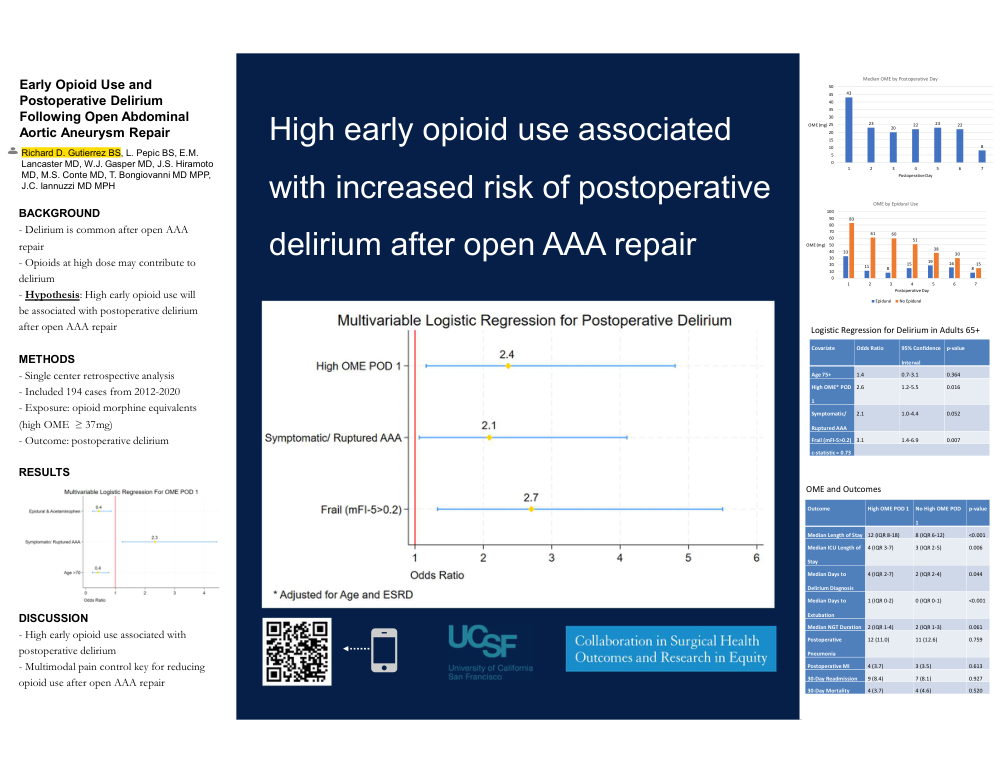
This was a retrospective analysis of OAR cases at a single quaternary care center from years 2012-2020. The primary exposure was oral morphine equivalents use (OME), calculated for postoperative days 1-7. A cut point analysis using a receiver operator curve for postoperative delirium determined the threshold for high OME (OME>37mg). The primary outcome was postoperative delirium incidence identified via a validated chart review method. Multivariable logistic regression was performed for postoperative delirium and adjusted for covariates meeting p<0.1 on bivariate analysis.
Results/Product:
Among 194 OAR cases, 67 (35%) developed postoperative delirium with median time to onset of 3 days (IQR=2-6). Patients with postoperative delirium were older (74 years vs 69 years), more frequently presented with symptomatic AAA (47% vs 27%) and had a higher proportion of comorbidities (all p<0.05). Cases with high OME utilization on postoperative day 1 (55%) were younger (69 vs 73 years), less frequently had an epidural (46% vs 77%), less frequently received acetaminophen on postoperative day 1 (49% vs 78%) and more frequently developed delirium (42% vs 25%, all p<0.05). Epidural use was associated with a significant decrease in OME utilization on postoperative day 1 (33 vs 83, p<0.01).
Postoperative delirium onset was later in those with high OME use (4 vs 2 days, p=0.04). On multivariable analysis, high OME remained associated with postoperative delirium after controlling for age, procedure urgency, frailty, and end-stage renal disease. In addition, epidural and acetaminophen use were protective against high OME utilization in a multivariable model.
Discussion/Conclusion:
High early opioid use is associated with an increased risk for postoperative delirium in patients undergoing OAR. Additionally, epidural and early acetaminophen use was associated with a significant reduction in early opioid utilization. Our study should be interpreted in the context of its limitations including its single center retrospective nature, limiting our generalizability and ability to control for all confounders. Along with other multidisciplinary interventions, epidural analgesia and acetaminophen may be important targets in helping reduce delirium. Future study should examine the potential impact of pain control regimens with targeted opioid reduction strategies in the postoperative setting on outcomes such as postoperative delirium for patients undergoing OAR.