127 posters, 10 topics, 20 sessions, 127 authors
ePostersLive by SciGen Technologies S.A. All rights reserved.
UCSF 2024 Inquiry Symposium
Conference ePosters

P061
Liver Perfusion Protocol for Supercooling Preservation
Poster Presenter
Authors
Part of Topic
Clinical & Translational Sciences
Liver Perfusion Protocol for Supercooling Preservation
Sophie Kupiec-Weglinski, Juan C. Reyna, Tammy T. Chang Department of Surgery, University of California, San Francisco
Introduction:
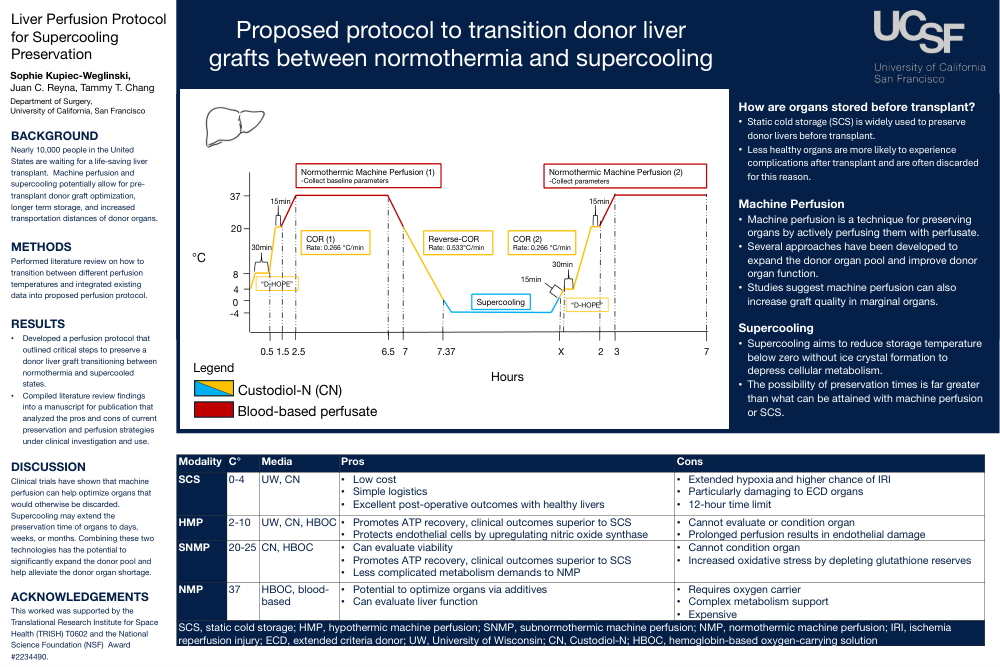
As of 2024, according to United Network for Organ Sharing (UNOS) data, nearly 10,000 people are waiting in the United States for a life-saving liver transplant. As the population ages, more donor livers meet extended-criteria donor (ECD) definitions, and over 50% of potential donor livers are predicted to be unsuitable for transplant by the end of this decade. Researchers have developed several machine perfusion approaches to expand the donor organ pool and improve donor organ function. Three major machine perfusion technologies exist for livers today: hypothermic machine perfusion (HMP), subnormothermic machine perfusion (SNMP), and normothermic machine perfusion (NMP). Each strategy has been shown in clinical trials to improve marginal organ function and, in some cases, enable transplant of donor organs that would have been otherwise discarded. To further improve graft quality and expand the donor pool, researchers have started combining HMP, SNMP, and NMP with supercooling, which could potentially allow ice-free storage of organs for days to weeks. However, limited information exists on the transition between these perfusion methods through different temperature ranges. Our research examined different combined liver perfusion protocols and identified the necessary steps to ensure a seamless and safe transition between them.
Hypothesis:
We hypothesize that a perfusion protocol can be developed in conjunction with supercooling to improve the storage and post-transplant outcomes of donor liver grafts, thus helping to alleviate the shortage of donor organs.
Aims:
To critically analyze current perfusion literature and determine optimal strategies to transition between perfusion modalities and temperatures.
Project Design/Methods:
We utilized PubMed to search for publications detailing various perfusion protocols, including NMP, HMP, and SNMP. We targeted publications that delved into the transition between diYerent temperatures because this topic was typically explored in less depth than static temperature perfusion protocols. From these previous protocols, we were able to derive a dynamic perfusion protocol for human livers that utilized all three perfusion techniques as well as supercooling.
Summary of major findings: After analyzing data from over 50 sources, we have developed a comprehensive perfusion protocol that can transition the liver from normothermic machine perfusion to supercooling preservation and back to normothermia. Major findings include which kind of perfusate should be used at specific temperatures, the range of temperatures where liver tissues are particularly susceptible to reperfusion injury, and the rate at which livers should be warmed. We described our findings in a review article manuscript that will be submitted for publication.
Discussion/Conclusion:
Liver transplantation faces a considerable challenge due to the shortage of donor organs relative to the increasing number of individuals in need. To tackle this issue, we developed a perfusion protocol to machine perfuse and supercool human donor liver grafts to minimize organ damage and increase preservation time. The supercooling aspects of the protocol require further exploration because additional experiments are needed to determine the optimal conditions to transition liver grafts through sub-zero temperatures leading up to stable supercooling preservation. This proposed protocol will be tested in our laboratory using human liver donor grafts deemed unsuitable for clinical transplant, and we will refine the protocol as needed.