127 posters, 10 topics, 20 sessions, 127 authors
ePostersLive by SciGen Technologies S.A. All rights reserved.
UCSF 2024 Inquiry Symposium
Conference ePosters

P059
Improving the Quality of Multidisciplinary Gastric Cancer Care in the Safety Net Setting at ZSFG
Poster Presenter
Authors
Part of Topic
Clinical & Translational Sciences
Improving the Quality of Multidisciplinary Gastric Cancer Care in the Safety Net Setting at ZSFG
Chiara Wabl; Hannah Rees, MD; Adnan Alseidi, MD; Niharika Dixit, MD; Terence Friedlander, MD; Rebecca DeBoer, MD.
Introduction
Gastric cancer is a leading cause of cancer death worldwide and disproportionally affects people of East Asian and Latin American ethnicities. Multidisciplinary providers at Zuckerberg San Francisco General Hospital (ZSFG) previously recognized a need to improve the quality of gastric cancer care.
Aims
This study aimed to implement and evaluate the effectiveness of an intervention to improve the guideline concordance and quality of gastric cancer care at ZSFG.
Methods
This was a pre-post study evaluating clinical data before and after a quality improvement (QI) intervention. First, a retrospective chart review of all patients with gastric adenocarcinoma at ZSFG between 2017-2019 (n=17) evaluated the concordance of care with evidence-based guidelines and quality metrics. Second, multidisciplinary meetings identified barriers to high quality care and established targets for improvement. Third, a context-specific algorithm was disseminated to standardize gastric cancer management at ZSFG. Fourth, a post-intervention chart review was conducted of all patients managed in 2021-2022 (n=22). Descriptive statistics and pre-post comparison of target metrics with Chi square and Kruskal Wallis tests were performed.
Results
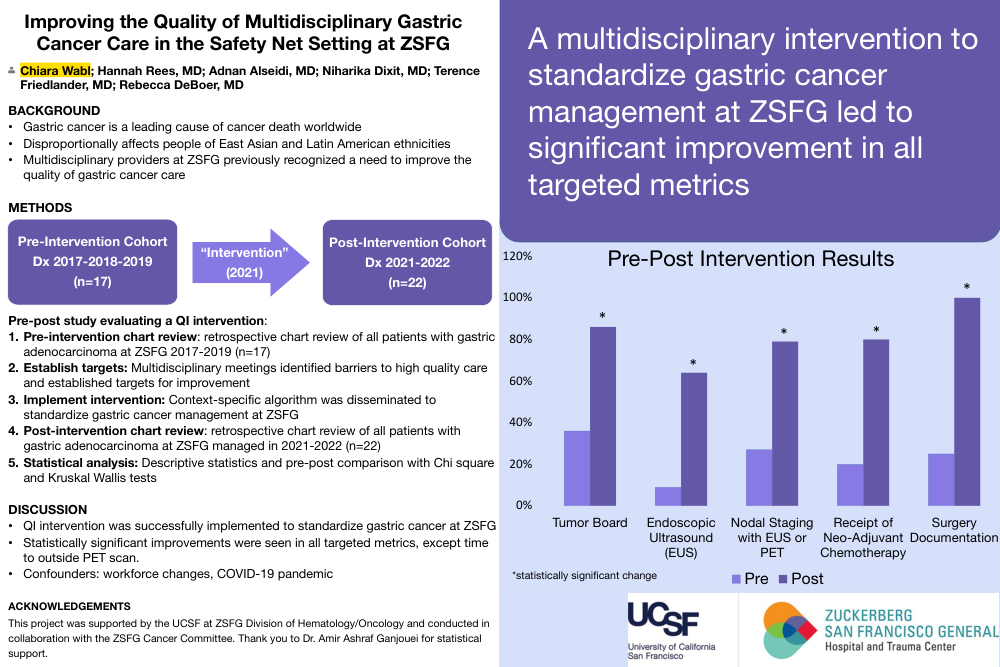
Barriers contributing to gaps in care included limited provider knowledge, rapidly evolving clinical guidelines, limited availability of diagnostic resources, and non-standardized surgical documentation. After implementation of an intervention to address these barriers, pre-post comparison revealed improvement in tumor board presentation (36.3% vs. 85.7%, P=0.033), endoscopic ultrasound (9.09% vs. 64.2%, P=0.017), nodal staging (27.2% vs. 78.5%, P=0.030), receipt of neoadjuvant chemotherapy (20% vs. 80%, P=0.007), documentation of lymphadenectomy type (25% vs. 100%, P=0.015), and time to PET scan (median, 8.5 weeks pre vs 7.1 weeks post, P= 0.268).
Discussion
A QI intervention was successfully implemented to standardize gastric cancer care at ZSFG. Statistically significant improvements were seen in all targeted metrics, except time to outside PET scan. Potential confounders affecting care quality included workforce changes (new surgical oncology and specialized endoscopy providers) and the COVID-19 pandemic. Nevertheless, our intervention led to sustained improvements in practice patterns, and we aim to replicate it in other malignancies at ZSFG.