127 posters, 10 topics, 20 sessions, 127 authors
ePostersLive by SciGen Technologies S.A. All rights reserved.
UCSF 2024 Inquiry Symposium
Conference ePosters

P012
Outcomes and adverse events in patients with cancer after diagnosis of immunotherapy-associated diabetes mellitus: a retrospective cohort study
Poster Presenter
Authors
Part of Topic
Clinical & Translational Sciences
Title: Outcomes and adverse events in patients with cancer after diagnosis of immunotherapy- associated diabetes mellitus: a retrospective cohort study
Abstract
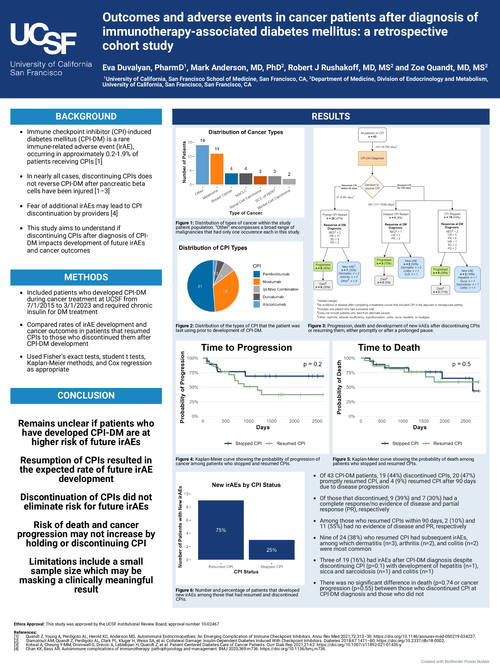
Introduction: Immune checkpoint inhibitor (CPI)-induced diabetes mellitus (CPI-DM) is a rare immune-related adverse event (irAE), occurring in approximately 0.2-1.9% of patients receiving CPIs. Unlike other irAEs, it is thought that discontinuing CPIs does not reverse CPI-DM once injury to beta-cells has occurred. Patients and providers fear that continuing CPIs puts patients at risk for additional morbidity from future irAEs and may discontinue therapy. Currently, there is little data to inform this decision.
Hypothesis: We hypothesize that patients who discontinue CPIs after CPI-DM will have lower rates of new irAEs and worse cancer outcomes compared to those who continued CPI therapy.
Aims: This study aims to elucidate whether discontinuing CPIs after diagnosis of CPI-DM impacts development of future irAEs and cancer outcomes.
Methods: Patients who developed CPI-DM during cancer treatment at UCSF from 7/1/2015 to 7/5/2023 were analyzed for cancer outcomes and irAE development. Fisher’s exact tests, Student t-tests, Kaplan-Meier methods, and Cox regression were used as appropriate.
Results: Of 43 patients with CPI-DM, 20 (47%) resumed CPIs within 90 days of the irAE, 4 (9%) patients restarted after 90 days, and 19 (44%) patients never restarted. Nine (39%) patients with complete response to CPI treatment (CR) discontinued CPI therapy while 2 (10%) resumed CPIs. Seven (30%) patients with partial response (PR) discontinued therapy and 11 (55%) resumed CPIs (p=0.15). Subsequent irAEs were diagnosed in 9 of 24 (38%) who resumed CPIs
and 3 of 19 (16%) who discontinued CPIs (p=0.17), among which dermatitis (22%), colitis (17%), and arthritis (11%) were most common. There was no significant difference in death (p=0.74), or cancer progression (p=0.55) between these two groups.
Conclusions: It remains unclear if patients who have developed CPI-DM are at higher risk for subsequent irAEs if CPI are resumed. While our single institution study did not show worse cancer outcomes after discontinuing CPIs, many variables impact outcomes which our study is not adequately powered to evaluate. A nuanced approach is needed to decide whether to continue CPI treatment after a severe irAE like CPI-DM, taking into account patient’s response to treatment, comorbidities, and risk tolerance.