127 posters, 10 topics, 20 sessions, 127 authors
ePostersLive by SciGen Technologies S.A. All rights reserved.
UCSF 2024 Inquiry Symposium
Conference ePosters

P058
Association between limited English proficiency (LEP) status and healthcare access, utilization, and satisfaction during the COVID-19 pandemic among individuals from low-resourced and minoritized backgrounds
Poster Presenter
Authors
Part of Topic
Epidemiology & Population Sciences
Title
Association between limited English proficiency (LEP) status and healthcare access, utilization, and satisfaction during the COVID-19 pandemic among individuals from lowresourced and minoritized backgrounds
Hamedullah Noorulhuda; Morgan Ye, MPH; Allison DeDent MD, MAS; Neeta Thakur, MD, MPH
Introduction
According to the 2021 American Community Survey, 8.3% of the American population, or 25.9 million people, have limited English proficiency (LEP)1 . LEP is defined by the US census as the ability to speak English less than “very well.” Previous studies have found LEP status has been associated with poor health, higher rates of not having a medical home, fewer regular check-ups, longer hospital stays when interpreters are not used, greater risk of line and surgical infections, and greater rates of readmission2-5 . While the disparities LEP patients face has been explored, there is a paucity of literature focused on healthcare access and utilization for these populations during the COVID-19 pandemic. The COVID-19 shelter-in-place measures and transitioning many components of healthcare to telehealth uniquely affected these patients as LEP populations face reduced access to technology, require medical interpreters, and have increased privacy concerns6 . This proposed study will investigate the relationship between LEP status and healthcare access, utilization, and satisfaction during the COVID-19 pandemic.
Aims
Aim 1: Characterize differences in the prevalence of having a medical home among patients from low income and minoritized backgrounds with LEP and without LEP. We hypothesize LEP individuals will have lower rates of having a usual place of seeking medical care.
Aim 2: Examine associations between LEP status and healthcare utilization (e.g., having ever been tested for coronavirus, being able to test for coronavirus if needed, receiving medical care if symptomatic). We hypothesize LEP individuals may have reduced rates of healthcare utilization compared to non-LEP counterparts.
Aim 3: Investigate associations between LEP status and satisfaction with an individual’s current medical care. We hypothesize LEP individuals may have reduced healthcare satisfaction.
Methods
The study data comes from the COVID19 Resources and Protections for Vulnerable and High-Risk Communities (RESOURCE) study—a longitudinal cohort study exploring health care access, perceptions of risk, and economic and social impact of the pandemic. From December 2020 until December 2021, 885 participants were enrolled across nine sites including Arizona, Texas, Colorado, Greater Boston metropolitan area, Chicagoland area, Kansas City metropolitan region, the Bronx, and the San Francisco Bay Area. Participants were adults aged 18 years or older and English, Spanish, and/or Portuguese speaking. Additionally, they needed to meet two of the three following criteria: 1) income <200% Federal Poverty Level (FPL) or live in a census tract where 20% of households in the census tract were <200% FPL, 2) person of color (Black, Latino, or Indigenous person), or 3) an immigrant. The Colorado site was an exception, as participants only were required to meet one of the three criteria if they were from a rural community. Participants were invited to complete the survey via telephone or online. The study was approved by the University of California San Francisco institutional review board and each respective site’s institutional review board.
Our main exposure of interest is English proficiency and was assessed by asking participants, “How comfortable do you feel communicating in English,” and responses ranged from very uncomfortable, somewhat uncomfortable, somewhat comfortable, and very comfortable. Responses indicating “very uncomfortable”, “somewhat uncomfortable”, and “somewhat comfortable” communicating in English were classified as having limited English proficiency status.
Healthcare access is the outcome variable and was assessed through several questions. Firstly, through the examination of having a medical home, participants were asked, “Is there a place that you USUALLY go to if you are sick and need health care?” Their responses included: “Yes”, “There is NO place”, “There is MORE THAN ONE place”, “Don’t know”, or “Other”. Participants were also asked about healthcare access specific to COVID-19 through the questions: 1) “Have you ever had a covid test?” and 2) “If you needed to would you be able to access a test for coronavirus?” The participants who selected “yes” were then asked to specify where they would get tested. The response categories available for selection were: “primary care”, “urgent care”, “emergency room”, “testing center”, or “somewhere else”. Participants were also asked questions regarding accessing care should they be symptomatic: “If you had symptoms concerning for coronavirus, and you became worried that you were not doing well, would you able to access CARE for yourself.” As before, if respondents who answered “yes” where then asked where they accessed care and had the option of selecting “primary care”, “urgent care”, “emergency room”, or “somewhere else”. Participants were also asked to rate their current medical care on a scale from 0 to 10.
Confounders for this study included age, sex, race/ethnicity, level of education, and household income. Study site was treated as a modifier for this study. Finally, insurance status will be a mediator. Race/ethnicity was categorized as Non-Hispanic White, NonHispanic Black, Hispanic, Asian, and other. Education was categorized as some high school or less, high school graduate, some college, and college or greater. Household income was categorized into tertiles with respect to their site. Insurance status was categorized as through an employer or union, direct purchase from insurance company, Medicare, government-assistance plans such as Medicaid, military health care, Veterans Affairs insurance, Indian Health Services, and uninsured.
Results
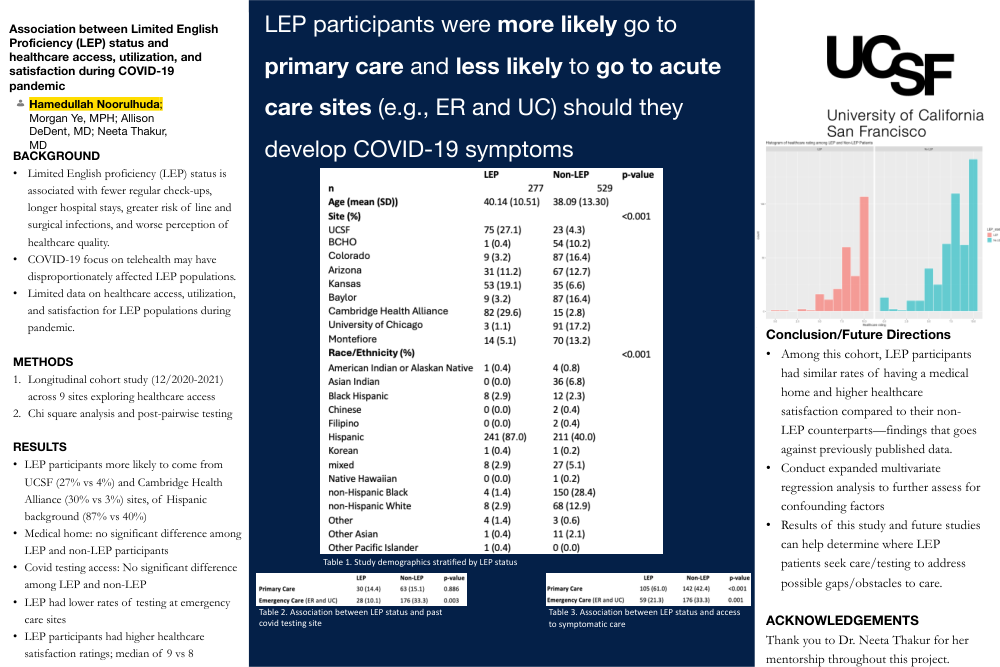
After removing participants with incomplete data, 806 participants (277 LEP, 529 non-LEP) across nine sites were included in the final analysis. Of note, LEP participants were more likely present at the UCSF (27.1% vs 4.3%), Cambridge Health Alliance (29.6% vs 2.8%), and Kansas (19.1% vs 6.6%) sites. The mean age for LEP participants was about 40 years old (SD: 10.51) and 38 years old (SD:13.30) for non-LEP patients. With regards to race/ethnicity, LEP patients were more likely to be Hispanic compared to their non-LEP counterparts (87% vs 40%). There was no significant difference between LEP and non-LEP participants with respect to gender or income. In terms of education, LEP participants were more likely to have attended up to either primary or middle school (12.4% and 20.4% vs 0.4% and 1%, respectively) than their non-LEP counterparts.
There were no significant differences in the presence of medical home between LEP and non-LEP (p-value = 0.36). There was also no significant difference in the association between LEP status and having had a COVID-19 test previously (p-value = 0.35). However, there is a significant difference in testing site as LEP participants were less likely to have received testing at more acute care sites, such as emergency rooms and urgent care, compared to non-LEP counterparts (10.1% vs 18.5%). There was no difference among the groups with respect to LEP status and being able to access a COVID-19 test (p-value = 0.33). While there were no significant differences in whether these participants could access healthcare should they be symptomatic, there was a significant difference in where they would get that care. LEP participants were more likely to go to primary care (61.0% vs 42.4%) and less likely to go to acute care sites such as urgent care and emergency room (21.3% vs 33.3%). With regards to healthcare satisfaction, LEP patients had higher satisfaction ratings (mean: 8.5, median: 9) when compared to their non-LEP counterparts (mean: 7.9, median: 8). A Wilcoxon rank test was performed, resulting in W= 71506 (p-value < 0.05), indicating that the LEP and non-LEP healthcare satisfaction distributions are significant different from one another.
Discussion
This study explores the association between LEP status and healthcare access, utilization, and satisfaction during the COVID-19 pandemic among individuals from low resource, minoritized backgrounds. There is a paucity of published literature regarding the effects of COVID-19 restrictions on healthcare access for LEP populations.
The finding within our cohort that LEP and non-LEP individuals having similar frequencies of having a medical home is surprising as it goes against previous published literature. Our focus on individuals from low resource and minority backgrounds as well as the differences in the site, race/ethnic, and education characteristics between two groups may account for the disparate findings.
While we did not find a significant association between LEP status and the likelihood of a previous covid test or being able to access a test in the future. It was surprising to find differences in coronavirus testing site with LEP participants having lower rates of being testing in acute care sites and more likely to get future tests through primary care. After running a logistic regression to account for site, race/ethnicity, income, education, and employment, there did not seem to be a significant difference between LEP and non-LEP individuals and testing sites.
With regards to healthcare satisfaction ratings, LEP individuals had higher satisfaction with their current healthcare than non-LEP counterparts. Again, this conflicts with previous published literature which suggested that LEP patients have lower perceived quality of care7 . The discrepancy here may be explained by our LEP cohort’s more Hispanic predominance (87% compared to the national rate of 62.9%1 ).
This study has several limitations. First, the data collected was from individuals from lowresourced and minoritized backgrounds making it difficult to generalize these conclusions to other populations. Second, LEP participants from this cohort primarily came from 3 sites (UCSF, Cambridge Health Alliance, and Kansas) and had stark differences in level of education. When accounting for these differences in a logistic regression model, the differences among LEP and non-LEP individuals were no longer significant. This may require the development of a model that better captures LEP status and detangles it from other confounders.
References:
1. United States Census Bureau. American Community Survey 2021: ACS 1-year Estimates Data Profile. Retrieved from https://data.census.gov/table?q=DP02&t=Language+Spoken+at+Home
2. Gulati, R. K. & Hur, K. Association Between Limited English Proficiency and Healthcare Access and Utilization in California. J Immigrant Minority Health 24, 95– 101 (2022).
3. Jang, Y. & Kim, M. T. Limited English Proficiency and Health Service Use in Asian Americans. J Immigrant Minority Health 21, 264–270 (2019).
4. Becerra, M. B., Becerra, B. J., Daus, G. P. & Martin, L. R. Determinants of Low Health Literacy Among Asian-American and Pacific Islanders in California. J. Racial and Ethnic Health Disparities 2, 267–273 (2015).
5. Applebaum, B. & Robbins, S. Language Access and Health Equity: Changes under the Affordable Care Act. Journal of Health Care for the Poor and Underserved 27, 416–426 (2016).
6. Tan-McGrory, A., Schwamm, L. H., Kirwan, C., Betancourt, J. R. & Barreto, E. A. Addressing virtual care disparities for patients with limited English proficiency. Am J Manag Care 28, 36–40 (2022).
7. Benjamins, M. R. & Whitman, S. Relationships between discrimination in health care and health care outcomes among four race/ethnic groups. J Behav Med 37, 402–413 (2014).