127 posters, 10 topics, 20 sessions, 127 authors
ePostersLive by SciGen Technologies S.A. All rights reserved.
UCSF 2024 Inquiry Symposium
Conference ePosters

P057
Preoperative Remote Cognitive Assessment for Delirium Prediction: A Pilot Study
Part of Topic
Clinical & Translational Sciences
Title:
Preoperative Remote Cognitive Assessment for Delirium Prediction: A Pilot Study
Authors:
Sara Zhou, B.A.1, Anika Sinha, B.A.1, Amy B. Wise, B.A.2, Sreya Dhanam, B.S.2, Kaylee Hernandez, B.A.1, Adam L. Boxer, M.D.2, Adam M. Staffaroni, Ph.D.2* , and Odmara L. Barreto Chang, M.D, Ph.D. 1* 1University of California San Francisco, Department of Anesthesia and Perioperative Care 2University of California San Francisco, Weill Institute for Neurosciences, Department of Neurology, Memory and Aging Center
* These authors contributed equally
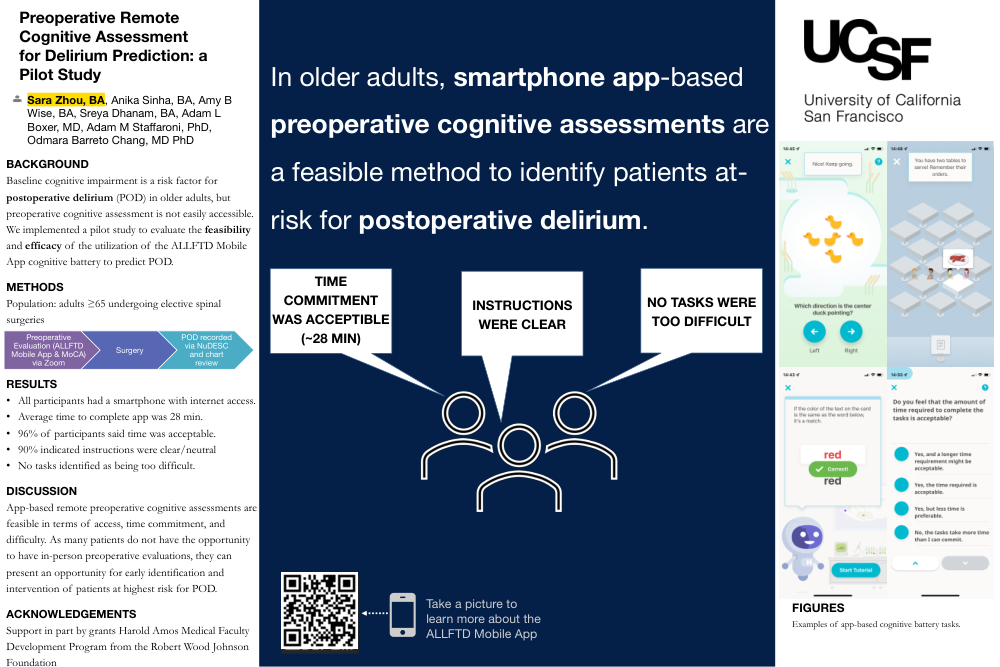
Introduction: In older adults, delirium is the most common postoperative complication. It is wellknown that baseline cognitive impairment is a significant risk factor for developing postoperative delirium (POD). However, many patients undergo surgery without knowing that they have baseline cognitive impairment. We sought to identify patients who are at highest risk of developing POD due to baseline cognitive impairment. While in-person preoperative cognitive evaluations are often unavailable, digital technologies provide an opportunity to expand access to preoperative assessments. Previous studies evaluating remote cognitive assessments have cited barriers such as lack of computer/internet access, time commitment, screen size, and audiovisual difficulties as barriers to implementation. Furthermore, while telephone versions of existing cognitive batteries exist (e.g. Telephone Montreal Cognitive Assessment [MoCA], Telephone Interview for Cognitive Status), challenges common in older adults such as hearing impairment, as well as lack of validated cutoffs in normative populations, limit the interpretation and utility of these tests. The ALLFTD Mobile App, developed on the Linkt Health platform, is a comprehensive smartphone-based battery of cognitive tests. Growing evidence supports the reliability and validity of this battery for remote dementia evaluation, but no studies have been conducted in surgical populations. Question: In this pilot study, we aim to evaluate the feasibility of administering smartphone-based cognitive assessments to predict POD.
Aims: We aim to 1) evaluate the feasibility of implementing preoperative remote cognitive assessments via smartphone-based apps via user experiencesurveys; 2) determine the efficacy of these assessments at predicting POD; and 3) compare the results to those of the MoCA to validate the utilization of the app.
Methods: We conducted an observational study of older adults (≥ 65 years old) undergoing elective spinal surgery ≥ 3 hours long at a single tertiary academic institution (IRB#19-28294, NCT05566275). Participants underwent a remote preoperative cognitive assessment conducted with an examiner present via Zoom. The ALLFTD Mobile App battery included tests of memory, executive function, motor function, speech, and language. Additionally, patients completed the 12-item Measurement of Everyday Cognition Scale (Ecog-12), a self-report measure of subjective cognitive concerns, as well as additional questions regarding user experience. The ALLFTD cognitive battery was validated by comparison to a MoCA completed during the virtual visit. POD was recorded daily using Nursing Delirium Screening Scale (NuDESC) and chart review.
Results: Thirty-four patients were enrolled in the study and 27 patients with complete data were included in the analysis. The average age of participants was 71.8 years (SD=4.9); 33.3% were women and 77.8% identified as non-Hispanic White. Forty-one percent of the participants had baseline cognitive impairment (MoCA ≤ 24). All participants had a smartphone with internet access to complete the tasks. The average time to complete the ALLFTD cognitive battery was 28 minutes. Most (96%) participants indicated that the time required to complete the app assessments was acceptable, 92% indicated that the number of tasks was acceptable, 90% indicated that the app instructions were clear or neutral, all participants indicated that the text on the app was large enough to read comfortably, and no tasks were identified as being too difficult to complete. Future analysis will compare the app-based scores to the MoCA and evaluate the value of preoperative smartphonebased cognitive tests for predicting POD.
Conclusions: These findings support the feasibility of remote preoperative cognitive assessments in older adults using smartphone app-based testing. Further analysis will determine the ability of these assessments to predict POD.