127 posters, 10 topics, 20 sessions, 127 authors
ePostersLive by SciGen Technologies S.A. All rights reserved.
UCSF 2024 Inquiry Symposium
Conference ePosters

P056
Overdose from unintentional fentanyl use when intending to use a non-opioid substance: an analysis of medically-attended opioid overdose events
Poster Presenter
Authors
Part of Topic
Epidemiology & Population Sciences
Title: Overdose from unintentional fentanyl use when intending to use a non-opioid substance: an analysis of medically-attended opioid overdose events
Introduction: In 2022, opioid overdoses caused over 70,000 deaths in the U.S. and 649 deaths in San Francisco, with 91% attributable to fentanyl and related analogues. Deaths involving stimulants (i.e. cocaine and methamphetamine) also attributed to fentanyl have become increasingly common nationwide, but not much is known about unintentional fentanyl use among people who primarily use non-opioid substances. Nationally and locally, opioid overdose mortality has disproportionally affected Black individuals. We sought to determine the prevalence of and racial and ethnic disparities in unintentional fentanyl use among people experiencing a medically-attended opioid overdose.
Aims:
1. Determine the prevalence of unintentional fentanyl use among emergency medical services (EMS) attended opioid overdoses
2. Investigate demographic correlates of unintentional opioid use overdose in San Francisco
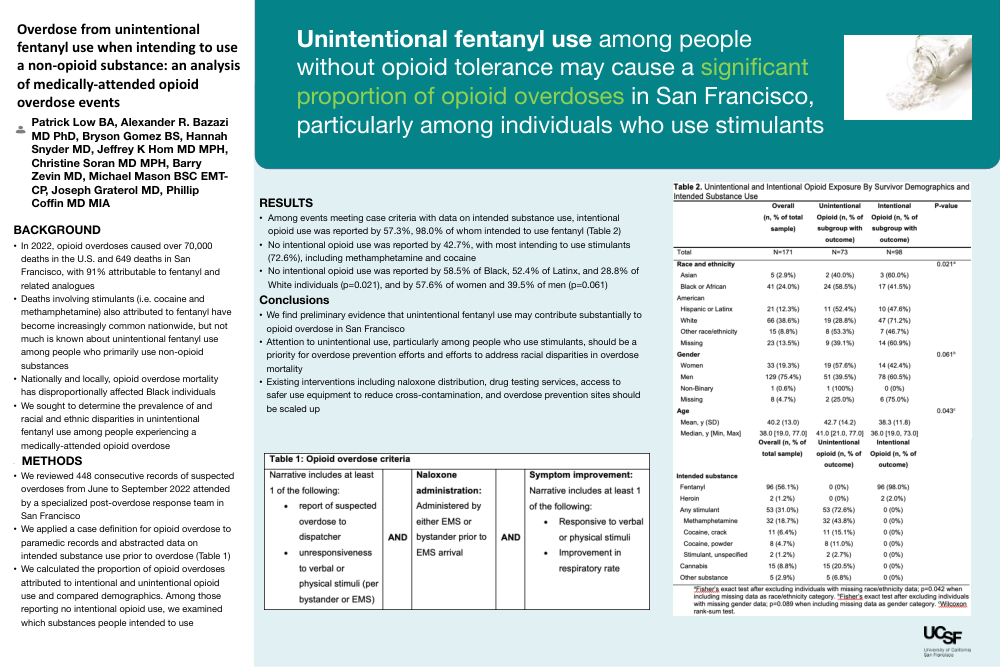
Methods: We reviewed 448 consecutive records of suspected overdoses from June to September 2022 attended by a specialized post-overdose response team in San Francisco. We applied a case definition for opioid overdose to paramedic records and abstracted data on intended substance use prior to overdose (Table 1). We calculated the proportion of opioid overdoses attributed to intentional and unintentional opioid use and compared demographics. Among those reporting no intentional opioid use, we examined which substances people intended to use.
Results: Among events meeting case criteria with data on intended substance use, intentional opioid use was reported by 57.3%, 98.0% of whom intended to use fentanyl. No intentional opioid use was reported by 42.7%, with most intending to use stimulants (72.6%), including methamphetamine and cocaine. No intentional opioid use was reported by 58.5% of Black, 52.4% of Latinx, and 28.8% of White individuals (p=0.021), and by 57.6% of women and 39.5% of men (p=0.061).
Discussion/Conclusions: In this first study to document the prevalence of self-reported unintentional opioid use among people who have just experienced an opioid overdose, we found that nearly half of overdoses were attributed to unintentional opioid use, with most of these reported to occur while intending to use stimulants, both cocaine and methamphetamine. Unintentional opioid use is believed to be almost entirely attributable to fentanyl in San Francisco, given that fentanyl is the predominant street opioid and that the now dwindling heroin market remains dominated by black tar heroin that is easily distinguished from and rarely mixed with fentanyl due to physical characteristics. This study does not identify potential mechanisms of unintentional fentanyl use, which include mistaking fentanyl for other substances (stimulants and fentanyl are both often sold as white powder or crystals), fentanyl contamination of non-opioid substances, storage of drugs together, and reuse of equipment previously used to consume fentanyl. In San Francisco, drug checking services and urine surveillance in a community-based study suggest that the presence of fentanyl in substances thought to be stimulants is a rare occurrence, 14 although even a rare occurrence could meaningfully contribute to mortality among people who use drugs daily. Unintentional fentanyl use overdoses were significantly more prevalent among Black and Latinx individuals compared to White individuals, more prevalent among women compared to men, and more prevalent among older persons. Observed racial and ethnic disparities may relate to differences in drug use patterns, drug selling networks, or the impact of structural racism on other aspects of the overdose risk environment, but observed disparities could also be related to underreporting of intentional fentanyl use due to stigma or perceived risk of disclosure among minoritized individuals. These findings suggest that efforts to prevent overdose from unintentional fentanyl use among people using stimulants, if directed toward minoritized communities, may help to lessen some of the profound disparities in overdose mortality. Our study has several limitations. First, we relied upon self-report, which as discussed may overestimate the rate of unintentional fentanyl use due to underreporting of intentional use. Also, our results may not generalize beyond San Francisco due to the regional nature of street drug markets and use patterns, though given regional similarities, they may apply more to western U.S. states than eastern states. Further research should consider mixed methods approaches to characterize reported unintentional use, cohort studies to determine incidence, and exploration of pharmacotherapy for opioid blockade. Existing interventions including naloxone distribution, drug testing services, access to safer use equipment to reduce cross-contamination, and overdose prevention sites should be scaled up. In conclusion, we find preliminary evidence that unintentional fentanyl use may contribute substantially to opioid overdose in San Francisco. Attention to unintentional use, particularly among people who use stimulants, should be a priority for overdose prevention efforts and efforts to address racial disparities in overdose mortality. Further research should consider mixed methods approaches to characterize reported unintentional use, cohort studies to determine incidence, and exploration of pharmacotherapy for opioid blockade. Existing interventions including naloxone distribution, drug testing services, access to safer use equipment to reduce cross-contamination, and overdose prevention sites should be scaled up.