127 posters, 10 topics, 20 sessions, 127 authors
ePostersLive by SciGen Technologies S.A. All rights reserved.
UCSF 2024 Inquiry Symposium
Conference ePosters

P054
Treating Opioid Use Disorder in the Peripregnancy Period on Labor and Delivery
Poster Presenter
Authors
Part of Topic
Epidemiology & Population Sciences
Treating Opioid Use Disorder in the Peripregnancy Period on Labor and Delivery
Melanie Rader; Kristin Harter, PharmD; Malini Nijagal, MD; Marlene Martin, MD; Dominika Seidman, MD
Introduction:
Drug overdose mortality among pregnant and postpartum people in the United States tripled from 2018-2021, mirroring non-pregnant populations. While treatments for opioid use disorder (OUD) are effective and safe in pregnancy, pregnant people face numerous and intersecting barriers to treatment including stigmatization, discrimination, misinformation, criminalization, and fear of separation from their children by the family regulation system Child Protective Services or CPS). Moreover, in areas heavily impacted by both the overdose and housing crises, accessing and initiating OUD treatment is more complex as individuals may prioritize shelter, food, and safety over treatment. In this context, many labor and delivery units offer admission for opioid use complicating pregnancy to initiate treatment. However, to our knowledge, there are limited published studies describing these admissions and their outcomes, particularly in the context of wide-spread fentanyl use, resulting in a dearth of guidance for evidence-based practice.
Purpose:
Pregnant people, postpartum people, and people experiencing homelessness are too often excluded from studies of individuals with substance use disorders. Here, we specifically focus on this population in order to understand admissions for OUD treatment and improve care provision in pregnancy and the postpartum period.
Aims:
-Describe the demographics of this study population in order to better understand the people presenting for OUD treatment
-Explore hospital utilization for admissions for OUD treatment (number of admissions, length of stay, etc.)
-Describe and better understand outcomes of OUD admissions for pregnant and postpartum people (CPS involvement, ability of parent and baby to discharge together, discharge to residential treatment, overdose in 1st year postpartum, readmissions/relapse)
Methods:
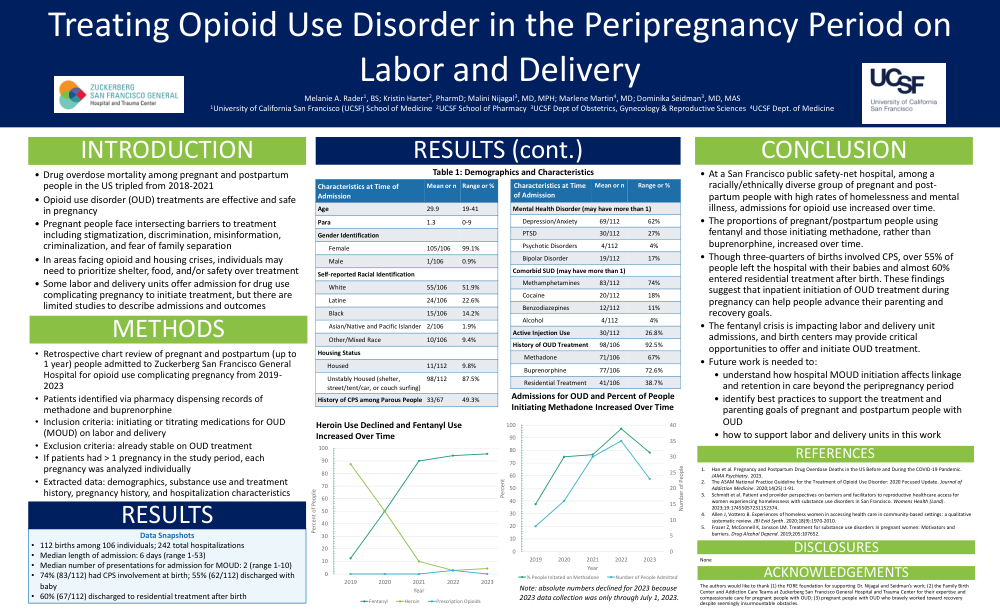
We conducted a retrospective chart review of all pregnant and postpartum (up to 1 year) people admitted to a public safety net hospital in San Francisco for opioid use complicating pregnancy. We included those who were initiated on or required titration of medications for OUD in the labor and delivery unit from 2019-2023. We identified patients through pharmacy dispensing records of methadone and buprenorphine. We excluded patients already on stable OUD treatment. If patients had more than one pregnancy in the study period, each pregnancy was analyzed individually. We also looked at multiple hospitalizations within a given pregnancy. We extracted demographic data, substance use and treatment history, pregnancy history, and hospitalization characteristics including length of stay, OUD treatment, discharge disposition, and birth outcomes.
Results:
One hundred and twelve births occurred among 106 people who met inclusion criteria. These individuals had a total of 242 hospitalizations for OUD, of which approximately 11% (12/112) were during the postpartum period. The median age at admission was 29 years (range 19-41). Among individuals, 52% identified as white (55/106), 23% (24/106) as Latine, 14% (15/106) as Black, 9% (10/106) as mixed race or other, 1% (1/106) as Asian, and 1% (1/106) as Native/Pacific Islander. At the time of presentation, 91% (102/112) were unstably housed or homeless, and over three-quarters (87/112) had significant mental illness. Of patients who were parous, 50% (34/68) reported a prior history with CPS. During the study period, the proportion of people using fentanyl over other opioids increased from 13% (1/8) in 2019 to 96% (22/23) in 2023. Overall, 80% (90/112) initiated methadone and 20% (22/112) initiated buprenorphine. In 2019, 38% (3/8) initiated methadone treatment while 97% (34/35) started methadone in 2022. There was also an increasing total number of patients and admissions over time, with 19 hospitalizations among 8 patients in 2019 and 46 hospitalizations among 23 patients in the first half of 2023. The median total daily dose of methadone at discharge was 100 mg (range 20-720 mg) and the median total daily dose of buprenorphine was 24 mg (range 8-48 mg). The median length of admission was 6 days (range 1-53). Individuals presented for admission and were initiated or titrated on MOUD a median of 2 times (range 1-10) during their pregnancy and postpartum course. At birth, 74% of patients (83/112) had CPS involvement, and 55% (62/112) were discharged from the hospital with their baby. Nearly 60% (67/112) of people discharged to residential treatment after birth. There were 4 overdoses in pregnant people during the study period. One overdose occurred during the initial admission for MOUD initiation, 2 were reported prior to initiating treatment, and 1 occurred after a self-directed discharge before reaching a stable MOUD dose. There was one death due to a gunshot wound (not OUD related).
Discussion/Conclusion:
At a public safety-net hospital in San Francisco, among a racially/ethnically diverse group of pregnant and post-partum people with high rates of homelessness and mental illness, admissions for opioid use complicating pregnancy increased over time. The proportion of people using fentanyl and those initiating methadone also increased over time. Though three-quarters of births involved CPS, over 55% of people left the hospital with their babies and almost 60% entered residential treatment after birth. These data suggest that inpatient initiation of OUD treatment during pregnancy can help people to advance their parenting and recovery goals. This study also demonstrates how the fentanyl crisis has impacted labor and delivery unit admissions, and how birth centers may provide a critical opportunity to offer and initiate OUD treatment. One limitation of this study was that we did not have access to residential treatment or methadone clinic records. Therefore, it is challenging to know how many people remained in treatment over time, beyond the peripregnancy period. Future work is needed to understand how hospital initiation affects linkage and retention in OUD care beyond the initial peripregnancy period. More data are also needed to identify best practices to support the treatment and parenting goals of pregnant and postpartum people with OUD, and how to support labor and delivery units in this work.