127 posters, 10 topics, 20 sessions, 127 authors
ePostersLive by SciGen Technologies S.A. All rights reserved.
UCSF 2024 Inquiry Symposium
Conference ePosters

P053
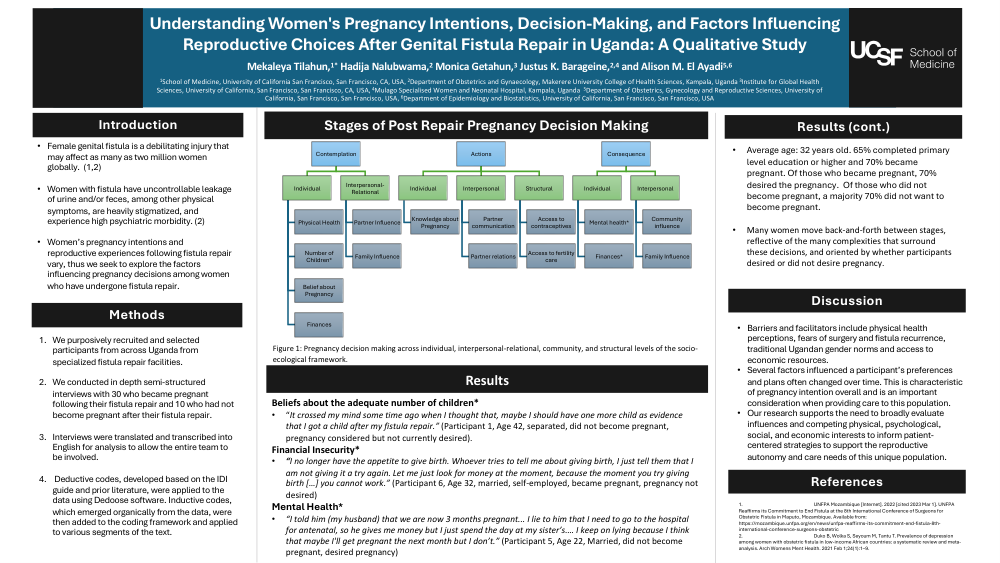
Understanding Women's Pregnancy Intentions, Decision-Making, and Factors Influencing Reproductive Choices After Genital Fistula Repair in Uganda: A Qualitative Study
Poster Presenter
Authors
Part of Topic
Social & Behavioral Sciences
Abstract
Introduction
Female genital fistula is a debilitating injury that may affect as many as two million women globally. While studies have examined women’s fertility intentions in Uganda and sub-Saharan Africa broadly, few have explored the factors influencing pregnancy decisions among women who have undergone fistula repair. Our study explored factors influencing pregnancy intentions among both women who became pregnant and those who did not become pregnant following fistula repair. This qualitative study leverages the socio-ecological framework to draw out nuanced insights into pregnancy decision-making following repair across individual, interpersonal, community, and organizational levels.
Methods
We conducted in-depth interviews with 40 women who had undergone fistula repair. Interviews were audio-recorded, transcribed into English, and coded using a group-developed collaborative coding framework. Interviews were translated and transcribed into English for analysis to allow the entire team to be involved. We analyzed data following a two-step process. The first step included coding informed by the interview guide and an initial review of transcripts for potential conceptual categories. Deductive codes, developed based on the IDI guide and prior literature, were applied to the data using Dedoose software. Inductive codes, which emerged organically from the data, were then added to the coding framework and applied to various segments of the text. Oriented by the socio-ecological framework, we reviewed factors contributing to pregnancy desire and decision-making for women who became pregnant and those who did not following fistula repair.
Results
Factors influencing pregnancy desire included partner support, financial circumstances, number of children, and health knowledge and perspectives. Women’s own beliefs about their ability to become pregnant and their fears around surgeries and fistula recurrence also influenced pregnancy desire. Participants desiring pregnancy but experiencing infertility expressed various mental health impacts including feelings of hurt, isolation, and yearning, and described infertility stigma. Finally, societal expectations of women to assume childbearing and prioritize home responsibilities influenced participants’ decisions to pursue pregnancy. However, discordance between partners or infertility resulted in various consequences, such as women becoming pregnant to fulfill their partner's needs, lying to their partner about their pregnancy status, or dissolution of the relationship.
Discussion
A nuanced understanding of pregnancy decision-making following fistula repair can help inform patientcentered post-repair pregnancy counseling to support the unique needs of women. Continued follow-up and counseling that addresses the complex interplay of physical, psychological, social, and economic factors impacting this population is needed. These efforts should span across a longitudinal time course given the fluid and ever-changing nature of pregnancy decision-making in this population. Furthermore, future studies should examine the long-term consequences of these pregnancy decisions on this population to inform more contextually relevant counseling following fistula repair.