127 posters, 10 topics, 20 sessions, 127 authors
ePostersLive by SciGen Technologies S.A. All rights reserved.
UCSF 2024 Inquiry Symposium
Conference ePosters

P051
Evaluation of Crowdsourced Entries from a Cochlear Implant Hackathon in CI Recipients
Poster Presenter
Authors
Part of Topic
Clinical & Translational Sciences
Title: Evaluation of Crowdsourced Entries from a Cochlear Implant Hackathon in CI Recipients
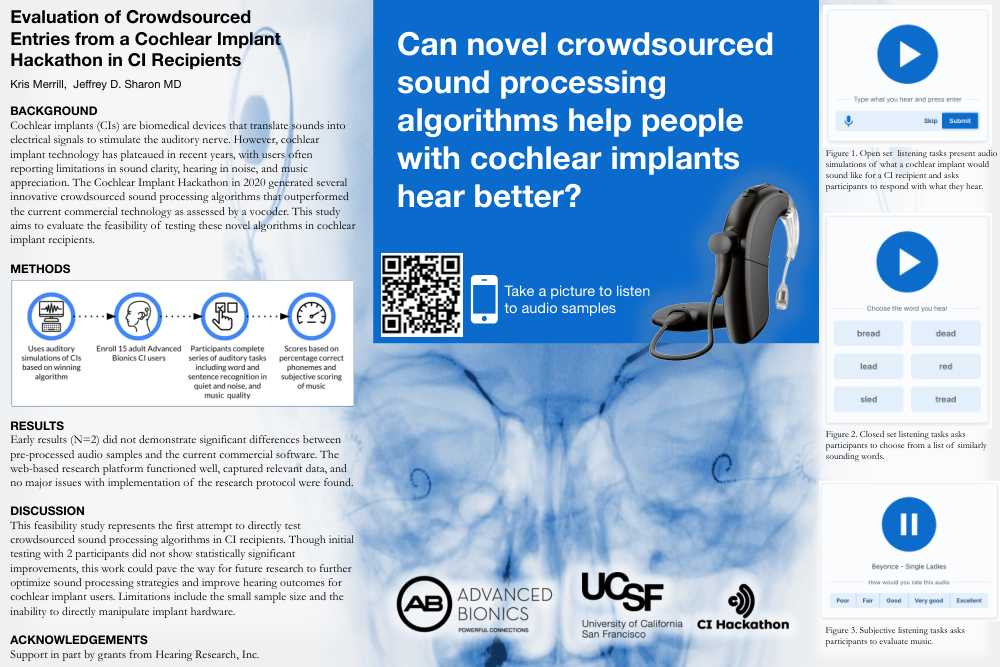
Introduction: Cochlear implants are biomedical devices that translate sounds into electrical signals to stimulate the auditory nerve. However, cochlear implant technology has plateaued in recent years, with users open reporting limitations in sound clarity, hearing in noise, and music appreciation. The Cochlear Implant Hackathon in 2020 generated several innovative crowdsourced sound processing algorithms that outperformed the current commercial technology. This study aims to evaluate the feasibility of testing these novel algorithms in cochlear implant recipients.
Hypothesis or question: Can pre-processed sounds generated from novel algorithms streamed to cochlear implant recipients' devices demonstrate improved performance compared to the current commercial sound processing strategy?
Aims: 1. Evaluate if cochlear implant users can perceive a significant difference between preprocessed audio samples generated by novel sound processing algorithms and the current commercial software. 2. Assess if the novel sound processing algorithms improve monosyllabic word recognition, sentence recognition in quiet and noise, and subjective music quality compared to the current commercial software. Project
Design/Methods: This is a prospective within-subjects repeated-measures study using unfiltered simulations of sounds assessed acutely without long-term follow-up. The study will enroll 15 adult cochlear implant users implanted with an Advanced Bionics HiResolution Bionic Ear System. Participants will temporarily have the front-end processing of cochlear implant processors deactivated to isolate the delivery of pre-processed audio samples. They will complete a series of auditory tasks, including monosyllabic word recognition, sentence recognition in quiet and noise, and subjective music quality ratings. Auditory tasks will be streamed via Bluetooth and evaluated using a custom web-based research software application built to simulate the common battery of audiometric testing.
Results/Product: Early, limited results with 2 participants did not demonstrate significant differences between the pre-processed audio samples and the current commercial software with monosyllabic word recognition, sentence recognition in quiet and noise, and subjective music quality compared to the current commercial software.
Discussion/Conclusion: This feasibility study represents the first attempt to directly test crowdsourced sound processing algorithms in cochlear implant recipients. While we do not expect statistically significant improvements, this work could pave the way for future research to further optimize sound processing strategies and improve hearing outcomes for cochlear implant users. The web-based application that was developed may have promising implications for future cochlear implant research because it is easily accessible, customizable, and able to provide real-time results. Limitations include the small sample size and the inability to directly manipulate the implant hardware. If successful, this approach could enable rapid testing and comparison of novel sound processing ideas generated through crowdsourcing