127 posters, 10 topics, 20 sessions, 127 authors
ePostersLive by SciGen Technologies S.A. All rights reserved.
UCSF 2024 Inquiry Symposium
Conference ePosters

P049
The Association Between Social Determinants of Health and Distal Radius Fracture Outcomes
Poster Presenter
Authors
Part of Topic
Clinical & Translational Sciences
Title: The Association Between Social Determinants of Health and Distal Radius Fracture Outcomes
Introduction: Distal radius fractures (DRF) are common and increasing in incidence. Although complications after surgical treatment are uncommon, they can result in great morbidity. Certain demographic factors, such as age and obesity, have known associations with adverse outcomes. However, the association of social determinants of health (SDOH), the conditions in which individuals are born and live (e.g. financial instability, healthcare literacy), and outcomes in patients with DRFs is unknown.
Aims: To determine if adverse social determinants of health (SDOH) are associated with differential complication rates following surgical fixation of distal radius fractures. Further, to assess which SDOH domain (economic, educational, social, healthcare, or environmental) is most associated with postoperative complications.
Methods: Using a national administrative claims database, we conducted a retrospective cohort analysis of patients undergoing open treatment for an isolated DRF between 2010-2020. Patients were stratified based on the presence/absence of at least one SDOH code and propensity score matched to create two cohorts balanced by age, sex, insurance type, and comorbidities. SDOH examined included economic, educational, social, healthcare, and environmental factors. Multivariate logistic regression analyses were performed to assess the isolated effect of SDOH challenges on 90-day and 1-year complication rates.
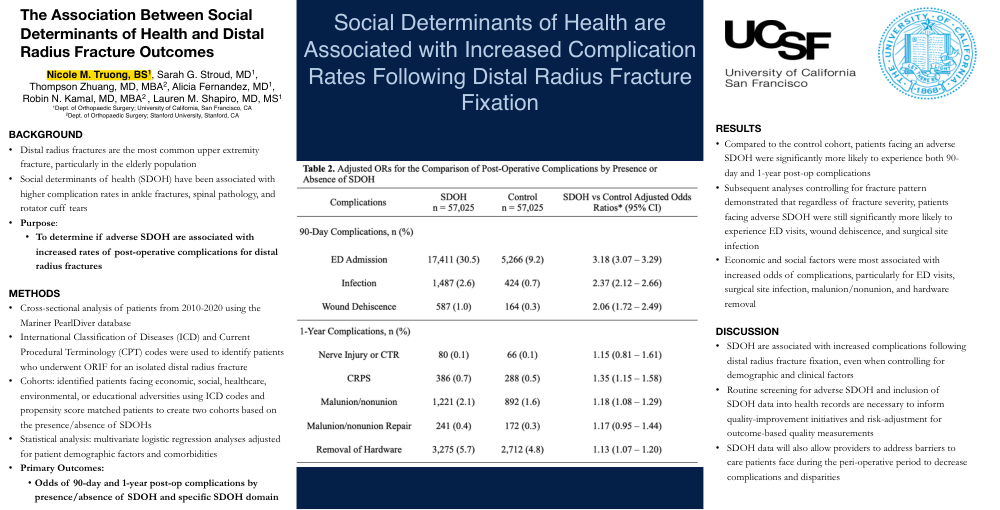
Results: After propensity matching, 57,025 patients in the adverse SDOH cohort and 57,025 patients in the control cohort were included. Patients facing an adverse SDOH were significantly more likely to experience 90-day complications, including ED visits (OR 3.18 [95% CI: 3.07- 3.29]; p<0.001), infection (OR 2.37 [95% CI 2.12-2.66]; p<0.001), and wound dehiscence (OR 2.06 [95% CI 1.72-2.49]; p<0.001), and 1-year complications, including complex regional pain syndrome (OR 1.35 [95% CI 1.15-1.58]; p<0.001), malunion/nonunion (OR 1.18 [95% CI 1.08- 1.29]; p<0.001), and hardware removal (OR 1.13 [95% CI 1.07-1.20]; p<0.001). Additionally, patients facing an adverse SDOH had a significantly increased risk of 90-day complications, regardless of fracture severity, and patients with economic and social challenges had the highest odds of both 90-day and 1-year post-operative complications.
Conclusions: SDOH are associated with increased complications following DRF fixation, even when controlling for demographic and clinical factors. We recommend routine screening for adverse SDOH and inclusion of SDOH data into health records to not only inform qualityimprovement initiatives and risk-adjustment for outcome-based quality measurements, but also to allow providers to begin to discuss and address such barriers during the peri-operative period to decrease potential complications and disparities.